
The final phase of a project is a critical test of profitability and reputation. Yet, an unnecessarily long snag list, filled with last-minute issues, can quickly erode both. The primary culprit is often preventable construction site damage-the seemingly minor scratches, chips, and dents that accumulate into major costs, project delays, and frustrating disputes between trades. In the UAE’s competitive market, replacing a single damaged marble tile or a high-spec glass panel can cost thousands of Dirhams, directly impacting your bottom line and jeopardising the handover schedule.
This definitive guide is engineered to solve that problem. We provide a complete framework to identify, prevent, and-most importantly-efficiently rectify surface damage. You will learn innovative repair techniques that serve as a cost-effective, high-quality alternative to replacement, enabling you to significantly shorten the snagging process, protect your budget from costly penalties, and deliver a zero-defect project that enhances your company’s professional reputation.
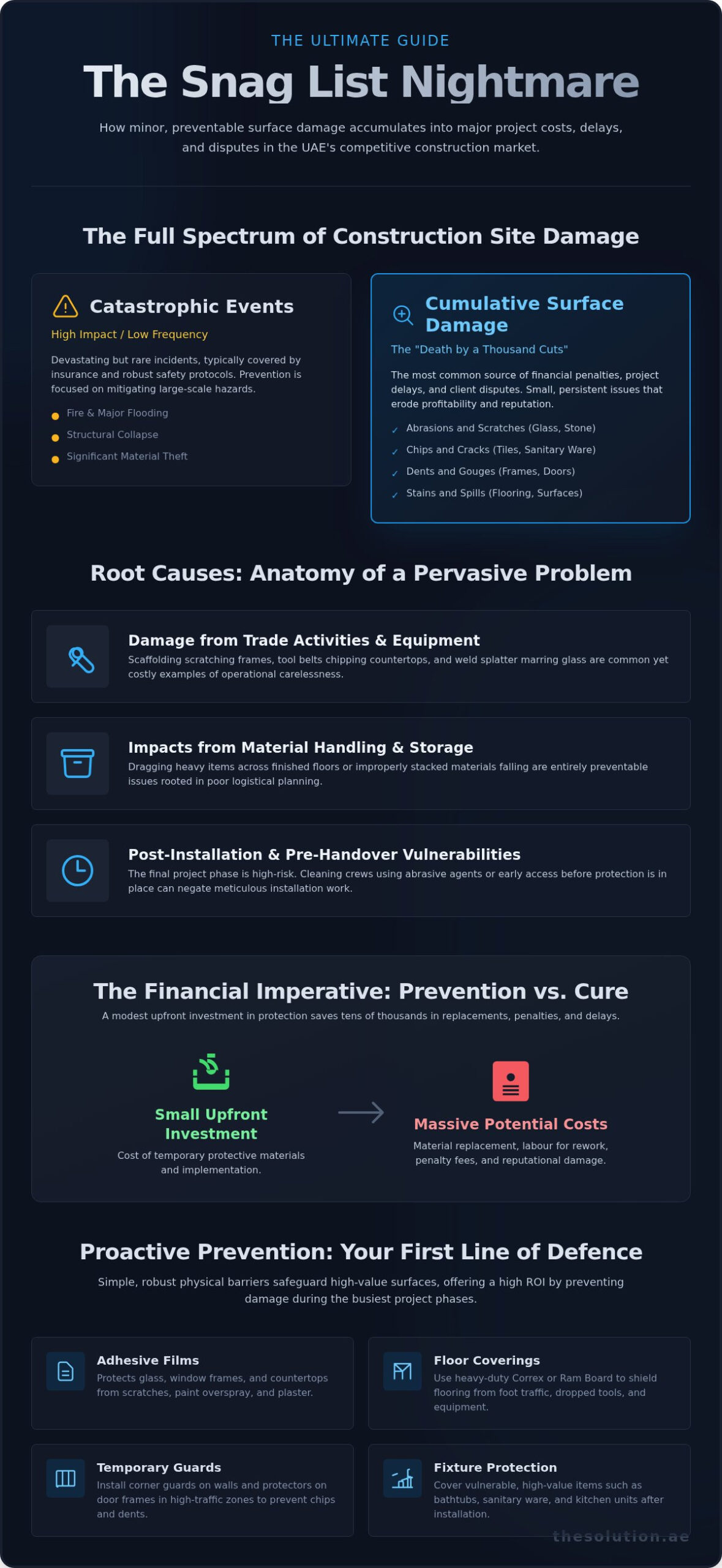
The Full Spectrum of Construction Site Damage: Beyond Major Disasters
In any construction project, from a high-rise tower in Dubai to a luxury villa on Palm Jumeirah, the risk of damage is an operational certainty. Effective project managers understand that this risk is not monolithic. Instead, construction site damage broadly falls into two distinct categories: high-impact catastrophic events and the far more common, profit-eroding cumulative surface damage. While site managers rightly focus on preventing major disasters, it is the accumulation of minor imperfections that frequently leads to budget overruns and delayed handovers, costing projects thousands of Dirhams.
Category 1: Catastrophic Events & Structural Damage
These are the high-impact, low-frequency incidents that command immediate attention: fire, major flooding, structural collapse, or significant theft of materials. While devastating, these events are typically well-understood risks covered by robust insurance policies. Prevention is rooted in rigorous adherence to site protocols, including advanced security measures, proper material storage, and the diligent application of core construction safety principles to mitigate large-scale hazards and protect both assets and personnel.
Category 2: Cumulative Surface Damage (The ‘Snag List’ Nightmare)
This category represents the most common source of financial penalties and client disputes at the project handover stage. It is the death-by-a-thousand-cuts scenario, where small, seemingly insignificant incidents collectively degrade the final quality of the build. This pervasive form of construction site damage erodes profitability and tarnishes a contractor’s reputation.
- Abrasions and Scratches: Damage to glass, polished stone, and high-gloss joinery.
- Chips and Cracks: Chipped tiles, cracked sanitary ware, or damaged countertops.
- Dents and Gouges: Impacts on aluminium window frames, steel fixtures, and lift doors.
- Stains and Spills: Paint splashes, chemical stains on flooring, and sealant residue on finished surfaces.
While one scratched window may seem trivial, a snag list detailing hundreds of such issues creates a significant financial liability and delays final project acceptance.
Root Causes: Why Surface Damage is So Common on Job Sites
Identifying the root cause of surface damage is the first step toward effective prevention and cost control. On a busy UAE construction site, damage is rarely the result of a single event. Instead, it stems from a combination of factors: operational carelessness, improper project sequencing, and a simple lack of adequate surface protection. When multiple trades work in confined spaces, the risk of accidental construction site damage multiplies. This oversight not only leads to aesthetic defects but also contributes significantly to budget overruns and project delays, a reality underscored by research into the high cost of construction damage and related site incidents. Understanding these critical phases helps project managers pinpoint where to focus prevention efforts.
Damage from Trade Activities & Equipment
The daily operations of various trades are a primary source of surface defects. Even the most skilled technicians can cause accidental damage when working without proper precautions or in a rushed environment. Common examples we consistently rectify include:
- Scaffolding and ladders scratching window frames, walls, and newly laid flooring.
- Tool belts and portable equipment causing chips and dents on countertops, doors, and sanitary ware.
- Weld splatter, paint overspray, and plaster splashes permanently marring finished glass and metal surfaces.
- Incorrect use of cleaning agents resulting in chemical burns, stains, or discoloration on sensitive materials.
The same level of care is required for finishing trades, such as those installing bespoke architectural lighting systems. For an idea of the high-end fixtures that are often at risk, you can check out LED Artistry.
For specialized trades like welding, meticulous process management is key to preventing such costly damage from occurring in the first place. For those looking to improve quality control in this area, it can be helpful to explore Digital Welding Documentation Platform to see how modern software helps manage these complex workflows.
Impacts from Material Handling and Storage
How materials are moved and stored is a critical factor in preventing costly repairs. Dragging heavy items across finished floors can cause deep, irreparable scratches, while improperly stacked materials pose a significant risk of falling and denting surfaces below. The absence of clearly designated pathways often forces traffic over unprotected areas, leading to widespread scuffs and wear. This type of construction site damage is entirely preventable with proper logistical planning and site management.
Post-Installation and Pre-Handover Vulnerabilities
A significant amount of damage occurs in the final stages of a project, after surfaces are installed but before the final handover. This is a highly vulnerable period. Final cleaning crews may inadvertently use abrasive materials on sensitive finishes, and early site access granted to other contractors before protective measures are fully in place can quickly negate weeks of meticulous installation work. Rectifying these last-minute defects can be a costly endeavour, often impacting project timelines and final budgets in AED.
Proactive Prevention: Protecting Surfaces and Your Budget
The most effective way to manage surface damage is to prevent it entirely. A modest upfront investment in protective measures is a sound financial strategy, often saving tens of thousands of Dirhams in costly repairs, replacements, and project delays. Effective prevention is not a single action but a continuous process, embedded in project planning from the initial stages through to final handover. It requires a combination of physical barriers, strategic management, and a site-wide culture of care.
Implementing Physical Protective Measures
Robust physical barriers are the first line of defence for high-value surfaces. These solutions are simple to deploy and offer a high return on investment by safeguarding finished elements from impacts, spills, and abrasions during the busy final stages of a project.
- Adhesive Films: Protect glass, window frames, and countertops from scratches and paint overspray.
- Floor Coverings: Use heavy-duty materials like Correx or Ram Board to shield flooring from foot traffic, dropped tools, and equipment.
- Temporary Guards: Install corner guards on walls and door frames in high-traffic zones to prevent chips and dents.
- Fixture Protection: Cover vulnerable items such as bathtubs, sanitary ware, and elevator panels to maintain their pristine condition.
Strategic Site Management and Sequencing
Beyond physical materials, disciplined site management is critical to reducing construction site damage. A well-sequenced project minimises the risk of newly installed finishes being damaged by subsequent trades. Key strategies include scheduling ‘wet’ and ‘dirty’ trades before finishing work begins, creating designated and protected pathways for moving materials, and implementing a clear accountability policy. A robust management plan, often referencing international best practices like the OSHA construction safety standards, helps build a framework where prevention is a shared responsibility.
Toolbox Talks and Contractor Communication
A proactive approach requires consistent communication and a shared ‘culture of care.’ Instilling this mindset among all contractors and workers is vital for success. Regular toolbox talks should be used to reinforce the importance of protecting finished work, demonstrate the correct installation and removal of protective materials, and outline the clear reporting process for when incidents of damage do occur. When everyone on site is aligned on prevention, the frequency of avoidable damage decreases dramatically.
The Handover Crisis: Quantifying the True Cost of Damage
The final handover stage should be a project milestone, not a point of conflict. However, unrectified surface damage is a primary cause of disputes, transforming a project’s completion into a costly crisis. The financial impact of this unresolved construction site damage extends far beyond the simple price of a replacement item, creating significant financial and reputational liabilities that can undermine an entire project’s profitability.
Direct Financial Implications
When damage is addressed through replacement, the direct costs accumulate rapidly. What may seem like a minor scratch on a countertop or a chip in a ceramic tile quickly escalates into a significant expense, directly impacting your bottom line. These costs include:
- Replacement Materials: Sourcing a single matching item often requires paying a premium, with express shipping fees from international suppliers adding thousands of AED to the bill.
- Labour Costs: You are not only paying for the installation of the new item but also for the careful removal and disposal of the damaged one, doubling the labour time.
- Project Delays: Waiting for replacement materials can delay handover, triggering potential liquidated damages that can cost tens of thousands of Dirhams per day on major UAE projects.
- Withheld Payments: Clients and main contractors will justifiably withhold final payments, often a significant percentage of the contract value, until every item on the snag list is perfectly rectified.
Indirect Costs and Reputational Harm
The most severe consequences of poor finishing are often the ones that do not appear on an invoice. These indirect costs erode your company’s long-term viability and standing in the competitive UAE construction market. The reputational harm manifests as:
- Damaged Professional Reputation: A handover plagued by defects signals a lack of quality control and attention to detail, tarnishing your brand’s reputation among clients, architects, and consultants.
- Strained Client Relationships: Disputes over damage create friction and destroy goodwill, turning a potential repeat client into a detractor.
- Increased Administrative Burden: Managing re-work orders, coordinating new deliveries, and negotiating disputes consumes valuable management time that should be focused on new projects.
- Loss of Future Work: A reputation for problematic handovers can directly influence your ability to win future tenders and secure profitable contracts.
Understanding these extensive costs highlights the strategic value of professional surface repair. Instead of absorbing the immense financial and reputational impact of replacement, an expert repair service offers a cost-effective and efficient alternative. By choosing to rectify damage with advanced techniques, you protect your budget, your timeline, and your professional integrity. To see how our specialist technicians can resolve your handover issues, visit thesolution.ae.
Repair vs. Replace: The Smart Solution for Construction Damage
When faced with surface damage on a project, the traditional response has often been to replace the affected item. This approach is not only costly and time-consuming but also creates unnecessary waste. Modern surface restoration techniques offer a superior alternative, providing a fast, cost-effective, and high-quality solution to rectify accidental damage. Opting for professional on-site repair is the key to resolving snagging lists efficiently, avoiding project delays, and ensuring a smooth, on-budget handover.
The Compelling Advantages of On-Site Repair
Engaging a specialist repair service provides tangible benefits that directly impact your project’s bottom line and timeline. This strategic approach to managing construction site damage eliminates the logistical complexities of replacement.
- Significant Cost Savings: Professional repair is typically 50-80% cheaper than the cost of sourcing, shipping, and installing a replacement item, saving your project thousands of Dirhams.
- Unmatched Speed: Our technicians can complete most repairs in a matter of hours. This is a stark contrast to the days or even weeks it can take to procure and fit a replacement, especially for bespoke or imported materials common in the UAE.
- Minimal Disruption: All work is carried out in-situ, without the noise, dust, and disruption of deconstruction. This allows other trades to continue their work unimpeded.
- Enhanced Sustainability: By restoring damaged surfaces, you prevent perfectly functional items from being sent to landfill, aligning your project with more sustainable construction practices.
What Types of Surface Damage Can Be Professionally Repaired?
Our highly skilled technicians utilise innovative techniques and specialist materials to achieve seamless repairs on a vast array of hard surfaces. We can effectively rectify damage on:
- Glass & Glazing: Scratches, grinder and weld splatter, chemical etching, and chips.
- Metals: Dents, scratches, and discolouration on stainless steel, powder-coated aluminium, and brass finishes.
- Stone & Ceramics: Chips, cracks, and drill holes in marble, granite, porcelain, and ceramic tiles.
- Wood & Laminates: Scratches, gouges, and impact damage on doors, flooring, joinery, and furniture.
Choosing the Right Specialist Repair Partner
To ensure an invisible, durable repair, it is crucial to partner with a proven specialist. Look for a company with a strong track record within the UAE construction sector, one that employs its own highly trained, in-house technicians rather than subcontractors. Always ask for a portfolio of their work and relevant case studies. A professional partner will confidently demonstrate their ability to solve complex damage issues and protect your project’s final finish. See how our expert technicians solve complex damage issues.
From Damage Control to Profit Protection
As we’ve detailed, surface damage is an almost inevitable reality on any UAE job site, impacting timelines and budgets during the critical handover phase. The true cost is not in a single major incident, but in the accumulation of minor flaws. While proactive prevention is fundamental, the most intelligent financial strategy is to address unavoidable issues with expert repair rather than costly replacement. This approach turns the challenge of construction site damage from a significant liability into a manageable operational cost.
The Solution is trusted by leading construction firms across the UAE to rectify surface flaws with unparalleled precision. Our expert technicians are masters of restoration for glass, metal, stone, and wood, consistently achieving savings of 50-80% compared to replacement. We ensure your project is handed over flawlessly and on budget, avoiding costly delays and disputes. Protect your project’s profitability. Get a quote for professional damage repair.
Take control of your project’s finish and secure your financial outcome.
Frequently Asked Questions About Construction Site Damage
Who is financially responsible for damage that occurs on a construction site?
In the UAE, financial responsibility for construction site damage is dictated by the project’s contracts. Typically, the subcontractor who caused the damage is liable for the cost of rectification. However, the main contractor often holds ultimate responsibility for delivering a defect-free project to the client. Proving liability can be complex, making swift, cost-effective repairs a pragmatic solution to avoid disputes and project delays, which can quickly inflate costs far beyond the initial repair value.
What is the difference between a snag list and a damage report?
A snag list is a comprehensive document compiled near project completion, detailing minor defects like paint drips or misaligned fittings that need correction before handover. A damage report, however, is an immediate record of a specific incident of significant damage, such as a deep scratch on a glass curtain wall or a chipped marble floor tile. The damage report is crucial for insurance claims and determining liability, while the snag list is a final quality control measure.
Can deep scratches in tempered glass or structural panels be repaired safely?
Yes, deep scratches in tempered glass and structural panels can be safely and effectively rectified by our highly skilled technicians. We utilise innovative, multi-stage polishing techniques that remove damage without compromising the material’s structural integrity or clarity. This process is significantly faster and more cost-effective than replacement, which for a large panel could cost thousands of Dirhams (د.إ) and cause extensive project delays. Our methods restore the surface to its original pristine condition.
How do you match the colour and finish of a repaired surface like a countertop or tile?
Our technicians are masters of precision colour-matching. We use a system of specialist pigments, polymers, and resins, blending them on-site to perfectly replicate the exact colour, pattern, and sheen of the original surface. Whether it’s the unique grain of a wood veneer, the specific veining in a marble countertop, or the high-gloss finish of a ceramic tile, our meticulous process ensures a seamless, undetectable repair that integrates flawlessly with the surrounding area.
Is it possible to repair damage to brushed stainless steel or other textured metals?
Absolutely. Repairing textured metals like brushed stainless steel is a highly specialised skill that our technicians have mastered. We don’t just fill the scratch or dent; we meticulously re-grain the surface using purpose-built tools to replicate the original brushed pattern. This proficient use of advanced techniques ensures the repair is completely invisible, restoring the aesthetic of lift doors, kitchen appliances, or architectural cladding without the considerable expense and disruption of replacement.
How much time can be saved during the handover process by using a repair service instead of replacing items?
The time savings are substantial and directly impact project deadlines. A typical surface repair can often be completed in a matter of hours, on-site, with minimal disruption. In contrast, replacing a damaged item involves sourcing, lead times that can span weeks for bespoke materials in the UAE, shipping, and installation. By rectifying damage in-situ, you can prevent significant delays in the handover process, avoiding costly penalties and ensuring a smooth, on-schedule project completion.


