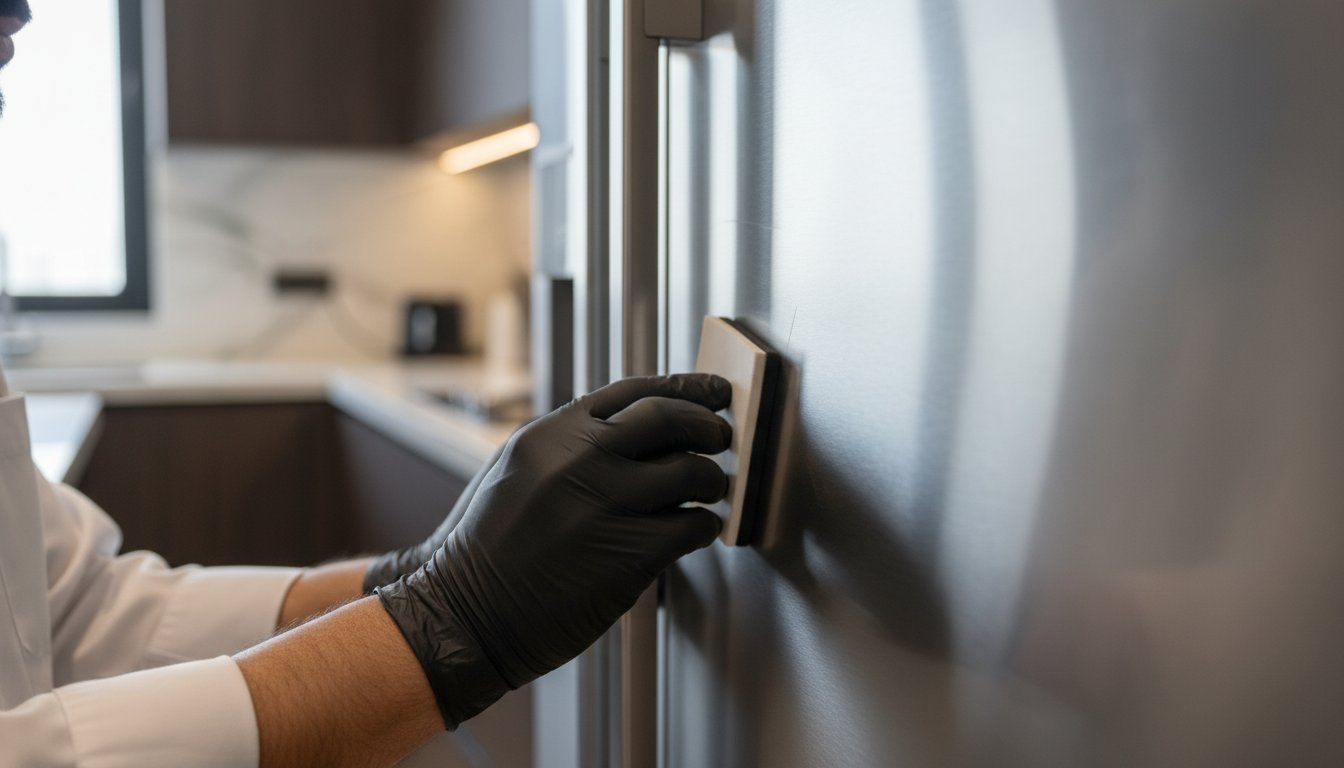
An unsightly scratch on a pristine stainless steel surface can instantly detract from the aesthetic of a high-end appliance or fixture. The immediate temptation is to attempt a quick fix, but an improper technique can worsen the damage, permanently altering the brushed finish and turning a minor issue into a costly problem. With replacement panels in the UAE often costing thousands of Dirhams, a failed DIY attempt is an expensive mistake to make. Before you risk further damage, it is critical to understand the correct, professional-grade methods to remove scratches from stainless steel.
This professional guide delivers a clear, methodical approach to restoring your surfaces. We will detail proven techniques for rectifying light scuffs and abrasions, allowing you to restore the flawless look of your investment. Crucially, you will also learn how to accurately assess the damage, distinguishing between a minor blemish you can safely repair and a deep gouge that requires specialist intervention. This knowledge provides a cost-effective alternative to replacement, ensuring you achieve exceptional results without compromising the integrity of the steel.
Key Takeaways
- Properly assessing the scratch depth and steel finish is the critical first step to prevent costly, irreversible damage.
- Learn specific DIY techniques to safely remove scratches from stainless steel, but understand they are effective only for minor scuffs on brushed finishes.
- Recognise the signs-such as deep gouges or damage to polished steel-that indicate a repair is beyond DIY capabilities and requires professional intervention.
- Discover how a professional restoration process rectifies severe damage for a flawless finish, providing a cost-effective alternative to expensive replacements.
First, Assess the Damage: Steel Finish and Scratch Depth
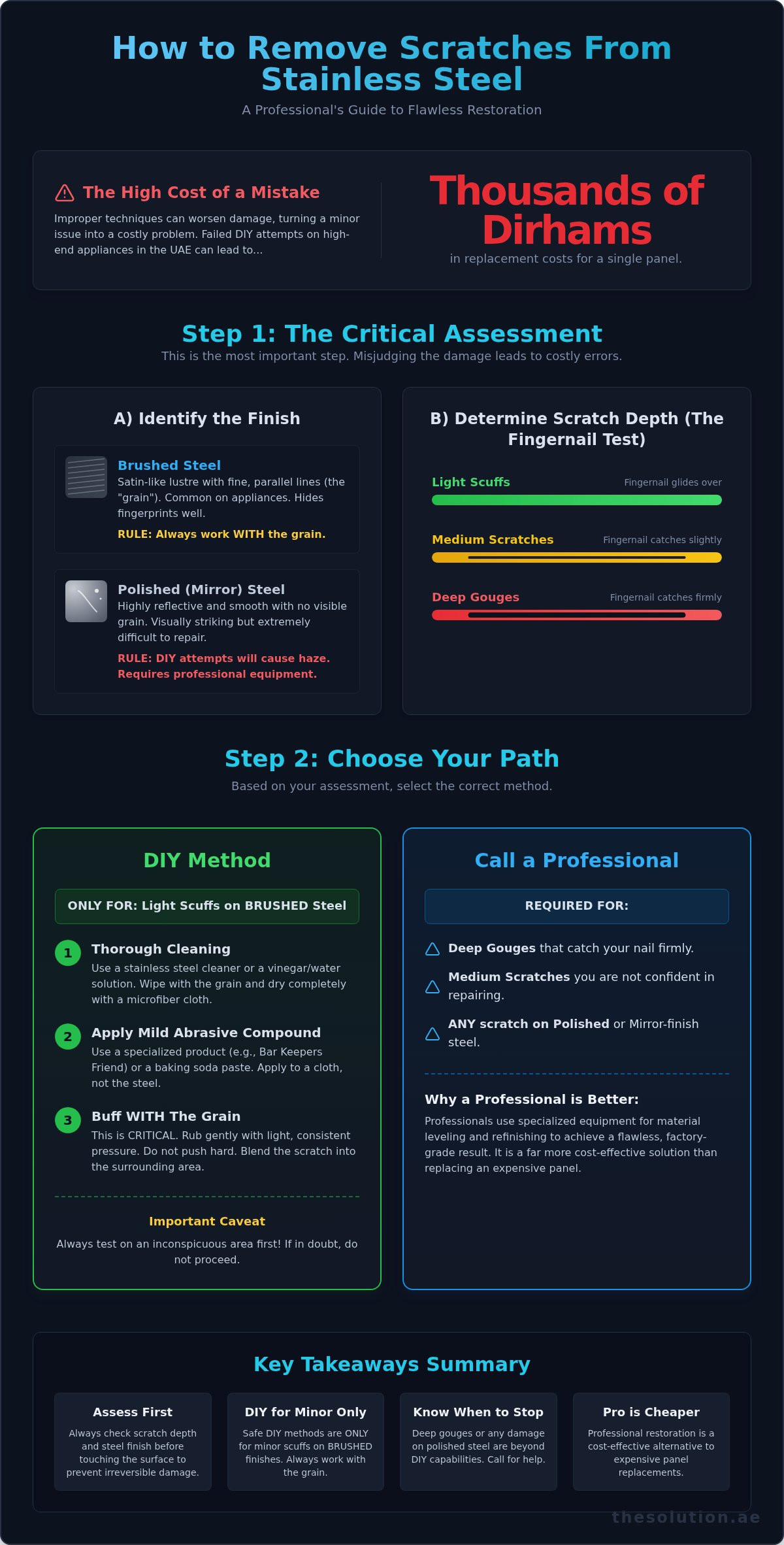
Before any attempt is made to rectify surface damage, a precise assessment is the most critical step. This initial evaluation prevents costly mistakes and determines the correct methodology and tools required to successfully remove scratches from stainless steel. Attempting a repair without understanding the material can quickly turn a minor issue into an irreversible problem, potentially requiring a full replacement at a significant cost in thousands of Dirhams. To effectively repair the damage, you must first understand the specific type of steel. If you are unfamiliar with its composition, a foundational understanding of What is stainless steel? is an excellent starting point.
Identify the Finish: Brushed vs. Polished Steel
The finish of the stainless steel dictates the entire repair process. The two most common types found in commercial settings like hotels are brushed and polished.
- Brushed Steel: Characterised by its satin-like lustre and fine, parallel lines, this finish is prevalent on appliances and elevator doors because it effectively hides fingerprints and minor scuffs. When treating brushed steel, it is imperative to work only with the grain (in the direction of the lines) to blend the repair seamlessly.
- Polished (or Mirror) Steel: This finish is highly reflective, smooth, and has no visible grain. While visually striking, it is exceptionally difficult to repair without specialist equipment. DIY attempts often result in a hazy, distorted patch, making professional intervention the most reliable and cost-effective solution.
Determine the Scratch Depth: The Fingernail Test
Once you identify the finish, you must assess the severity of the damage. The fingernail test is a simple, effective diagnostic technique. Run your fingernail gently across the scratch. The feedback from this test helps categorise the damage:
- Light Scuffs: Your fingernail glides over the mark without catching. These are typically surface-level blemishes that can often be buffed out with non-abrasive methods.
- Medium Scratches: Your fingernail catches slightly in the groove. These scratches have penetrated the surface and require a more involved, abrasive approach to remove.
- Deep Gouges: Your fingernail catches firmly and sinks into the scratch. This indicates significant material has been displaced. A deep gouge cannot be polished out; it requires professional material leveling and refinishing to restore the surface to its original condition.
DIY Methods for Light Scratches on Brushed Stainless Steel
For minor, superficial scuffs on brushed stainless steel surfaces, a do-it-yourself approach can be a highly effective and cost-efficient first step. These methods are designed to rectify light aesthetic imperfections before they necessitate a professional call-out. However, it is crucial to recognise their limitations; they are not suitable for deep gouges or extensive damage. Before attempting any repair, always test your chosen method on a small, inconspicuous area to ensure compatibility with the specific finish.
To begin, gather your materials. You will need:
- Two or three clean, soft microfiber cloths
- A specialized stainless steel cleaner or a white vinegar solution
- A mild, non-bleach abrasive compound
Step 1: Thorough Cleaning
Meticulous surface preparation is the foundation of a successful repair. Any dirt, grime, or residue left on the surface can become abrasive during the buffing process, potentially creating new, more widespread scratches. Begin by spraying the affected area with a dedicated stainless steel cleaner. Alternatively, a simple solution of equal parts white vinegar and water is effective. Wipe the surface clean, moving with the grain, and dry it completely with a separate microfiber cloth.
Step 2: Using a Scratch Removal Compound or Paste
The objective is to gently polish the area to blend the scratch with the surrounding surface. For this, a mild abrasive is required. We recommend using a product specifically formulated to remove scratches from stainless steel for the most reliable results. Commercially available options like Bar Keepers Friend are highly effective. As an alternative, you can create a paste with baking soda and a small amount of water. Apply a small quantity of the compound directly onto a clean microfiber cloth, not the steel surface, for better control.
Step 3: Buffing With the Grain
Identifying the direction of the grain-the faint parallel lines in the metal’s finish-is the most critical part of the process. Applying pressure against the grain will create cross-scratches and permanently alter the finish. Gently rub the compound into the scratch using light, consistent pressure, moving only back and forth in the same direction as the grain. Avoid circular motions entirely. For a clear demonstration of this technique and other professional tips for scratch removal, referencing established home improvement guides can provide valuable visual context. After a few passes, wipe the residue away with a clean, damp cloth and buff the area dry. Repeat if necessary, but cease if you notice the area becoming dull, as over-polishing can create a new blemish.
Deep Scratches and Polished Finishes: When to Call a Professional
While DIY methods are effective for minor surface scuffs, attempting to remove scratches from stainless steel that are deep can quickly lead to irreversible damage. A significant gouge is not merely a surface imperfection; it is a loss of material. Rectifying this damage requires a level of precision and specialised equipment that is beyond the scope of consumer-grade kits. Understanding when to cease DIY efforts and engage a professional is critical to protecting your asset’s value and appearance.
The Dangers of Over-sanding and Uneven Finishes
The fundamental principle behind removing a deep scratch is to level the surrounding steel down to the depth of the damage itself. While online guides on removing scratches from stainless steel can be helpful, they often underscore the risks. An untrained hand can easily apply uneven pressure, creating a noticeable depression or “low spot.” This over-sanded area will distort reflections and produce a warped, wavy effect that is often more conspicuous than the original scratch.
Why Polished (Mirror) Finishes Require Specialist Tools
Polished or mirror-finish stainless steel presents an even greater challenge. Unlike brushed finishes, which have a grain that can help mask minor imperfections, a mirror finish has none. Any abrasive material, no matter how fine, will immediately dull the reflective surface and leave a hazy patch. Restoring this high-gloss look requires a multi-stage process using variable-speed power polishers and a progression of specialised cutting and finishing compounds to seamlessly blend the repair and restore the flawless, reflective quality.
Cost Analysis: Professional Repair vs. Full Replacement
Before attempting a high-risk DIY repair, consider the financial implications. Replacing a single stainless steel elevator door panel in the UAE can cost over 15,000 د.إ when factoring in materials, removal, disposal, and installation. In contrast, professional surface restoration is a far more cost-effective solution. Our expert technicians can rectify the damage for a fraction of that cost, with savings to the client of 50-80% being standard practice. This approach not only saves significant capital but also minimises operational disruption and environmental waste.
Don’t risk a costly mistake that leads to a full replacement. Get a professional assessment from The Solution.
The Solution’s Professional Stainless Steel Restoration Process
While minor surface blemishes can sometimes be addressed with commercial products, achieving a flawless, factory-grade finish on high-value commercial assets requires specialist intervention. At The Solution, we have developed a systematic restoration process that guarantees exceptional, lasting results, protecting your investment and maintaining your property’s pristine image. Our approach is built on precision, technical expertise, and a commitment to minimal disruption for your business operations.
On-Site Assessment and Precise Diagnosis
Our process begins with a comprehensive on-site consultation. A highly skilled technician will visit your location in the UAE to perform a detailed damage assessment. We precisely identify the specific grade and finish of your stainless steel-from brushed and satin to a perfect mirror polish. This diagnosis allows us to formulate a targeted action plan and provide you with a clear, upfront quote, ensuring complete transparency before any work commences.
Advanced Repair & Refinishing Techniques
Our technicians are equipped with state-of-the-art sanding and abrasion tools designed to safely remove material and eliminate damage. Our proprietary techniques allow us to perfectly replicate the original grain pattern, ensuring any repair is seamlessly blended and completely invisible. For polished or mirror-finish steel, we employ a multi-stage process of sanding, compounding, and polishing to restore a perfect, distortion-free reflective shine. This meticulous method is how we effectively remove scratches from stainless steel while preserving the integrity and value of the surface.
Common Commercial Items We Restore
Our expertise is trusted by leading businesses across the construction, hospitality, and facilities management sectors. We regularly restore high-traffic and high-visibility stainless steel assets, including:
- Elevator doors, lift interiors, and control panels
- Commercial kitchen surfaces, backsplashes, and appliances
- Architectural panels and building façades
- Staircase balustrades, handrails, and kick plates
- Lobby fixtures, decorative trim, and yacht fittings
Scratches, scuffs, and vandalism detract from your brand’s image and devalue your assets. Restore the value and appearance of your property. Request your quote today.
Restore Your Stainless Steel to a Flawless, Factory Finish
As this guide has demonstrated, the correct approach to remove scratches from stainless steel is entirely dependent on the finish and the severity of the damage. While simple DIY methods can be effective for minor scuffs on brushed surfaces, attempting to rectify deeper gouges without specialist equipment often leads to more extensive, costly damage. The key is to accurately assess the situation before proceeding.
When professional intervention is the only viable option, The Solution provides a definitive answer. As specialists in commercial and architectural stainless steel restoration, we serve the UAE’s most demanding sectors, including construction, marine, and hospitality. Our technicians utilize innovative techniques to deliver an exceptional quality finish, offering a proven and highly cost-effective alternative to the disruptive expense of replacement. We restore, renew, and protect your high-value assets.
Don’t let surface damage diminish the appearance and value of your property. For a guaranteed flawless finish, contact The Solution’s restoration experts today. Trust our expertise to bring your stainless steel back to its original, pristine condition.
Frequently Asked Questions
Can you use steel wool to remove scratches from stainless steel?
No, using standard steel wool is strongly discouraged. It is highly abrasive and will create a new, more extensive pattern of scratches, permanently damaging the finish. Furthermore, particles from non-stainless steel wool can embed in the surface and cause rust spots to appear. Professional restoration uses specialized, non-destructive techniques to blend the repair seamlessly with the original grain, a result that steel wool cannot achieve. Relying on improper methods often leads to more costly repairs.
Does toothpaste actually work for removing scratches?
While some online sources suggest toothpaste as a DIY remedy, it is not an effective or reliable solution for genuine scratches. Toothpaste is a very mild abrasive that may slightly dull the area around a microscopic scuff, but it lacks the cutting power to rectify a visible scratch. Attempting this can result in an uneven, hazy patch on the appliance or surface, making the area more noticeable. For a guaranteed and uniform finish, professional intervention is the only correct course of action.
How much does professional stainless steel scratch repair cost in the UAE?
The cost for professional scratch repair in the UAE varies based on the damage severity, size of the affected area, and the type of finish. Minor, localized repairs on an appliance may start from approximately 300 د.إ. More extensive damage, such as deep gouges on a large elevator panel, could range from 800 د.إ to over 2,000 د.إ. We provide a detailed assessment and quote, ensuring a cost-effective solution that delivers significant savings compared to panel or appliance replacement.
Is it possible to fix scratches on high-end appliances like Sub-Zero or Wolf?
Yes, absolutely. Our technicians are proficient in repairing high-grade stainless steel surfaces, including those on premium brands like Sub-Zero, Wolf, and Miele. We understand the specific finishes and material compositions of these luxury appliances. Our precise, innovative techniques ensure that the repair restores the original aesthetic without compromising the integrity of the surface. Entrusting these valuable assets to our specialists protects your investment and avoids the risk of irreversible damage from improper DIY attempts.
What is the best way to clean stainless steel to avoid scratches?
To prevent scratches, always clean stainless steel with the grain, never in a circular motion. Use a soft, non-abrasive cloth, such as microfiber, with a mild detergent and water solution or a pH-neutral cleaner specifically designed for stainless steel. Avoid using abrasive sponges, scouring pads, or harsh chemicals like bleach and ammonia. Regularly wiping away grime and fingerprints with the correct materials is the most effective strategy to maintain a pristine, scratch-free finish on your surfaces.
Can you repair scratches on a stainless steel sink?
Yes, scratches on stainless steel sinks are a common issue that we regularly rectify. Sinks endure heavy daily use, making them susceptible to scratches from cutlery, pots, and abrasive cleaning. Our technicians are highly skilled in methods to remove scratches from stainless steel sinks, whether they have a brushed, satin, or mirrored finish. We can effectively restore the surface, eliminating signs of wear and tear and saving you the significant expense and disruption of a full replacement.


