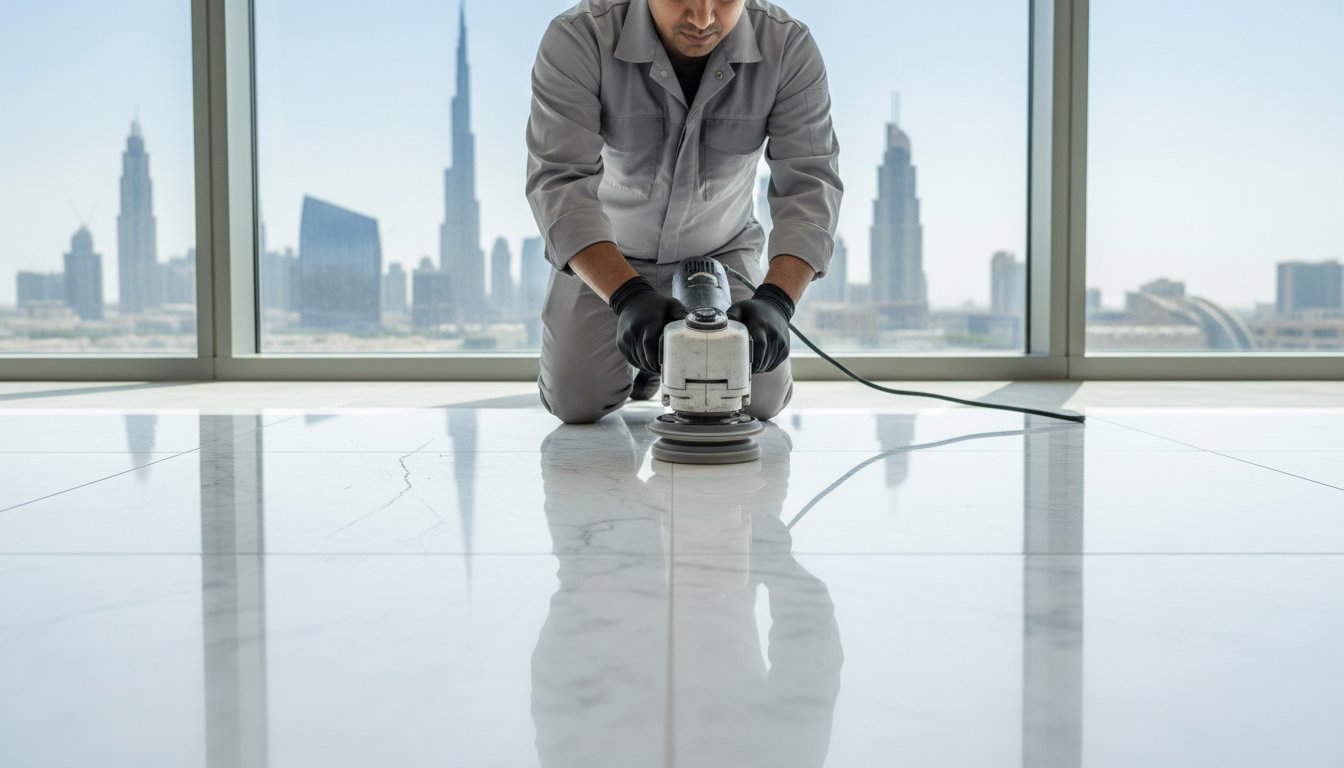
Every day a major development in Dubai or Abu Dhabi remains unfinished past the deadline, the contractor faces liquidated damages that typically reach 10% of the total contract sum. It’s a high-stakes scenario where a single scratch on a bespoke marble slab or a chip in a glass facade can delay a multi-million dirham project. You’ve likely seen how the final 5% of a snag list can consume a disproportionate amount of your remaining budget and time. Fixing construction defects before handover doesn’t have to mean waiting weeks for expensive replacement materials to arrive from international suppliers.
We’ve proven that technical surface restoration is the most efficient way to clear your snag list and protect your margins. This guide shows you how to achieve a zero-defect handover certificate while reducing your snagging costs by up to 80% compared to traditional replacement. We’ll examine the innovative resins and specialist techniques used to rectify damage across all hard surfaces. You’ll discover how to meet your project deadline with precision, avoiding the lead-time delays that often lead to costly penalties.
Key Takeaways
- Understand the critical role of DDA and Municipality inspections in the UAE and how surface quality directly impacts final buyer approval.
- Discover why fixing construction defects before handover through professional restoration is significantly faster than the standard six-week lead time for replacement materials.
- Learn how to reduce project overheads by achieving savings of 50–80% compared to the high costs of procuring and installing new surfaces.
- Explore specialized techniques for rectifying damage across diverse materials, including wood, glass, stone, and metal, to ensure a flawless finish.
- Gain insights into the professional assessment and repair process that allows contractors to clear complex snag lists efficiently and meet tight deadlines.
Understanding Construction Defects at Handover
Construction defects represent the gap between the design intent and the physical reality of a finished project. These issues generally fall into three categories: workmanship errors, material failures, and site-inflicted damage. Workmanship errors involve poor execution, such as misaligned tiles or uneven joinery. Material failures occur when products don’t perform as specified, often due to improper storage. Site-inflicted damage is the most common hurdle during the final push, where heavy foot traffic and moving equipment result in scratched glass, chipped stone, or dented metalwork.
The stakes for fixing construction defects before handover are exceptionally high in the UAE. Regulatory bodies like the Dubai Development Authority (DDA) and Dubai Municipality conduct rigorous inspections to ensure safety and quality standards. Simultaneously, high-end buyers in the Dubai and Abu Dhabi markets demand a flawless finish. Even a single deep scratch on a marble countertop can stall a multi-million dirham transaction. Minor cosmetic defects often become the primary reason for delayed sign-offs on the punch list or snag list, preventing the transfer of keys and final payments.
Financial repercussions for these delays are severe. Liquidated Damages (LDs) in UAE construction contracts often range from 5% to 10% of the total contract value. For a large-scale development, daily penalties can exceed AED 10,000. Efficiently fixing construction defects before handover isn’t just about aesthetics; it’s a critical strategy to protect project margins and avoid these mounting costs.
The Impact of the UAE Climate on Finishing Defects
Extreme environmental conditions in the UAE complicate the final finishing phase. Temperatures frequently reach 50°C, affecting the curing process of specialist resins and stone fillers. If not managed with technical mastery, these materials can shrink or discolor. Dubai high-rise glazing often suffers from thermal stress defects where rapid temperature shifts between chilled interiors and scorching exteriors cause glass to crack or sealants to fail. Furthermore, high humidity levels lead to expansion and contraction in high-end joinery, resulting in hairline cracks that appear just days before the final inspection.
Snagging vs. Rectification: Closing the Loop
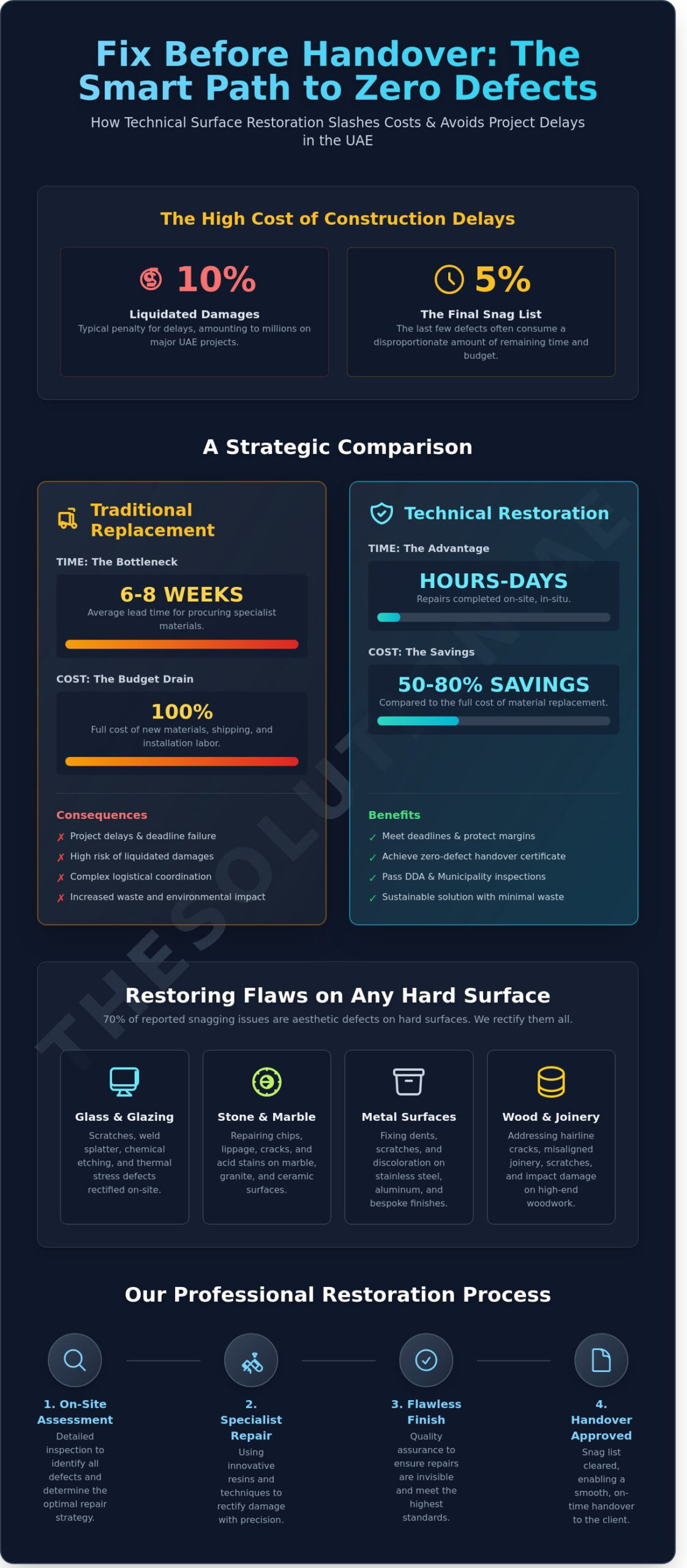
Identifying a problem is only the first step. A comprehensive snag list identifies the “what,” but it doesn’t solve the “how.” The traditional approach of waiting for replacement materials creates a major bottleneck. Procuring a specific batch of Italian marble or custom-coated aluminum can take 6 to 8 weeks, which is time a project manager doesn’t have. Specialized restoration offers a pragmatic alternative. By using innovative techniques to rectify damage on-site, we address the final 2% of project completion in hours rather than weeks. This approach typically delivers savings to the client of 50-80% compared to the cost of full replacement, ensuring a smooth handover without the logistical burden of new material procurement.
Common Hard Surface Defects Found During Snagging
Glass and Glazing Defects
Distinguishing between manufacturing seeds and site-acquired scratches is vital for determining liability. Manufacturing seeds are internal bubbles, while surface scratches usually happen during site cleaning or debris removal. Replacing a single scratched balcony glass panel in a Dubai Marina skyscraper can cost between 15,000 AED and 25,000 AED once you factor in cradle logistics and specialized labor. Glass polishing rectifies these defects on-site, allowing facades to pass inspection without the logistical nightmare of a full replacement.
Stone and Ceramic Imperfections
Lippage, where tile edges aren’t flush, is a primary defect in high-traffic lobby flooring. This creates safety risks and ruins the visual flow of the stone. Acidic cleaning agents often cause etch marks on marble countertops, requiring professional intervention to restore the surface tension. For projects requiring natural stone floor restoration, our team determines when to polish a full area versus performing localized repairs. You can consult our experts for affordable repair solutions that ensure your stone meets handover standards without the cost of replacement.
Metal and Stainless Steel Damage
Scratched elevator interiors are the most frequent last-minute defect found during the handover phase. These high-polish surfaces are easily damaged by moving equipment or protective film removal. Fixing construction defects before handover in elevator cabins is particularly urgent because these areas receive the most scrutiny from the end-user. Restoring the grain in brushed stainless steel requires technical mastery to ensure the repair is invisible. We also address oxidation and pitting on exterior metal cladding, which is common in coastal UAE environments where salt spray is prevalent. Our innovative techniques provide significant savings to the client, often reaching 80% compared to the cost of replacing entire panels.
Repair vs. Replacement: A Strategic Comparison
Choosing between repairing a damaged fixture and replacing it entirely is a critical decision when fixing construction defects before handover. Project managers often default to replacement, assuming it’s the only way to guarantee quality. This approach often leads to the “Lead Time Trap.” In the UAE, specialized materials like Italian marble or bespoke joinery can take 6 weeks or longer to arrive. When your handover date is 10 days away, waiting for a shipment isn’t a viable option.
Surface restoration provides a pragmatic alternative that keeps projects on schedule. By choosing to rectify damage rather than rip out installations, you maintain the momentum of the final snagging list. The benefits are measurable:
- Significant Savings: Restoration typically saves 50-80% compared to the cost of new procurement.
- Waste Reduction: Keeping existing fixtures in place reduces construction waste and aligns with UAE sustainability goals.
- Structural Safety: Localized repairs avoid disturbing adjacent “perfect” surfaces, which often happens during aggressive demolition.
- Time Efficiency: Most repairs are completed within hours, not weeks.
Calculating the Real Cost of Replacement
The price tag on a new component is only a fraction of the total expense. You must factor in labor for the removal of the damaged item, disposal fees for construction debris, and the cost of re-installation. There’s also a high risk of “secondary damage.” Ripping out a chipped bathtub often cracks the surrounding waterproof seal or adjacent wall tiles, creating a new set of problems. For B2B clients, hard surface repair is the intelligent financial choice because it eliminates these hidden variables and protects the bottom line.
Durability and Aesthetic Standards
The Professional Surface Restoration Process
Successfully fixing construction defects before handover requires a systematic, technical approach. The Solution follows a rigorous five-step methodology to rectify damage, ensuring every repair meets the high standards of UAE developers and consultants. We don’t just patch holes; we restore the structural and aesthetic integrity of the material. Our process begins with a technical site assessment to determine the defect’s depth. This diagnostic phase identifies whether the damage is superficial or requires a deep-fill structural intervention. It’s a vital step that prevents repair failure after the building is occupied.
Once the assessment is complete, technicians isolate the work area. We use industrial-grade extraction and containment systems to prevent dust spread, which is essential when working in finished luxury apartments or commercial lobbies. The restoration continues with material matching. We utilize specialist resins and laboratory-grade pigments to achieve a 100% color match. This isn’t a “near enough” process; it’s a precise chemical formulation tailored to the specific surface. After the material is applied and cured, we rebuild the surface profile. The final step involves texture blending and polishing, ensuring the light reflects off the repaired area exactly as it does from the original surface. This meticulous attention to detail is a critical final step in fixing construction defects before handover.
- Site Assessment: Evaluating the impact depth to choose the correct resin density.
- Surface Preparation: Cleaning and decontaminating the area for maximum adhesion.
- Material Matching: Custom blending pigments to match the unique patina of the substrate.
- Precision Application: Layering materials to replicate the original surface contours.
- Final Blending: Using varied grit abrasives to match the surrounding sheen levels.
On-Site Glass Polishing Techniques
Scratched glazing is a frequent issue on Dubai’s high-rise projects. We employ a multi-stage abrasive process to remove deep scratches without creating optical distortion. Our technicians use optical-grade compounds to bring the glass back to its original clarity. For large-scale facade projects, glass polishing and restoration is the standard alternative to replacement, often saving clients between 50% and 80% on procurement and installation costs. It’s a faster, more sustainable solution for meeting handover deadlines.
Restoring Stainless Steel Grain
Marble and Tile Chip Repair
Natural stone and ceramic tiles often suffer from edge chipping or “lippage” during the final cleaning phase. We address ceramic and tile repair by infusing chips with UV-stable resins that won’t yellow over time. Technicians level the repair to match the surrounding floor height perfectly. This process is particularly effective in wet areas like bathrooms and kitchens, where a seamless, waterproof finish is required to pass snagging inspections. Our repairs are engineered to withstand the heavy footfall common in UAE commercial properties.
Don’t risk project delays due to damaged surfaces. Contact our team for a professional damage assessment today.
Partnering with The Solution for a Flawless Handover
The Solution is the premier damage repair partner for UAE contractors who demand excellence. We provide technical mastery across a diverse range of projects, from luxury hotel lobbies in Dubai to complex industrial marine surfaces. Our team understands that the final stages of a project are often the most stressful. We act as a reliable partner to ensure every hard surface meets the highest standards of quality and aesthetics before the client takes possession.
Our “Invisible Repair” promise is designed to help you pass the most stringent consultant inspections. When fixing construction defects before handover, the goal is to make damage disappear completely. We use specialist resins and proficient techniques to rectify chips, scratches, and cracks. This level of precision prevents the costly rejection of work and ensures a smooth transition. Our services are an intelligent financial decision, often providing savings to the client of 50% to 80% compared to the price of full replacement.
Expert Technicians and Advanced Methodology
In February 2024, we assisted a major Dubai developer facing significant late penalties due to damaged lift interiors. Replacing the custom panels would have delayed the handover by several weeks. Our team performed a specialized stainless steel finish restoration that brought the surfaces back to factory standards within two days. This intervention saved the project timeline and thousands of AED in potential liquidated damages.
Requesting a Site Assessment
Integrating professional restoration into your final project schedule is efficient. To begin, you can send photos of the damaged areas for a rapid repair quote. This allows our team to assess the scope of work and provide a clear, cost-effective solution quickly. We understand the urgency of the final weeks and prioritize rapid response times for our partners.
Our on-site mobilization is designed to minimize disruption. Technicians can work alongside your final cleaning teams to ensure the site is ready for inspection. We provide a structured approach for fixing construction defects before handover that respects your project deadlines. Don’t let minor surface damage compromise your reputation or your budget. Contact The Solution to schedule your site audit today and ensure a flawless project delivery.
Achieve a Flawless Project Delivery Today
Achieving a snag-free finish doesn’t require the extreme costs or timeline delays associated with full surface replacement. By prioritizing professional restoration, you streamline the process of fixing construction defects before handover while maintaining the highest quality standards. Our fully trained technicians specialize in invisible on-site repairs for all hard surfaces, including wood, stone, and glass. This technical approach is already trusted by major UAE developers and leading hotel chains to ensure their properties meet rigorous inspection criteria.
Choosing restoration over replacement typically generates savings of 50-80% for your project budget. We rectify damage with precision, ensuring your development stays on track for its scheduled opening. Our team understands the high-stakes environment of the UAE construction market and provides the reliability you need for a successful handover. Don’t let minor surface damage derail your final delivery or inflate your expenses. It’s time to choose a pragmatic, cost-effective solution that protects your bottom line.
Get a Quote for Your Snag List Restoration
Let’s ensure your project makes the right first impression from the moment the keys are turned.
Frequently Asked Questions
What are the most common construction defects found during handover in Dubai?
The most common construction defects found during handover in Dubai include scratched glass facades, chipped ceramic tiles, and dented powder-coated aluminum frames. Industry snagging statistics show that a standard luxury apartment in Downtown Dubai can present over 60 individual surface defects. Our technicians frequently rectify these issues on-site to ensure the property meets the high standards expected by investors and residents in the UAE market.
Is on-site surface repair as durable as replacing the original material?
Professional on-site surface repair is engineered to be as durable as the original material. We use specialist resins and UV-stable coatings that bond at a molecular level with the substrate. These repairs withstand the extreme heat and humidity of the Dubai climate, often exceeding the lifespan of the surrounding material. Our restoration methods ensure that fixing construction defects before handover provides a permanent solution rather than a temporary aesthetic fix.
How much can I save by repairing construction defects rather than replacing them?
Clients typically save between 50% and 80% when choosing restoration over replacement. Replacing a damaged marble slab or a structural glass panel involves high procurement costs, long lead times, and expensive labor for removal and installation. By repairing the damage in situ, you eliminate the need for new materials and avoid the logistical costs of disposing of damaged goods. This approach protects your project margins during the final stages of construction.
Can scratches on glass facades be removed without causing visual distortion?
We remove scratches from glass facades using a multi-stage polishing process that maintains the optical clarity of the pane. Our technicians use precision-engineered abrasive pads and cerium oxide compounds to gently level the surface. This technique ensures there’s no lens effect or visual distortion, which is a critical requirement for passing rigorous inspections in Dubai’s high-rise commercial sectors. The glass is restored to its original factory finish without the need for costly pane replacement.
How long does a professional surface restoration typically take to complete?
A standard professional surface restoration typically takes between 2 and 4 hours per defect. While a complete kitchen worktop restoration might require a full working day, individual chips in tiles or scratches on door frames are often rectified in under 60 minutes. This speed allows contractors to meet tight handover deadlines without the weeks of delay associated with ordering replacement parts from international suppliers.
Will a surface repair be visible to a property snagging inspector?
A high-quality surface repair is invisible to the naked eye and will pass a standard snagging inspection. We match colors and textures precisely using digital color-matching technology and specialist graining tools. Our technicians are trained to replicate the light-reflective properties of the original surface. Because we restore the item to its original condition, inspectors see a flawless finish rather than a patched area, ensuring a smooth handover process.
What types of surfaces can be repaired on-site before handover?
Our team can repair a vast array of surfaces on-site including stainless steel, wood, ceramic, marble, granite, and powder-coated aluminum. We also specialize in restoring laminate, acrylic, and various types of glass. This comprehensive capability makes us a one-stop shop for fixing construction defects before handover, as we handle everything from a scratched elevator car to a chipped vanity unit in a single visit.
Do you provide surface repair services for commercial elevators and escalators?
We provide specialized surface repair services for commercial elevators and escalators, focusing on stainless steel and glass components. Our technicians can remove deep scratches, graffiti, and scuff marks from elevator interiors and landing doors. We also restore the brushed or mirrored finishes on escalator side panels. These repairs are performed outside of peak hours to minimize disruption to building operations while maintaining the professional appearance of the facility.


