
With 83,000 residential units scheduled for completion in 2026, the pressure to secure a mandatory Quality and Safety Certificate under Dubai’s Law No. (3) of 2026 is immense. You likely understand that the gap between a finished build and a successful transfer often hinges on the quality of your pre-handover snagging and de-snagging process. A single scratched marble slab or a chipped glass panel can stall a handover, trigger contractor disputes, and lead to significant penalties. Replacing these high-end fixtures isn’t just slow; it’s a costly endeavor that eats into your project margins and delays final payment.
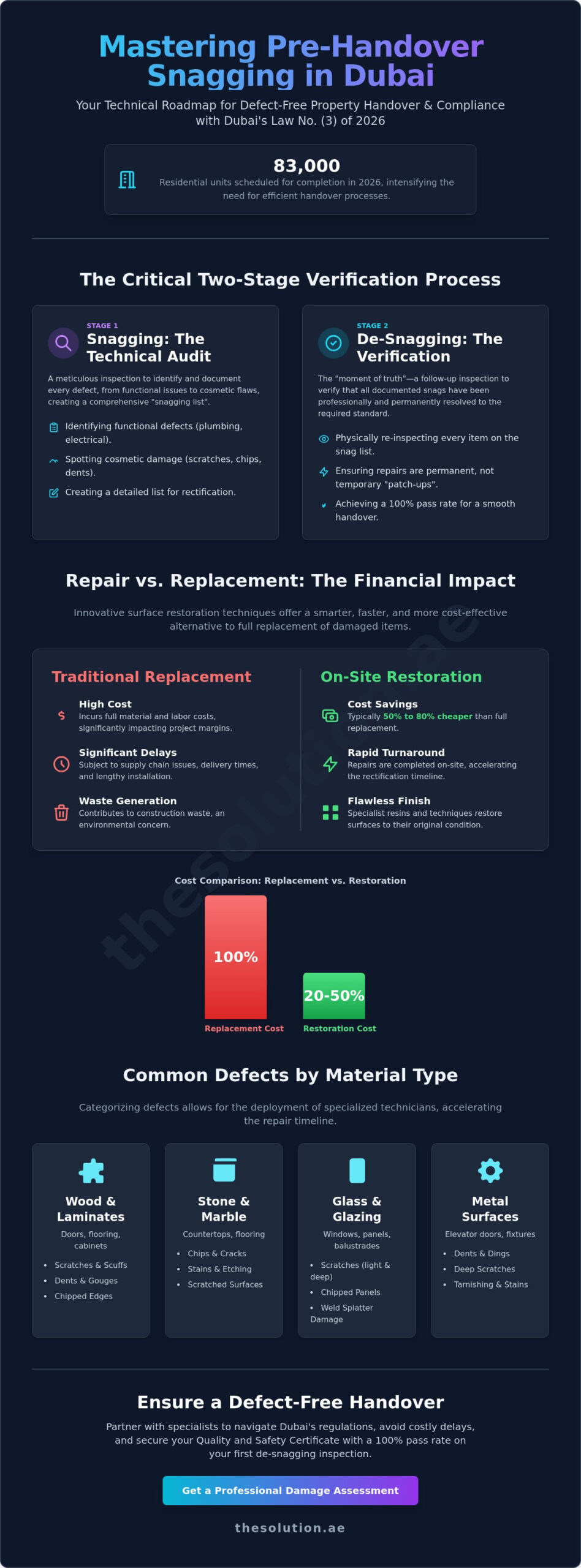
We agree that the traditional “replace everything” mindset is outdated and inefficient for modern developers and contractors. This guide provides a technical roadmap to master the nuances of snagging so you can ensure a defect-free property handover. You’ll learn how to rectify surface damage using innovative restoration techniques that typically save 50 to 80% on costs compared to full replacement. We’ll preview the mandatory 2026 regulatory changes, the critical difference between diagnosis and cure, and how to achieve a flawless de-snagging report for a smooth, profitable transfer to the end-user.
Key Takeaways
- Master the critical differences between the initial technical audit and the final verification process to avoid common handover pitfalls.
- Implement a professional pre-handover snagging and de-snagging workflow to ensure your property meets the stringent requirements of Law No. (3) of 2026.
- Evaluate the financial benefits of on-site surface restoration, which typically reduces repair costs by 50-80% compared to full item replacement.
- Learn a structured approach to categorizing defects by material type to deploy specialized technicians and accelerate the rectification timeline.
- Secure a defect-free de-snagging report by utilizing advanced repair resins and polishing techniques for high-value surfaces like marble and stainless steel.
Understanding Pre-Handover Snagging and De-Snagging
Successful property delivery in Dubai relies on a precise two-stage verification process. The pre-handover snagging and de-snagging phase serves as the final barrier between a construction site and a move-in ready asset. Snagging is the initial technical audit where a property is scrutinized for defects. If you’re wondering, What is a snagging list?, it’s essentially a comprehensive document detailing every item that requires rectification before the keys change hands. De-snagging is the follow-up inspection to verify that these specific items have been professionally resolved to the required standard.
This process is non-negotiable for protecting asset value in Dubai’s competitive market. With the enforcement of Law No. (3) of 2026, building quality is now a legal mandate rather than a suggestion. For developers, a failed inspection means delayed revenue and potential penalties. For contractors, it results in withheld payments and liquidated damages. A specialist restoration team bridges the gap between these parties, providing the technical mastery needed to rectify complex surface damage that general laborers often struggle to fix properly. This high-precision approach to surface perfection is a standard also upheld by specialists like Five Star Dent Removal in the field of automotive restoration.
The Snagging Meaning: More Than Just a Checklist
Snags generally fall into two categories: functional and cosmetic. Functional issues involve plumbing or electrical systems, while cosmetic snags include scratches on glass, chips in marble, or dents in stainless steel. Don’t let the term “cosmetic” fool you. Minor surface damage often causes the most significant delays during final handover approval because it’s the first thing an owner notices. Achieving a flawless finish requires a professional hard surface repair approach. We use specialist resins and innovative techniques to restore surfaces to their original condition, ensuring they meet RERA-level standards without the need for costly replacements.
What is De-Snagging and Why Does it Often Fail?
De-snagging is the moment of truth. It’s the physical re-inspection of the original list to ensure every defect is gone. Many de-snagging attempts fail because general contractors rely on poor quality “patch-up” jobs. Smearing grout into a tile chip or using off-the-shelf paint on a scratched door isn’t a repair; it’s a temporary cover-up. These shortcuts are usually rejected by inspectors, leading to a second or third round of pre-handover snagging and de-snagging which stalls the entire project. Professional restoration ensures a 100% pass rate on the first de-snagging attempt. Our technicians are fully trained in damage assessment, providing a permanent cure that withstands the most rigorous technical audits.
Common Defects in Dubai Properties: The Snagging Checklist
Dubai’s construction environment is fast paced and demanding. With over 202,349 residential sales transactions recorded in 2025, the volume of properties moving toward handover is staggering. However, high volume often leads to overlooked details. During the pre-handover snagging and de-snagging phase, inspectors frequently find that luxury finishes have suffered from the “final mile” of construction. Even with the rigorous standards set by the Consumer Code for New Homes, physical defects are common. These aren’t just minor eyesores; they’re liabilities that can delay the transfer of a multi-million dirham asset.
High-traffic areas are particularly vulnerable. Elevator doors often show deep vertical scratches from moving equipment, while wall panels in lobbies frequently arrive dented. Floor tiles in entryways are prone to chipping when heavy tools are dropped during the final fit-out. Identifying these issues early is vital for maintaining project momentum. You can consult with our technicians for a comprehensive damage assessment before the final audit begins.
Hard Surface Damage: Wood, Stone, and Ceramic
Luxury bathrooms and kitchens are the centerpieces of Dubai real estate, yet they’re magnets for damage. We often see chips in ceramic and tile repair scenarios where the aesthetic of a premium space is compromised by a single impact mark. Natural stone surfaces, like marble countertops, are frequently stained by chemical spills or construction dust that wasn’t cleared immediately. In living areas, premium wood flooring often shows dents or deep scratches from furniture installation. These defects require specialist resins and proficient use of color-matching techniques to rectify without leaving a trace.
Glass and Stainless Steel: The High-Value Snags
Dubai’s architecture relies heavily on expansive glazing and sleek metalwork. Scratches on floor-to-ceiling windows or glass balustrades are common, often caused by abrasive construction cleaning methods. Because replacement is a logistical nightmare in high-rise buildings, glass polishing and restoration is the most efficient way to clear a snagging list. Stainless steel fixtures present a different challenge. Rectifying scratches on elevator interiors requires technical mastery to restore the specific grain of “brushed” finishes or the mirror-like clarity of “polished” surfaces. Our pre-handover snagging and de-snagging protocols ensure these high-value items are restored to factory standards, saving the client up to 80% on restoration costs.
Repair vs. Replacement: A Strategic Approach to De-Snagging
Choosing between repairing a surface or replacing the entire fixture is the most critical decision in the pre-handover snagging and de-snagging phase. While replacement seems like a definitive fix, it’s often the most inefficient path for high-stakes developments. On-site restoration typically achieves savings to the client of 50 to 80% compared to the cost of new materials and labor. Beyond the direct financial benefit, restoration eliminates the lead times associated with procurement. In a market where 83,000 units are expected to handover in 2026, waiting weeks for a specific ceramic tile or a custom-cut glass pane can lead to missed deadlines and heavy penalties.
Restoration also protects the structural integrity of the property. Ripping out a damaged window frame or a chipped floor tile often causes collateral damage to surrounding surfaces, creating a cycle of new snags. By choosing to rectify damage on-site, you significantly reduce construction waste. This approach aligns with the Al Sa’fat 2.0 Silver Sustainability Framework, which is mandatory for all new Dubai permits in 2026. It’s a pragmatic solution that balances quality with environmental responsibility.
When Restoration is the Superior Choice
Restoring a scratched stainless steel finish is a prime example of strategic de-snagging. Replacing an entire elevator panel requires significant downtime and technical labor; our technicians can rectify surface scratches on-site in a single shift. Similarly, on-site glass scratch removal prevents the need for complex, crane-assisted glass replacement in high-rise towers. For stone and tile, our “invisible repair” techniques use specialist resins to make chips in marble and ceramic disappear. This process restores the surface to its original factory standard without the risk of damaging the subfloor or waterproofing layers.
Calculating the ROI of Specialist Snag Rectification
The true return on investment for specialist restoration includes the avoidance of liquidated damages and handover delays. A stalled handover can cost thousands of dirhams per day in lost rental yields or interest payments. Our use of specialist resins and innovative techniques provides a permanent, warrantied fix that passes the most stringent technical audits. When you compare the cost of a highly skilled technician to the procurement, shipping, and installation logistics of new materials, restoration is the only logical choice for a profitable property transfer. Our pre-handover snagging and de-snagging protocols prioritize speed and quality, ensuring the asset is ready for its Quality and Safety Certificate without unnecessary expenditure.
How to Manage the Handover Process Efficiently
Managing the pre-handover snagging and de-snagging cycle requires a structured workflow to avoid the typical 22% completion rate bottleneck seen in 2024. Efficiency starts with a four-step framework designed to clear technical audits without the friction of contractor disputes. By following a logical sequence, you ensure that every defect is identified, categorized, and rectified before the final keys change hands.
- Step 1: Conduct an independent inspection. A factual report from a third-party specialist provides an objective baseline, removing emotional bias from the process.
- Step 2: Categorize snags. Grouping defects by material type (Glass, Metal, Stone, Wood) allows for the strategic deployment of technicians with material-specific toolsets.
- Step 3: Appoint a specialist restoration partner. The Solution provides the technical mastery to rectify surface damages on-site, ensuring high-value items like marble or stainless steel are restored to factory standards.
- Step 4: Execute the de-snagging walkthrough. This is the final sign-off where you verify that every specific item on the original report is resolved, allowing for the issuance of the Quality and Safety Certificate.
Working with Contractors and Developers
A detailed snagging report is a powerful leverage tool for final payment releases. Contractors are often under pressure to meet handover deadlines for the 83,000 units expected in 2026, which can lead to “new snags” being created during the rushed rectification of old ones. We find that a meticulous tile grout inspection serves as a reliable indicator of overall workmanship quality. If the grout lines are inconsistent or stained, it usually suggests that other technical details, such as waterproofing or joinery, have also been overlooked.
The Role of Technology in Modern Snagging
Digital snagging apps have replaced paper checklists, allowing for real-time progress tracking from identification to sign-off. These tools facilitate better communication between the developer and the restoration team. Documentation is vital for a successful pre-handover snagging and de-snagging outcome. High-resolution “before and after” photos provide the evidence needed for de-snagging approval, especially when dealing with “invisible” repairs on stone or ceramic. Our technicians use specialist compounds and precision tools to achieve these results with minimal disruption. To ensure your project stays on schedule and avoids costly delays, book a damage assessment with The Solution today.
Why The Solution is the Premier Partner for Dubai Handovers
Efficiency in the final stages of construction is the difference between a profitable project and a penalized one. The Solution stands as the premier partner for pre-handover snagging and de-snagging because we prioritize technical mastery over temporary fixes. We have developed a range of innovative repair solutions to rectify damage to all types of hard surface. This ensures your project meets the highest standards before the final inspection. Our technicians are fully trained in damage assessment and restoration. They identify the most efficient path to a defect-free handover without the need for structural changes.
Our footprint extends across the UAE, serving the construction, hospitality, and marine sectors. We understand the unique pressures of each industry. In hospitality, a single scratched lobby window can ruin the guest’s first impression. In the marine sector, the precision of stainless steel finishes is paramount. Our commitment to results means we don’t stop until your de-snagging report is cleared with exceptional quality. We position ourselves not just as a service provider, but as a reliable partner for complex repair challenges.
For developers and operators who require full-scale interior fit-out and renovation solutions before the final snagging phase, Penta Zonetechnical Services offers the comprehensive expertise needed to deliver world-class commercial and residential spaces.
Unmatched Versatility in Surface Restoration
Our experience spans Dubai’s most prominent projects. We have worked on everything from ultra-luxury villas in Palm Jumeirah to commercial skyscrapers in the DIFC. We don’t just repair; we restore with a meticulous focus on quality. Our ability to match complex textures and colors for wood, laminate, ceramic, and stone is what sets us apart from general contractors. This proficiency is why we are the preferred choice for marble polishing in Dubai. Whether it’s a chipped countertop or a scratched lift interior, we ensure the finish is indistinguishable from the original material. Our goal is to provide a seamless result that passes even the most rigorous technical audits.
Get a Professional Rectification Quote
Navigating the final stages of a project is often a complex endeavor. We simplify the pre-handover snagging and de-snagging process by providing clear, factual estimates based on your existing snagging report. Simply submit your report to our team. We will provide a competitive restoration quote that highlights the tangible benefits of repair over replacement. Our promise is minimal disruption to your site schedule and significant financial benefit. Savings to the client of 50 to 80% are normal practice when choosing our on-site services. Contact The Solution today for expert pre-handover restoration and ensure your property is handed over with exceptional quality and on schedule.
Streamlining Your Path to a Profitable Handover
Successful property delivery in Dubai’s 2026 market requires more than just identifying defects. It demands a technical strategy that prioritizes high-quality restoration over the slow and expensive process of replacement. By mastering the pre-handover snagging and de-snagging cycle, you protect your project margins and ensure compliance with Law No. (3) of 2026. This proactive approach transforms the final technical audit from a bottleneck into a streamlined path toward asset transfer and final payment release.
The Solution provides the technical expertise needed to rectify damage across 15+ types of hard surfaces, including luxury marble, architectural glass, and stainless steel. Our methodology is trusted by Dubai’s leading developers and international hotel chains to deliver flawless results under tight completion deadlines. Choosing on-site restoration isn’t just about aesthetics; it’s a pragmatic financial decision that typically yields savings of 50 to 80% compared to new procurement and installation costs.
Secure your property’s value with expert snag rectification from The Solution. Our fully trained technicians are ready to help you achieve a 100% pass rate on your next de-snagging report. Let’s ensure your handover process is as efficient as it is profitable.
Frequently Asked Questions
What is the difference between snagging and de-snagging?
The primary difference lies in the stage of the verification process. Snagging is the initial technical audit where inspectors identify defects such as chipped tiles or scratched glass. De-snagging is the follow-up inspection to verify that every item on the original list has been rectified. Completing the pre-handover snagging and de-snagging cycle is essential for a successful property transfer.
How long does a typical pre-handover snagging inspection take?
A standard inspection usually takes 3 to 5 hours for an apartment. It takes up to 8 hours for a villa. The duration depends on the property’s size and the complexity of its finishes. For example, a 1,500 square foot unit requires a 4-hour window to thoroughly check all hard surfaces, plumbing, and electrical points.
Can deep scratches in glass be removed during the de-snagging process?
Yes, deep scratches can be removed through professional glass polishing and restoration. Our technicians use a series of specialized abrasive pads to grind down the damage before polishing the surface back to its original clarity. This on-site process is significantly faster than ordering a replacement pane and avoids the need for heavy lifting equipment or road closures.
Is it cheaper to repair a chipped tile or replace it?
Repairing a chipped tile is significantly cheaper than a full replacement. On-site restoration typically achieves savings to the client of 50 to 80% because it eliminates the cost of new materials and specialized tile-setting labor. Additionally, repairing avoids the collateral damage often caused when removing a single tile from a bonded floor or wall.
Who is responsible for fixing snags: the developer or the buyer?
The developer is responsible for rectifying defects identified before handover and during the one-year Defect Liability Period. However, the buyer must ensure these defects are documented through a professional pre-handover snagging and de-snagging report. This documentation serves as a legal record to ensure the developer fulfills their contractual obligations for building quality.
What happens if snags are not fixed before the final handover?
Unresolved snags can stall the issuance of a Quality and Safety Certificate under Law No. (3) of 2026. This delay prevents the final transfer of ownership and can lead to financial penalties for the developer. For the buyer, it means delayed move-in dates or lost rental yields. As of April 2026, average gross rental yields for apartments in Dubai reached 7%.
Can stainless steel elevator doors be restored to their original finish?
Yes, stainless steel elevator doors can be restored to their original brushed or polished finish on-site. We use innovative techniques to remove vertical scratches and scuffs caused during the construction phase. This restoration process is a permanent solution that returns the metal to factory standards without the high cost and downtime of replacing the entire panel system.
How do I choose the best snagging company in Dubai?
Choose a company that provides detailed, high-resolution reports and has deep knowledge of the Dubai Building Code. It’s beneficial to select an inspector who understands the difference between a patch-up job and a professional restoration. Look for firms that have a proven history of working with prominent developers and can demonstrate a high de-snagging pass rate.


