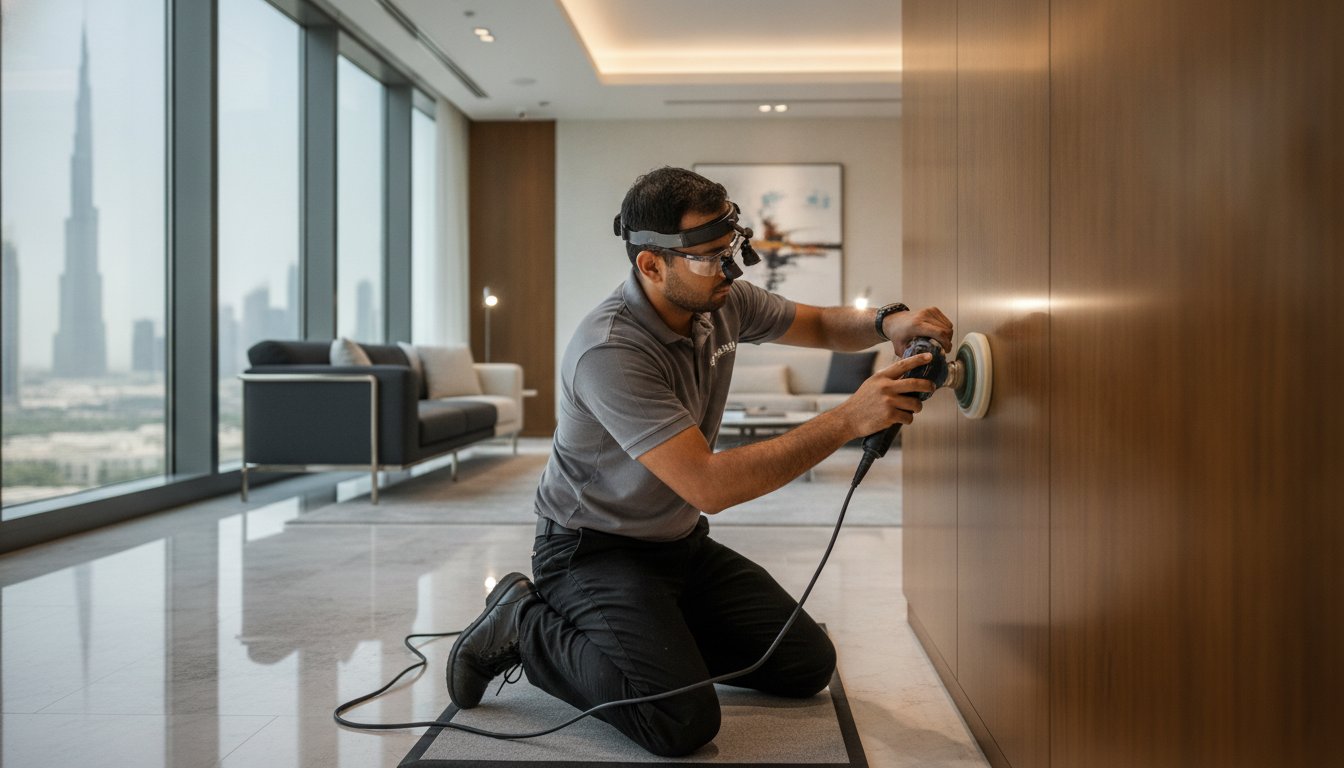
Choosing to replace a damaged high-end surface in a Dubai commercial property is often an unnecessary drain on your capital budget. You’re likely familiar with the 12-week lead times for imported materials and the high cost of demolition that stalls your operations. It’s a common frustration for asset managers who need their spaces ready for immediate use. This guide shows you how avoiding replacement costs with surface repair can slash your maintenance overheads by up to 80% and eliminate operational downtime entirely.
We understand that quality is non-negotiable, especially with the introduction of Dubai Law No. (3) of 2026. This regulation mandates strict safety and quality standards, making professional restoration a critical component of your maintenance strategy. You’ll discover how specialized techniques for wood, glass, and stainless steel provide an invisible finish that passes the most rigorous handover inspections. We’ll break down the financial benefits of technical restoration and explain why choosing repair over replacement is the most intelligent decision for your bottom line. By focusing on precision and technical mastery, you can ensure your assets meet new compliance deadlines while maintaining a premium aesthetic.
Key Takeaways
- Understand why the true cost of replacement includes hidden expenses like demolition, debris removal, and logistics.
- Discover how avoiding replacement costs with surface repair bypasses 12-week import lead times for specialized architectural finishes.
- Learn the technical methodology used to achieve invisible results on wood, glass, and stainless steel surfaces.
- Identify how on-site restoration helps secure Final Handover Certificates and avoids liquidated damages in the UAE real estate sector.
- Explore how strategic surface maintenance ensures compliance with the mandatory safety standards of Dubai Law No. (3) of 2026.
The Financial Iceberg: Why Replacement Costs More Than the Invoice
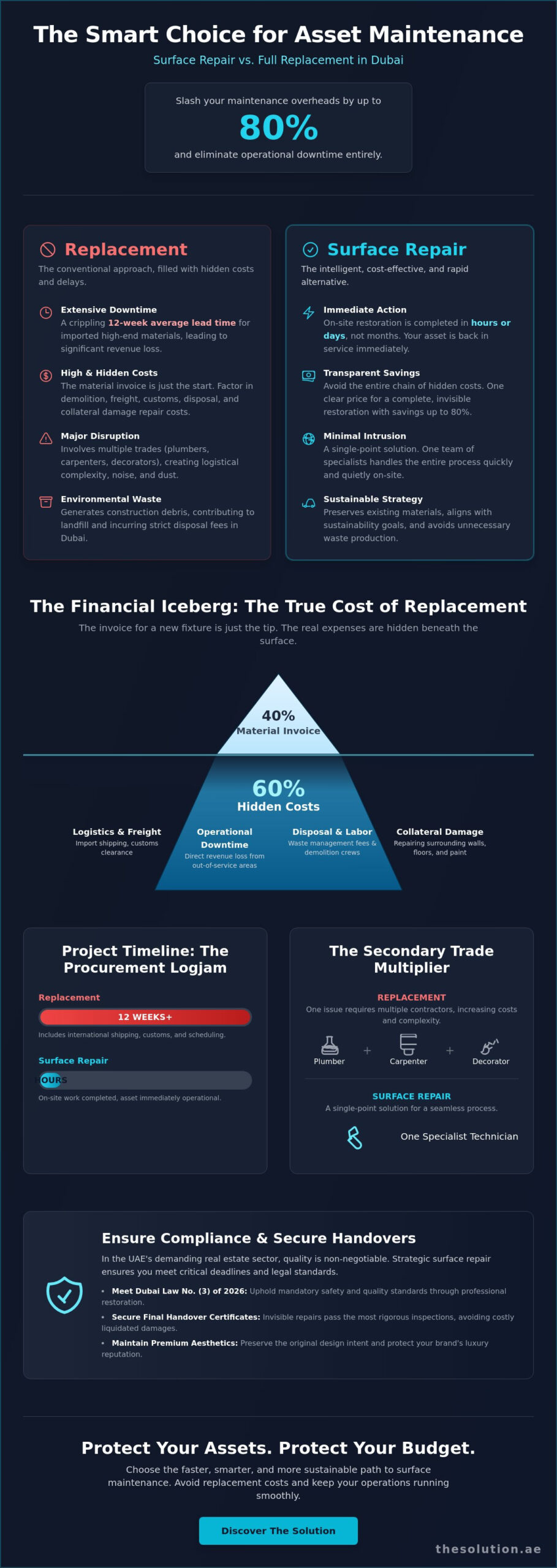
Asset owners often mistake the purchase price of a new fixture for the total cost of the project. This oversight creates what we call the “Iceberg Effect.” The visible portion, the invoice for the material, is typically only 40% of the total expenditure. The remaining 60% lies beneath the surface, hidden in the procurement cycle, logistical delays, and labor requirements. Choosing a strategy of avoiding replacement costs with surface repair addresses the entire iceberg, not just the tip. By restoring rather than replacing, you eliminate the compounding expenses that turn a simple fix into a capital-heavy project.
Within the technical meaning of maintenance, we distinguish between corrective and preventive actions. Corrective replacement often triggers a chain reaction of expenses that surface restoration bypasses completely. When a surface is damaged, the immediate instinct is to buy new. However, the financial impact of this decision extends far beyond the procurement office. You must account for several indirect costs:
- Logistics and Freight: High-end architectural finishes in the UAE are frequently imported, incurring significant shipping and customs fees.
- Operational Downtime: A room or retail space out of service for 12 weeks represents a direct loss of revenue.
- Disposal Fees: Dubai’s strict waste management regulations require specific handling for construction debris.
- Collateral Damage: The removal of fixed assets often damages surrounding paint, plaster, or flooring.
The Hidden Costs of Demolition and Disposal
Removing a damaged fixture isn’t a clean process. In the UAE, waste management fees for construction debris are increasing as the market moves toward sustainability. Beyond these fees, the physical act of “ripping out” a built-in unit often compromises the integrity of adjacent surfaces. A simple tile replacement can lead to cracked waterproofing or damaged grout lines in neighboring sections. We focus on “fixing in place” to avoid these logistical and structural risks.
The Secondary Trade Multiplier
Replacement rarely involves a single technician. If you replace a damaged vanity in a hotel suite, you need a plumber to disconnect the water, a carpenter to remove the frame, and a decorator to touch up the paintwork. Managing three different contractors for one repair is a logistical burden that invites scope creep. Our technical restoration acts as a single-point solution. We handle the repair, texture matching, and finishing in one visit, which simplifies your project management and protects your budget from the secondary trade multiplier.
Operational Continuity: Avoiding the Procurement Logjam
The UAE’s status as a global luxury hub creates a unique logistical challenge for asset managers. Most high-end architectural finishes used in Dubai’s five-star hotels and Grade A offices are specialized imports from Europe or North America. When a stainless steel elevator panel is dented or a bespoke wood veneer is scorched, the standard procurement route involves a 12-week lead time. This delay isn’t just an administrative hurdle. It’s a period where your asset remains damaged, potentially impacting your brand’s reputation and your bottom line.
Choosing a strategy of avoiding replacement costs with surface repair acts as a critical procurement bypass. Instead of waiting months for international shipping and customs clearance, technical restoration happens on-site, often within hours. This approach aligns with a sophisticated life-cycle cost analysis, where the focus shifts from the initial purchase price to the total value of keeping an asset in service. Every day an asset remains out of commission, the indirect costs of replacement climb higher. By restoring what you already have, you maintain the original design intent without the wait.
Revenue Loss vs. Restoration Speed
In the hospitality and retail sectors, “Out of Service” inventory is toxic to profitability. Consider a luxury hotel suite in Downtown Dubai. If a damaged bathtub or a scratched floor forces a room closure, the daily revenue loss is immediate and compounding. Over a 12-week procurement period, these losses can easily exceed the cost of the replacement item itself. Our restoration process returns the surface to a factory-finish standard in a single shift. This speed ensures that your property maintains its aesthetic standards without the “broken window syndrome” that can lead to negative guest reviews and diminished brand perception.
Minimal Disruption in Occupied Spaces
Traditional replacement is an invasive process. It involves noise, dust, and vibration that can disturb guests in adjacent rooms or shoppers in a retail environment. Managing these disruptions often requires after-hours work, which further inflates labor costs. Surface repair is inherently non-intrusive. Our technicians work with precision tools and specialized resins to fix damage in place. There’s no need for demolition or heavy machinery. This allows for 24/7 operations to continue without interference. If you are facing a looming deadline or a critical inspection, a quick technical assessment can determine if your surfaces can be restored immediately rather than replaced. Maintaining a clean site environment during high-traffic business hours is a core benefit of choosing restoration over the chaos of a construction site.
Technical Feasibility: Can Your Damaged Surface Be Saved?
Determining the technical feasibility of a repair depends on the composition of the substrate and the depth of the damage. Most architectural surfaces in commercial assets suffer from common issues: impact chips, deep scratches, chemical burns, or structural cracks. While traditional maintenance might suggest these require full replacement, modern technical restoration proves otherwise. By avoiding replacement costs with surface repair, you leverage advanced polymer science to reconstruct the material’s original profile without the need for demolition.
The secret to an invisible restoration lies in three technical pillars: grain replication, texture matching, and light refraction. Our technicians don’t just fill a hole; they reconstruct the surface to interact with light exactly like the surrounding area. This precision ensures that even under the harsh, direct lighting typical of UAE showrooms and hotel lobbies, the repair remains undetectable. We work with a wide array of high-end materials, including:
- Natural Stone: Marble, granite, and limestone restoration.
- Luxury Wood: Veneers, solid timber, and engineered flooring.
- Architectural Metals: Stainless steel, brass, and bronze finishes.
- Technical Glass: Structural panels, balustrades, and mirrored surfaces.
Restoring High-Value Architectural Assets
High-traffic zones like elevator cabins and grand entrances often suffer from unsightly abrasions. We provide specialized stainless steel restoration to remove scratches and restore the original brushed or mirrored finish. Similarly, for exterior facades or lobby partitions, our glass polishing and restoration services eliminate deep scratches and mineral deposits without distorting the view. We also handle luxury wood veneers and natural stone, using pigment-matching resins that mimic the natural variations of the material.
Durability and Longevity of Repairs
A common concern is whether a repair can withstand the rigors of a commercial environment. We use modern resins and polymers that are engineered for high-traffic durability. These materials are UV-stable and moisture-resistant, which is vital in the UAE climate where heat and humidity can degrade inferior fillers. In many cases, the bond strength of our professional restoration exceeds the original factory finish. This longevity ensures that your asset remains in peak condition for years, effectively avoiding replacement costs with surface repair while maintaining a premium aesthetic. Our process doesn’t just hide damage; it restores structural integrity and surface resilience.
The UAE Context: Handover Deadlines and Sustainability
The UAE real estate market is operating at a historic pace. In the first quarter of 2026 alone, Dubai recorded over 45,000 residential transactions. With a pipeline of more than 140,000 new units expected to enter the market by the end of the year, the pressure on developers to meet handover deadlines is unprecedented. In this high-stakes environment, a single scratched window or a chipped marble counter can stall the issuance of a Final Handover Certificate (FHC). Avoiding replacement costs with surface repair is no longer just a budget preference; it is a critical strategy for meeting contractual obligations and avoiding liquidated damages.
Dubai Law No. (3) of 2026 has further intensified the focus on building quality and safety. This regulation mandates that owners of buildings 20 years or older must obtain a Quality and Safety Certificate, while newer buildings must undergo periodic maintenance to rectify defects. Professional restoration ensures that surfaces remain compliant with these evolving standards. By choosing to restore rather than replace, asset managers can address snagging lists immediately, ensuring that properties pass rigorous inspections without the delays associated with new material procurement.
Securing Construction Handovers
The final phase of any commercial project is often defined by the “Handover Crisis,” where minor aesthetic defects lead to major payment delays. Replacing a damaged asset during this phase is often impossible due to time constraints. Our specialized repair services rectify chips, burns, and scratches on-site, providing results that are invisible to the naked eye. These restorations pass the most stringent quality audits, allowing contractors to secure their FHC and hand over the keys on schedule. This precision prevents the high cost of replacement penalties that can erode project profitability in the final weeks.
ESG and Sustainability Benefits
Strategic asset management in the UAE is now inextricably linked to the UAE Net Zero 2050 commitment. Every new item manufactured and shipped to the Middle East carries a significant carbon footprint. Opting for hard surface repair is a tangible way to support corporate ESG goals. It diverts hundreds of kilograms of high-end materials from landfills and eliminates the energy consumption required for new manufacturing and international freight. This circular economy approach provides a clear environmental ROI that aligns with the nation’s green building incentives. If you are looking to improve your building’s sustainability rating while protecting your budget, you can request a technical consultation to audit your current assets for restoration potential.
Partnering with The Solution for Asset Protection
The Solution stands as the UAE’s leading resource for technical restoration. We don’t just patch damage; we apply a rigorous, assessment-driven methodology to every project. Our technicians undergo extensive training to master the nuances of various substrates, from brushed stainless steel to exotic wood veneers. This level of specialization is what makes avoiding replacement costs with surface repair a viable, long-term strategy for high-value assets. We treat every repair as a precision engineering task, ensuring the final result is structurally sound and aesthetically perfect.
Our expertise covers a comprehensive range of materials, including:
- Stainless steel and architectural metals
- Glass and mirrored surfaces
- Natural stone and marble
- Ceramics and tiles
- Wood and bespoke veneers
- Powder-coated and spray-painted finishes
Our On-Site Repair Process
Every project begins with a technical assessment to determine the material composition and damage depth. Once the site is prepared, our technicians clean and stabilize the substrate. We then use specialized resins and fillers, meticulously color-matched to the original surface. The structural rebuilding phase ensures the repair is flush with the surrounding area. Finally, we apply texture-matching techniques and a polishing phase to restore the original light refraction. This structured protocol guarantees a flawless result every time. Client sign-off is the final step, ensuring the restoration meets the strict standards required for premium UAE properties.
Next Steps for Your Facility
By choosing to restore, you protect your bottom line and support the UAE’s sustainability goals. Don’t let procurement delays or high demolition costs stall your operations. Contact The Solution for a professional repair quote and discover the benefits of technical surface restoration today.
Optimize Your Asset Lifecycle with Technical Restoration
Strategic asset management in Dubai’s competitive market requires a shift from reactive replacement to technical restoration. You’ve seen how the “Iceberg Effect” turns a simple fixture purchase into a logistical and financial burden. By choosing a path of avoiding replacement costs with surface repair, you eliminate the 12-week procurement logjam and ensure immediate operational continuity. This approach isn’t just about aesthetics; it’s a pragmatic financial decision that delivers proven 50% to 80% cost savings compared to new procurement.
Our expert technicians are trained to achieve invisible results on everything from stainless steel to luxury wood veneers. We’re proud to be trusted by the UAE’s leading hospitality and construction brands to secure critical handovers and maintain compliance with Dubai Law No. (3) of 2026. Transitioning to a “Repair First” mandate protects your bottom line while supporting national sustainability goals. It’s time to stop waiting for international shipments and start restoring your existing value.
Save up to 80% on asset costs—Request a free technical assessment from The Solution today
Take control of your maintenance overheads and ensure your property remains a high-performing asset for years to come.
Frequently Asked Questions
How much can I save by choosing surface repair over replacement?
You can typically save between 50% and 80% of the total project cost by choosing restoration over full replacement. This calculation accounts for the purchase price of new materials and the “Iceberg Effect” of hidden costs like demolition, debris removal, and logistics. By avoiding replacement costs with surface repair, you eliminate the need for multiple secondary trades and reduce labor-intensive project management overhead.
Will the repair be visible to the naked eye after it is finished?
Professional technical restoration results in an invisible finish that is undetectable under standard commercial lighting. Our technicians use advanced color-matching technology and grain replication techniques to ensure the repaired area mimics the surrounding substrate’s texture and light refraction. These high-standard results are designed specifically to pass the most rigorous handover inspections and quality audits in luxury UAE properties.
What types of surfaces can be repaired on-site in Dubai?
We repair an extensive range of architectural surfaces on-site, including stainless steel, structural glass, natural stone, wood veneers, and ceramics. Our technical capabilities also cover powder-coated metals and high-end floor finishes. This on-site methodology is essential for maintaining operational continuity in occupied hotel rooms or retail spaces, as it eliminates the need for disruptive removal and transport of fixed assets.
How long does a typical surface repair take to complete?
Most minor surface repairs are completed within two to four hours, allowing the asset to return to service almost immediately. More complex restorations involving structural rebuilding or extensive polishing may require a full shift. This speed provides a massive advantage over the 12-week lead times often required to import specialized architectural finishes to the UAE, significantly reducing operational downtime.
Is the repair durable enough for high-traffic commercial areas?
Our repairs are engineered to withstand the extreme demands of high-traffic zones like hotel lobbies, shopping malls, and office elevators. We utilize modern polymers and resins that are UV-stable and moisture-resistant to ensure longevity in the UAE’s specific climate. Technical assessments show that the bond strength of our professional restoration materials often exceeds the resilience of the original factory finish.
Can you repair damage to specialized finishes like brushed stainless steel?
We specialize in restoring complex finishes, including brushed, mirrored, and satin stainless steel. Our process involves specialized graining techniques that replicate the original factory texture with absolute precision. This is a vital service for elevator interiors and building entrances where avoiding replacement costs with surface repair protects high-value architectural assets from the financial impact of scratches, dents, or chemical tea-staining.
Do you provide services for construction handover snags?
We provide dedicated support for the final snagging phase of construction projects to ensure seamless property handovers. Our technicians rectify aesthetic defects on-site, helping contractors and developers secure their Final Handover Certificates (FHC) without logistical delays. This service is critical for meeting tight contractual deadlines and avoiding the liquidated damages associated with project overruns in the fast-moving Dubai real estate market.
Does surface repair help with LEED or sustainability certifications?
Surface restoration directly supports LEED and Estidama certifications by significantly reducing construction waste and lowering a project’s total carbon footprint. By choosing to repair instead of replace, you divert high-end materials from landfills and eliminate the environmental impact of new manufacturing and international freight. This strategy aligns your facility with the UAE Net Zero 2050 commitment and supports corporate ESG objectives.


