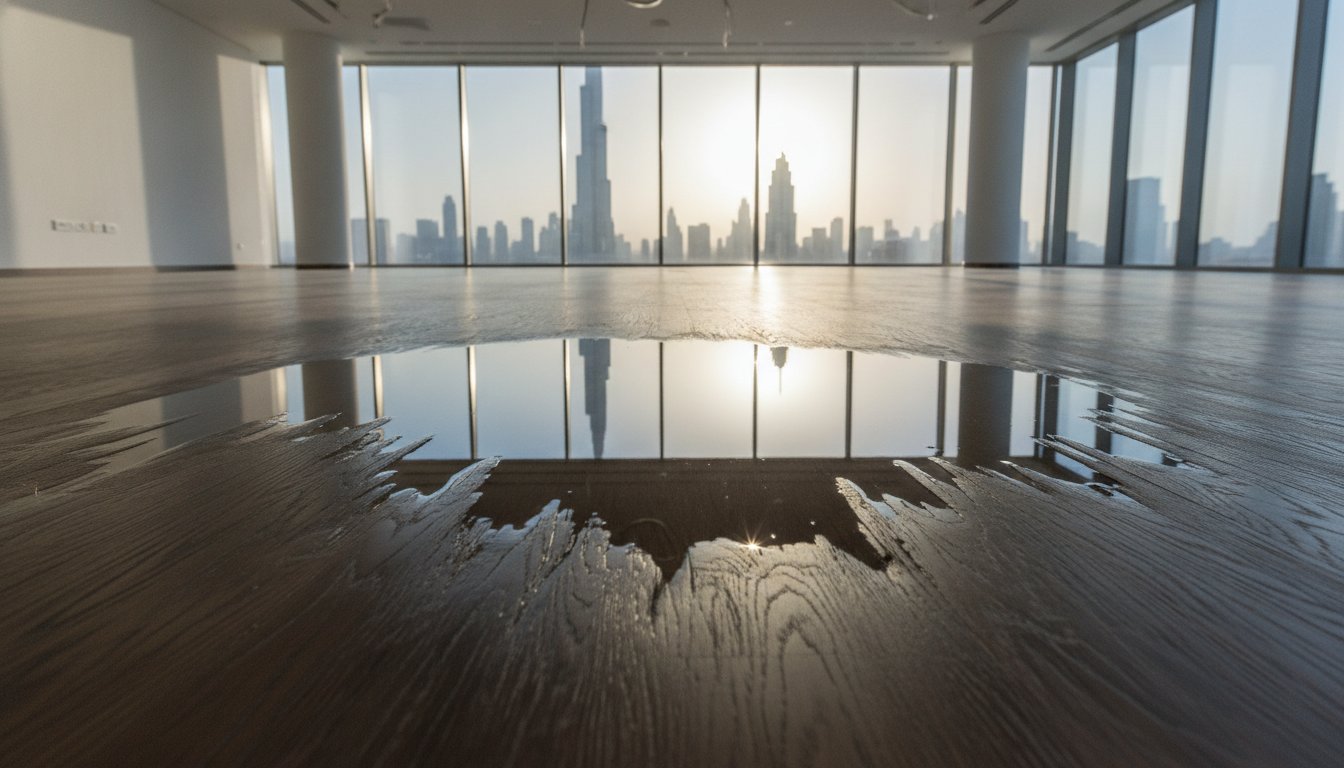
The most expensive way to deal with a water-damaged wood floor isn’t the repair itself; it’s the decision to replace it entirely. Many facility managers and property owners believe that once cupping or deep staining appears, the only solution is a costly, disruptive tear-out. It’s a common misconception that leads to unnecessary capital expenditure and weeks of operational downtime. You’re likely concerned about the wood floor water damage repair cost and whether a restored surface can ever truly match your existing grain and stain.
We agree that protecting your property’s aesthetic and structural value is a priority. This guide will show you how technical restoration factors influence your budget and why professional repair is the most pragmatic alternative to replacement. You’ll discover the specific variables that drive project expenses, from moisture categories to subfloor assessments. We’ll also explain how specialized drying and precision grain replication achieve a seamless, invisible result while saving you a significant percentage of what you’d spend on new materials and installation.
Key Takeaways
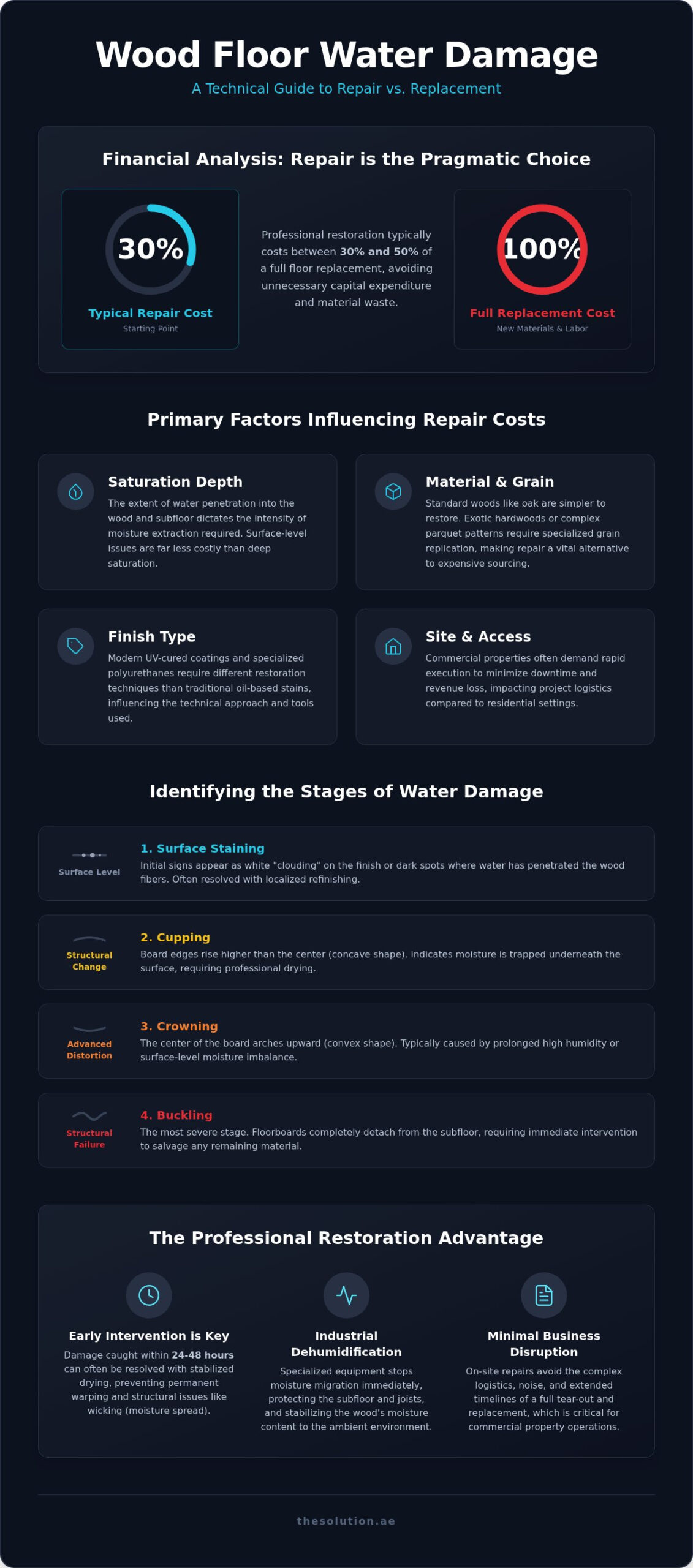
- Understand why professional restoration typically costs between 30% and 50% of the price of a full floor replacement.
- Identify how moisture saturation levels and wood species complexity dictate the final wood floor water damage repair cost.
- Distinguish between surface-level finish clouding and structural cupping to determine the appropriate technical response.
- Learn how industrial-grade dehumidification and precision sanding restore the floor profile without the need for new material sourcing.
- Discover how on-site repairs minimize operational downtime for commercial properties by avoiding the logistics of a full construction project.
Factors Influencing Wood Floor Water Damage Repair Costs in 2026
Calculating the wood floor water damage repair cost requires a technical assessment of four primary variables: saturation depth, material rarity, finish type, and site accessibility. Unlike a simple replacement estimate, restoration pricing is dictated by the level of precision needed to salvage existing timber. Surface-level moisture often allows for on-site drying and refinishing, while deep penetration into the subfloor necessitates more intensive moisture extraction protocols. The scale of the damage is rarely just about the visible surface; it’s about how far the water has migrated into the building’s infrastructure.
The location of the damage also plays a significant role in the project scope. Repairing a high-traffic commercial lobby involves different logistical challenges than a private residential unit. Commercial projects often require rapid execution to prevent revenue loss, which influences the technical approach. Additionally, the type of finish matters. Modern UV-cured coatings or specialized polyurethane finishes require different restoration techniques than traditional oil-based stains. Each variable adds a layer of complexity to the restoration process.
The Role of Moisture Levels in Cost Estimation
Technical restoration starts with the use of precision moisture meters. These tools identify the exact saturation percentage within the wood and the underlying subfloor. Early detection is the most effective way to control your wood floor water damage repair cost. When moisture is caught within the first 24 to 48 hours, we can often utilize stabilized drying to prevent permanent warping or “cupping.” This proactive approach avoids the need for structural teardowns.
If left untreated, moisture moves through a process called wicking. This means water travels through the cellular structure of the wood to adjacent, unaffected boards. What began as a localized spill can quickly expand into a facility-wide structural issue. Professional restoration focuses on stopping this migration immediately through industrial-grade dehumidification, ensuring the damage doesn’t spread to the subfloor or joists.
Material Rarity and Grain Matching
The specific Wood flooring types installed in your property significantly affect the restoration strategy. Standard oak is relatively straightforward to match, but exotic hardwoods or intricate parquet patterns require specialized grain replication techniques. Sourcing replacement planks for rare species is often expensive and time-consuming, making professional repair a much more fiscally responsible choice than attempting a full replacement.
In the UAE, the interaction between external humidity and internal climate control is critical. We define Moisture Content Equilibrium as the specific state where the wood neither gains nor loses moisture relative to the surrounding environment, a balance that is heavily influenced by the constant operation of UAE HVAC systems. Maintaining this equilibrium is essential during the drying process to prevent future buckling or gaps. A master craftsperson doesn’t just dry the floor; they stabilize it to ensure the repair remains invisible and permanent.
Identifying Types of Water Damage: Surface Stains to Structural Buckling
Water damage isn’t a monolithic problem. It manifests in distinct stages, each requiring a specific technical response. Surface staining is the most common entry-level issue. This often appears as white “clouding” in the finish or dark spots where water has penetrated the wood fibers. While these look alarming, they are often resolved through localized floor restoration techniques that focus on the top layers of the timber rather than a full board replacement.
As moisture penetration deepens, the physical structure of the wood begins to change. Cupping occurs when the edges of the floorboards rise higher than the center, creating a concave shape. This is a clear indicator that moisture levels are higher underneath the boards than on the surface. Conversely, crowning happens when the center of the board arches upward, typically due to high humidity or moisture introduced from above. The most severe stage is buckling. This is when the floorboards completely detach from the subfloor, a structural failure that demands immediate intervention to salvage the remaining materials.
The Mechanics of Cupping and Crowning
Wood is a hygroscopic material, meaning it constantly absorbs and releases moisture. When water is trapped beneath the surface, the bottom of the board expands across the grain more rapidly than the top. This differential expansion creates the physical tension that leads to cupping. The timeline is critical; visible deformation can appear within 48 to 72 hours of a leak. Waiting for the floor to “dry out naturally” often backfires. As the wood dries without professional stabilization, it can become permanently brittle or “set” in its warped shape, significantly increasing the eventual wood floor water damage repair cost.
Subfloor Integrity and Mold Risks
The type of subfloor significantly influences the restoration strategy. Plywood subfloors tend to absorb and hold water, potentially leading to rot or delamination. Concrete subfloors, while structurally stable, act as a reservoir that slowly releases moisture back into the wood over weeks. This creates a high-risk environment for microbial growth. Following EPA guidelines on water damage, it’s vital to address damp materials within 24 to 48 hours to prevent mold colonization.
In humid climates like the UAE, the secondary cost of antimicrobial treatments must be considered. If the moisture has reached the subfloor, the project moves from an aesthetic repair to a structural one. Professional assessment determines if the subfloor can be dried in place or if sections must be removed to protect the building’s air quality. This decision is a key factor in the total wood floor water damage repair cost, as preventing mold is always more cost-effective than remediating a full-blown infestation.
Repair vs. Replacement: A Financial Analysis for UAE Property Managers
Choosing between restoration and replacement isn’t just an aesthetic preference; it’s a critical financial decision. For property managers in Dubai and Abu Dhabi, the wood floor water damage repair cost is typically 50% to 70% lower than the capital expenditure required for a full installation. While a replacement quote might seem straightforward, it rarely accounts for the “Domino Effect.” Removing a single water-damaged board often compromises the tongue-and-groove integrity of three surrounding boards. This leads to an exponential increase in material needs and labor hours that technical restoration avoids entirely.
On-site restoration prioritizes the preservation of the existing floor system. By treating the damage at the source, we eliminate the need for massive material procurement which can take weeks in the UAE market. This timeline efficiency is a primary driver for choosing repair. Most professional restorations are completed in a matter of days, whereas a full floor replacement involves demolition, subfloor preparation, and lengthy acclimation periods for new timber.
The “Invisible” Costs of Full Floor Replacement
Full-scale construction in high-rise buildings or luxury developments introduces logistical complexities that inflate the total project cost. Disposal fees for old flooring and debris management in restricted access areas are significant “soft costs” that property managers often overlook. In the hospitality and retail sectors, every day of construction is a day of lost revenue. Business interruption costs often exceed the price of the floor itself. Additionally, matching a new batch of timber to existing architectural trim or aged patina is technically difficult and often results in a mismatched finish that devalues the property.
ROI of Professional Surface Restoration
Investing in localized restoration preserves the structural and aesthetic continuity of the entire floor. Utilizing specialized hard surface repair for minor incidents ensures that small leaks don’t turn into multi-million dirham replacement projects. This approach aligns with the 2026 trend of “sustainable facility management” through repair, which prioritizes the extension of asset life cycles over wasteful replacement cycles.
By choosing technical restoration, you’re not just saving on the immediate wood floor water damage repair cost; you’re maintaining the long-term ROI of your interior finishes without the disruption of a construction site. This pragmatic strategy allows commercial sectors to remain operational while achieving a flawless, invisible finish. Our methodology focuses on delivering a high standard of quality that makes the original damage impossible to detect, even under harsh lighting.
Professional Restoration Techniques for Water-Damaged Wood
Restoring timber after a saturation event requires a methodical approach that balances chemistry with craftsmanship. We don’t just sand away the surface damage; we manage the internal moisture levels of the wood to prevent future movement. This technical precision is what keeps the total wood floor water damage repair cost manageable by avoiding the need for new material sourcing. Our process utilizes industrial-grade moisture extraction to pull water from the deepest layers of the grain and the subfloor.
In the UAE, HVAC leaks are a primary cause of localized wood damage. High indoor humidity can trap moisture between the floor and the concrete slab, creating a pocket of saturation that won’t evaporate on its own. We use stabilized drying techniques to extract this moisture slowly. If you dry wood too quickly, it splits. If you dry it too slowly, mold takes hold. Finding the technical sweet spot is essential for a successful outcome that avoids the high price of replacement.
The Science of Controlled Drying
Wood is a living material that reacts to its environment. Rapid drying causes the surface to contract faster than the core, leading to irreversible cracking and splitting. We monitor the drying progress daily using precision hygrometers to ensure the moisture content drops at a safe, controlled rate. Maintaining a consistent ambient temperature is particularly challenging in the UAE climate, where exterior heat fluctuates. Our technicians manage the internal micro-climate around the repair site to ensure the timber stabilizes without distortion or structural failure.
Advanced Finishing and Blending
Once the wood is dry and level, we focus on the aesthetic restoration. This involves precision sanding to remove surface staining without over-thinning the wear layer of the board. For deep gouges or missing grain, we utilize advanced grain replication. Our master craftspeople hand-paint wood patterns to mask repairs, making them completely invisible to the naked eye. This is a far more efficient alternative to sourcing rare timber that may no longer be in production.
Achieving a seamless result requires expert-level floor restoration knowledge. We match the sheen of the surrounding floor, whether it’s a matte, satin, or high-gloss finish. We also use UV-stable resins to fill permanent dents and cracks, ensuring the repair doesn’t yellow or degrade over time. This level of detail is why professional restoration is the most intelligent choice for high-end commercial properties. If you need immediate technical assistance, you can request a professional assessment to stabilize your property’s assets and control your wood floor water damage repair cost.
Specialist Surface Restoration: The Intelligent Choice for Commercial Property
Commercial facility managers face unique pressures when leaks occur. A flooded lobby or damaged office floor isn’t just an aesthetic flaw; it’s a liability and a direct disruption to daily operations. Choosing a specialist for restoration is the most efficient way to control the wood floor water damage repair cost while maintaining a premium environment. Our on-site methodology allows repairs to be completed in hours rather than days, eliminating the need for extensive cordoning or total room closures that interrupt your business flow.
We specialize in the technical restoration of high-end materials, including complex parquet patterns and exotic solid hardwoods. These surfaces are often difficult to source and expensive to replace in the UAE market. Our experts use precision tools to stabilize the wood and replicate the original grain, ensuring the repair is indistinguishable from the surrounding area. This rapid response is available UAE-wide, supporting construction teams during final handovers and facility managers during plumbing or HVAC emergencies. Professional repairs offer long-term durability that temporary DIY fixes simply can’t match, providing a permanent solution to structural and aesthetic damage.
Partnering with The Solution for Facility Maintenance
Facility maintenance is about preserving the long-term value of the asset. We act as a strategic partner for luxury developments, providing comprehensive care that extends beyond timber. Regular stainless steel restoration combined with wood repair ensures that every high-touch surface meets the property’s rigorous standards. Our master craftspeople provide the peace of mind that comes with technical mastery, allowing you to focus on operations while we handle the intricate details of surface stabilization and refinishing.
Requesting a technical assessment for water damage is the first step in mitigating financial loss. By identifying the saturation levels early, we can implement a drying and repair plan that prevents the need for a full-scale renovation. This proactive approach is the hallmark of intelligent facility management in 2026. It ensures that minor incidents don’t escalate into major capital expenditures.
Conclusion: Securing Your Investment
The evidence is clear: professional repair is the most pragmatic financial path for any property owner. When you factor in the avoidance of business downtime, the elimination of disposal fees, and the preservation of original materials, the wood floor water damage repair cost is a fraction of the price of a full replacement. Restoration isn’t a temporary fix; it’s a durable, long-term solution that maintains the structural integrity and visual appeal of your floors.
Secure your property’s value by choosing technical expertise over wasteful replacement. Our team is ready to provide a detailed assessment and a seamless restoration for your commercial or residential assets. Contact The Solution for a Wood Floor Restoration Quote today and restore your surfaces to their original standard.
Secure Your Property Assets Through Technical Restoration
Restoring a water-damaged floor is a precision craft that avoids the logistical burden of sourcing new timber. It preserves structural integrity while maintaining the aesthetic continuity of high-end materials like parquet and exotic hardwoods. By prioritizing technical intervention over demolition, you protect the long-term ROI of your interior finishes. Managing your wood floor water damage repair cost effectively depends on rapid response and specialized expertise.
Our on-site repairs save up to 80% compared to the total capital expenditure of a full replacement. As specialists in UAE luxury property standards, we deploy master craftspeople trained in advanced grain replication to ensure every repair is invisible to the naked eye. This approach minimizes operational downtime and eliminates the waste associated with full-scale construction. You can trust our team to restore your surfaces to their original standard without the need for disruptive tear-outs.
Request a Professional Wood Floor Damage Assessment to stabilize your surfaces today. You don’t have to settle for the high costs and delays of replacement when a seamless, pragmatic alternative is available. We look forward to helping you preserve the beauty and value of your property.
Frequently Asked Questions
How long does wood floor water damage repair take?
Most on-site restorations are completed within 24 to 72 hours. This timeline includes the essential stabilized drying phase and the final precision refinishing of the surface. Unlike a full replacement which can take weeks for procurement and installation, professional repair minimizes business downtime. The exact duration depends on the moisture saturation depth and the specific wood species being treated.
Can you fix wood floor water damage without replacing the boards?
Yes, we specialize in salvaging original timber through industrial-grade dehumidification and precision sanding. If the wood hasn’t reached a state of irreversible structural failure or rot, we can restore the flat profile and original sheen. This approach significantly reduces the overall wood floor water damage repair cost by eliminating the need for expensive new materials and complex logistics.
Will my insurance pay for professional wood floor restoration?
Coverage depends on your specific policy and whether the damage resulted from a sudden event like a burst pipe. Many commercial policies favor restoration over replacement because it’s more cost-effective for the insurer. You should consult your policy documents and provide a professional technical assessment to your provider to support your claim for specialized restoration services.
Is it possible to match the grain of my existing wood floor?
We achieve a seamless match using hand-painted grain replication and custom-blended stains. Our technicians are trained to mimic the natural patterns and aged patina of your existing floorboards. This ensures that the repaired section is indistinguishable from the rest of the surface, even in high-end properties with exotic wood species or intricate parquet designs.
What are the first steps I should take when I notice water damage?
Your first priority is to eliminate the source of the leak and remove any standing liquid immediately. Use a wet vacuum and soft towels to dry the surface, then increase air circulation to prevent mold colonization. Contact a professional restoration partner within 24 hours to assess subfloor moisture. Early intervention is the most effective way to control the wood floor water damage repair cost.
Does water damage always lead to mold under the wood floor?
Mold is not inevitable if you act quickly to stabilize the environment and extract moisture. Addressing damp materials within 24 to 48 hours effectively prevents mold colonization according to industry standards. We use industrial dehumidifiers to pull moisture from the subfloor and concrete slab. If moisture remains trapped for more than a week, the risk of microbial growth increases significantly.
How much does it cost to repair a small section of water-damaged wood?
Pricing for localized repairs is determined by the technical requirements of the site rather than a flat rate. Factors such as the depth of moisture penetration, the rarity of the wood species, and the complexity of the finish dictate the final quote. Repairing a small section is consistently more fiscally responsible than a full floor replacement, offering significant savings for facility maintenance budgets.
Is engineered wood easier or harder to repair than solid hardwood?
Engineered wood requires more technical precision because it has a thinner wear layer that cannot withstand aggressive sanding. Restoration requires a high level of skill to level the surface without cutting through the veneer. Solid hardwood is more forgiving during the sanding process but often requires more time for deep moisture extraction. Both materials are fully restorable when handled by technicians who understand their specific properties.


