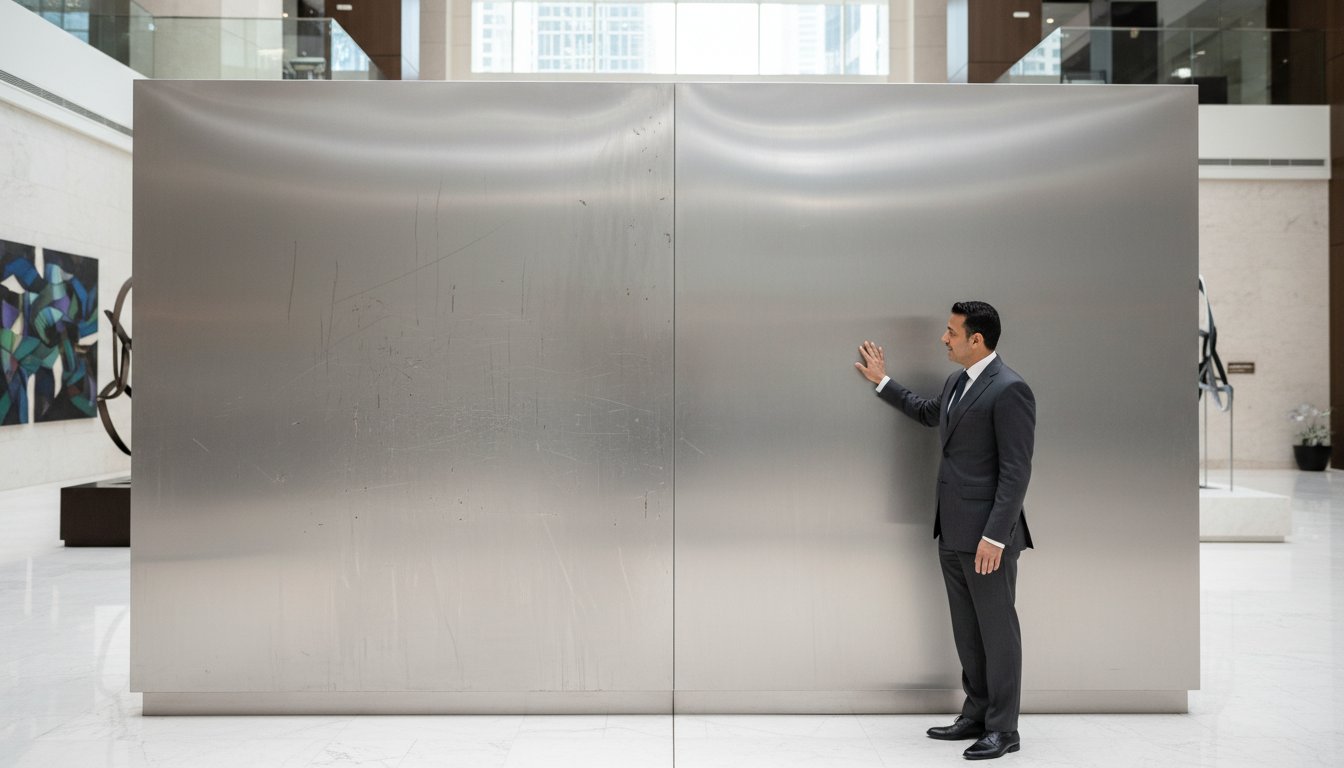
A single deep scratch on a stainless steel elevator door or widespread discolouration on an architectural panel can create a poor impression and trigger a costly replacement cycle. For facility managers and property owners across the UAE, the expense of replacing large metal fixtures-often running into tens of thousands of Dirhams-is a significant financial concern. Compounding this is the uncertainty: can this surface be repaired, or will an attempt with the wrong cleaning agent cause irreparable harm?
This guide provides the definitive answers. We will explore the most common metal finishes found in modern construction, from brushed steel to anodized aluminum and polished brass. You will gain the technical knowledge to accurately identify different finishes, understand their specific vulnerabilities, and recognise when a surface is a prime candidate for restoration. Our objective is to empower you to move beyond the expensive ‘replace’ mindset and embrace advanced repair solutions that restore surfaces to their original condition for a fraction of the cost.
Understanding the Fundamentals: What Are Metal Finishes?
Metal finishing is a critical industrial process that modifies the exterior of a metallic object to achieve a desired aesthetic or functional property. The primary objectives are twofold: enhancing the visual appeal and increasing durability. This treatment is applied to a wide range of base metals commonly found in commercial properties across the UAE, including stainless steel, aluminium, and brass. For a complete technical overview of the methods involved, Wikipedia offers an excellent resource on the fundamentals of surface finishing.
A professionally applied finish delivers tangible benefits that protect an asset and reduce long-term operational costs. Key advantages include:
- Corrosion Resistance: Creates a protective barrier against moisture and environmental contaminants, preventing rust and degradation, which is especially important in the UAE’s coastal climate.
- Enhanced Durability: Increases hardness and resistance to scratches, dents, and daily wear and tear in high-traffic commercial environments.
- Aesthetic Improvement: Achieves a specific look, such as a reflective polish, a uniform matte texture, or a specific colour, to align with architectural and brand standards.
Mechanical, Chemical, and Coated Finishes: What’s the Difference?
The vast array of available metal finishes can be classified into three primary categories. Understanding these distinctions is crucial, as the type of finish directly impacts its performance, longevity, and the methods required to rectify any surface damage.
- Mechanical Finishes: These physically alter the metal’s surface texture through abrasion. Examples include brushing, which creates fine parallel lines, and polishing, which produces a smooth, mirror-like surface.
- Coated Finishes: These involve applying a distinct layer of material over the base metal. Common methods include powder coating and painting, which add colour and a protective film.
- Chemical Finishes: These use chemical reactions to change the properties of the metal’s surface layer. Anodizing aluminium or passivating stainless steel are prime examples that enhance corrosion resistance.
The original finishing method dictates the correct approach for restoration. A coated finish with a deep scratch cannot be polished; it requires specialist repair and re-coating techniques to achieve a seamless result.
Why a Professional Finish Matters in Commercial Spaces
In the competitive landscape of Dubai and Abu Dhabi, the appearance of a commercial property directly reflects on the brand. For hotels, corporate offices, and luxury retail outlets, the quality of metal fixtures-from lift doors and lobby accents to architectural cladding-is a critical touchpoint. A pristine, well-maintained finish conveys professionalism and attention to detail.
This focus on high-quality fixtures is often part of a broader design strategy that includes sourcing exceptional luxury furniture Dubai to create a cohesive, premium atmosphere.
Beyond aesthetics, durability is paramount. High-traffic areas are subjected to constant contact, impacts, and cleaning. A professionally specified and applied finish is engineered to withstand this demanding environment, preventing premature failure. This investment significantly reduces long-term maintenance costs, minimising the need for costly replacements and ensuring that facilities operate without disruption, ultimately saving thousands of Dirhams over the asset’s lifecycle.
Common Mechanical Finishes: Texture, Sheen, and Repairability
Mechanical finishes are achieved by physically abrading or texturing a metal’s surface to control how it reflects light. Unlike chemical processes, which alter the metal’s surface composition as detailed in this comprehensive EPA guide to metal finishing, mechanical methods rely on grinding, polishing, or blasting. The resulting texture dictates the sheen, from a perfect mirror to a completely dull matte. Understanding these common metal finishes is critical for specifying materials and planning for their long-term maintenance and repair.
Polished & Mirror Finishes (#8)
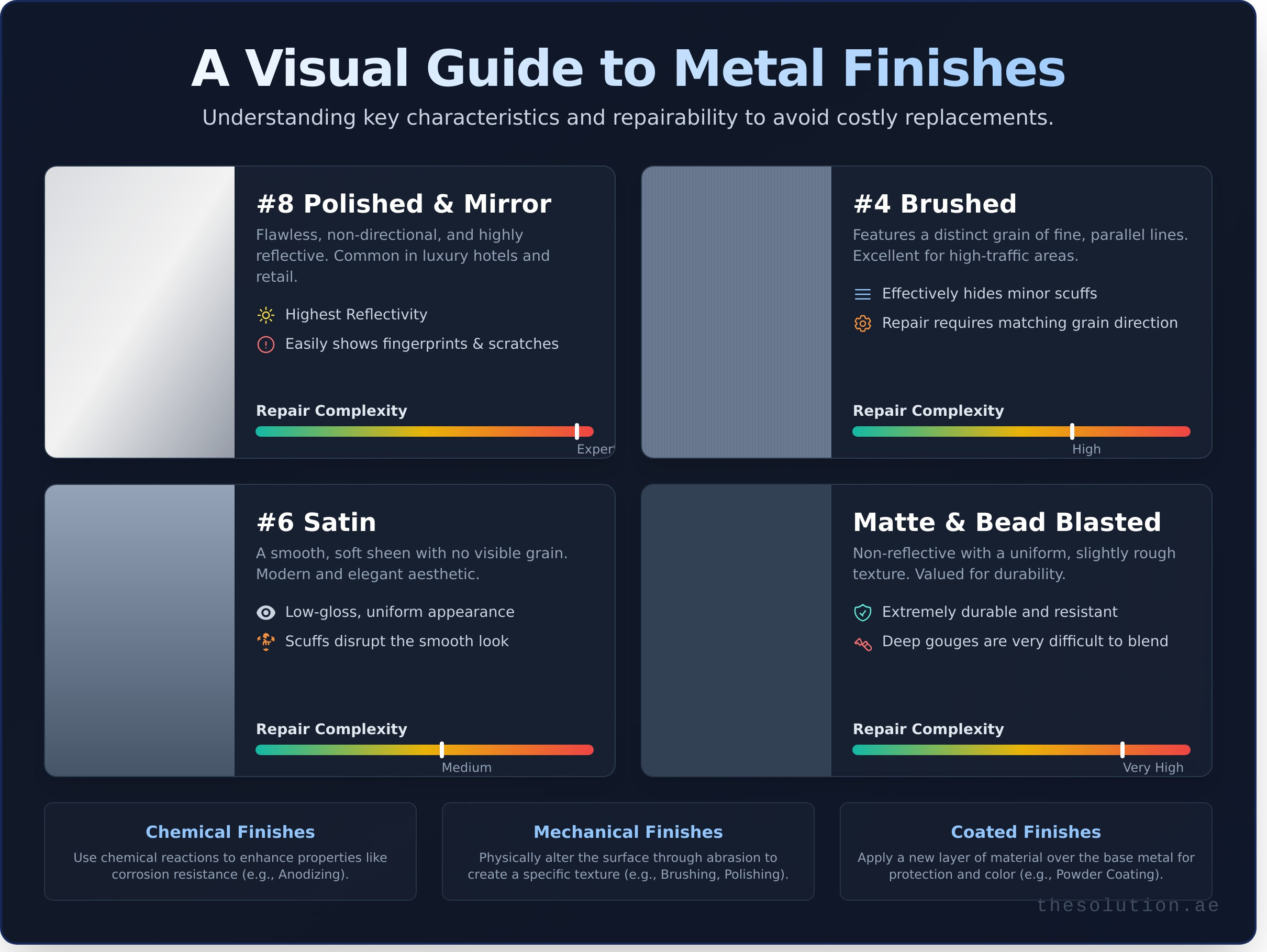
A #8 mirror finish is the most reflective, offering a flawless, non-directional surface. It is frequently specified in the UAE for high-end applications such as architectural trim in luxury hotels, premium retail fixtures, and elevator interiors. While visually stunning, this finish is highly susceptible to showing fingerprints, smudges, and fine scratches. Damage can be rectified, but it requires highly skilled technicians to re-polish the surface and restore its perfect reflective quality without distortion.
Brushed Finishes (#4)
Characterised by fine, parallel polished lines, a #4 brushed finish has a distinctive grain that effectively diffuses light. This quality makes it a practical and popular choice for stainless steel appliances, elevator doors, wall panels, and kick plates in high-traffic commercial areas. It excels at hiding minor scuffs and wear. However, deep scratches that run against the grain are highly visible and require expert repair to blend seamlessly by matching the original grain direction and depth.
Satin Finishes (#6)
A satin finish offers a smooth, soft sheen that sits between a brushed and a matte look, with no visible grain lines. It provides a modern, elegant appearance ideal for door handles, bathroom fixtures, and window frames. Its uniform, low-gloss surface is prone to showing scratches or scuffs that disrupt the smooth look. Repairing this finish is a meticulous process that requires specialised blending techniques to avoid a patchy or uneven appearance, restoring its original lustre.
Matte & Bead Blasted Finishes
These finishes are non-reflective and have a dull, slightly rough or pebbled texture created by blasting the surface with media like glass beads or sand. Valued for their durability and industrial aesthetic, they are used for modern architectural elements and heavy-duty components. While extremely resistant to minor abrasions, rectifying deep gouges is a significant challenge. A localised repair is often impossible to blend, sometimes making re-blasting the entire component necessary-a potentially costly endeavour that our on-site solutions can often prevent.
Coated & Chemical Finishes: Colour and Corrosion Resistance
Unlike mechanical finishes that alter the existing surface, coated and chemical finishes add a new layer to the metal or chemically change its top layer. Their primary functions are to provide a specific colour or aesthetic and to offer superior protection against corrosion and wear. When these advanced metal finishes are damaged, the repair process is fundamentally different. Damage typically involves a breach, such as a chip, peel, or deep scratch, which exposes the vulnerable base metal underneath. Rectifying this requires specialist techniques to restore the protective layer.
Powder Coating
This highly durable finish is created by electrostatically applying a dry powder to a metal surface, which is then cured with heat to form a hard, protective skin. It is exceptionally common in the UAE for its resilience in harsh weather, seen on aluminium window frames, outdoor furniture, and large-scale building facades. While robust, impact can cause chips and deep scratches. Repair involves meticulous on-site preparation and colour-matched spraying to seamlessly restore the finish and its protective qualities, avoiding the costly replacement of the entire panel or component.
This finish is also a top choice for large residential fixtures exposed to the elements, such as the custom products offered by Door Supply, where durability is key.
Anodized Finishes (Primarily Aluminum)
Anodizing is an electrochemical process that thickens the natural oxide layer on a metal’s surface, making it extremely hard and corrosion-resistant. This premium finish is integral to products like smartphone bodies, high-specification architectural cladding, and window frames. Although incredibly tough, an anodized surface can be damaged by deep scratches or harsh chemicals. Repairing this type of finish is a highly specialised task, as the colour is integral to the surface itself. Our technicians utilise innovative techniques to rectify damage and restore the uniform appearance without compromising the surrounding area.
Plated Finishes (Chrome, Brass, Nickel)
Plating involves bonding a thin layer of a decorative metal, such as chrome or nickel, onto a base metal like steel or zinc. This finish is prevalent in high-end residential and hospitality settings on items like bathroom taps, door handles, and decorative trim. Scratches, scuffs, or chemical damage can wear through the thin plating, exposing the base metal to corrosion. While complete replating is a disruptive and expensive off-site process, specialist on-site repairs can often restore the damaged area, providing a cost-effective solution that saves thousands of Dirhams (AED) and minimises downtime.
Assessing Damage: A Facilities Manager’s Guide to Metal Finishes
For facilities managers in the UAE, maintaining the pristine appearance of architectural elements is paramount. A precise initial damage assessment is the first step toward a swift and cost-effective resolution. By accurately identifying the type and severity of damage to your metal finishes, you can expedite the quoting process and ensure the correct restoration technique is employed from the outset.
How to Identify Your Metal Finish
A correct identification is critical for determining the appropriate repair method. Use this simple checklist to gather essential information:
- Polished vs. Brushed: Does the surface have a mirror-like reflection (polished), or can you see fine, uniform grain lines (brushed)?
- Coated Finishes: Note the colour and texture. Powder-coated or painted finishes have a distinct layer that can chip or peel, unlike raw metal.
- Metal Type: Use a small magnet. If it sticks, the material is likely stainless steel. If it does not, it could be aluminum or a non-magnetic grade of stainless steel.
Evaluating the Severity of Damage
Understanding the difference between superficial and deep damage is key to managing repair expectations and costs. The primary distinction lies in whether the damage has penetrated beyond the surface layer of the finish.
- Surface Scuffs vs. Deep Scratches: Perform the fingernail test. If your nail glides over the mark, it is a surface scuff that can often be polished out. If your nail catches in the groove, it is a deep scratch that requires a more intensive, specialist repair.
- Dents and Dings: Assess the location and depth of impact damage. Dents on flat panels are more straightforward to rectify than those on complex curves or corners.
- Staining and Corrosion: Identify the cause if possible. Chemical stains from harsh cleaners and rust spots (corrosion) require specific treatments to neutralise the damage before cosmetic restoration can begin.
Repair vs. Replace: Making the Right Financial Decision
When faced with damaged metal surfaces, restoration is almost always the superior financial and logistical choice. On-site repair by skilled technicians eliminates the high costs of manufacturing, shipping, and installation associated with full replacement. The benefits are clear:
- Cost-Effectiveness: On-site restoration is typically 50-80% more affordable than replacing an entire panel, elevator door, or architectural feature.
- Minimal Downtime: Repairs are completed quickly and efficiently, minimising disruption to tenants, guests, and daily operations.
- Sustainability: Restoring existing assets is the environmentally responsible option, reducing landfill waste and the carbon footprint of manufacturing new materials.
Before committing to a costly replacement, let our technicians provide a detailed evaluation. Get a professional damage assessment from our experts.
Professional On-Site Restoration for Metal Finishes
While routine care can maintain the appearance of most surfaces, significant scratches, dents, and chemical damage often require professional intervention. Attempting complex repairs without the correct tools and expertise can lead to further, often irreversible, damage. Replacing fixtures, panels, or architectural elements is a costly and disruptive process. The Solution provides a superior alternative: on-site restoration that rectifies damage and renews your assets for a fraction of the replacement cost.
Our highly skilled technicians are proficient in a wide range of innovative techniques designed to restore all types of metal finishes to their original condition, directly at your location.
Techniques for Restoring Mechanical Finishes
Mechanical finishes demand meticulous attention to detail to achieve a flawless result. Our specialists are adept at rectifying damage on these surfaces through proven methods:
- Precision Polishing: We remove scratches, scuffs, and imperfections from mirror-polished stainless steel and chrome, restoring a perfect, reflective surface.
- Expert Re-graining: Our technicians skillfully replicate the original grain pattern on brushed and satin finishes, ensuring any repair is completely invisible.
- Specialist Compounds: We use advanced compounds to seamlessly blend repairs on matte and satin surfaces, eliminating any sign of previous damage.
Solutions for Coated and Chemical Finishes
Damage to coated or chemically treated metals requires a different set of advanced skills. We have developed a range of repair solutions to rectify issues on these sensitive surfaces:
- Expert Colour-Matching: We perform on-site repairs to powder-coated and painted metal, perfectly matching the original colour and sheen.
- Seamless Chip & Gouge Repair: Using specialist fillers and resins, we can flawlessly repair deep scratches, chips, and dents in coated surfaces.
- Anodized & Plated Surface Restoration: We employ specific techniques to address damage on anodized aluminium and plated finishes, preserving their unique protective and aesthetic qualities.
Why Choose The Solution for Metal Finish Repair in the UAE
When it comes to restoring high-value metal finishes in the UAE’s demanding commercial environment, expertise and efficiency are paramount. We are the premier choice for businesses seeking to avoid the high costs and operational downtime associated with replacement. Our technicians are fully trained in damage assessment and execute every repair with precision. By working on-site, we minimize disruption to your operations, whether on an active construction site, in a functioning hotel, or within a busy commercial facility. Our proven track record across the hospitality, construction, and facilities management sectors makes us the trusted partner for protecting your investment. To learn more about our capabilities, visit thesolution.ae.
Expert Restoration: The Intelligent Choice for Your Metal Surfaces
Understanding the distinction between mechanical, coated, and chemical finishes is fundamental to their longevity. A proficient damage assessment allows for a strategic approach, often revealing that professional on-site restoration is a far more intelligent and cost-effective solution than outright replacement, protecting your initial investment.
For facilities managers and property owners across the UAE, rectifying damage to high-value metal finishes is a critical operational and financial decision. The Solution provides a proven alternative. Trusted by leading construction and hospitality brands, our specialized on-site service minimizes operational downtime and achieves remarkable savings of 50-80% compared to the cost of replacement. We restore your surfaces to their original specification with exceptional quality, safeguarding your brand’s image and your budget.
Take the first step towards flawless surfaces. Request your no-obligation quote for metal surface restoration today and discover the significant benefits of expert repair.
Frequently Asked Questions
What is the most durable metal finish for high-traffic commercial areas?
For high-traffic commercial environments in the UAE, such as hotel lobbies or retail entrances, powder coating provides superior durability. This finish creates a thick, hard layer that is highly resistant to scratches, chipping, and fading from UV exposure. Another premium option is Physical Vapor Deposition (PVD), which offers exceptional hardness and corrosion resistance, making it ideal for high-touch fixtures and architectural elements that must withstand constant use and maintain a pristine appearance.
Can you repair a deep scratch on a brushed stainless steel elevator door?
Yes, rectifying deep scratches on brushed stainless steel is a specialist task that we perform regularly. Our highly skilled technicians use innovative re-graining techniques and specific abrasive compounds to meticulously blend the repair with the surrounding surface. This process restores the original directional grain and appearance, avoiding the significant cost of replacing the entire door panel, which can save clients thousands of Dirhams and minimise operational disruption.
How do you match the colour for a powder-coated surface repair?
We employ a precise, technical process to ensure a perfect colour match. Our technicians use digital spectrophotometers to analyse the exact colour and sheen of the existing surface. This data is cross-referenced with industry-standard colour systems like RAL to formulate a matching coating on-site. This meticulous approach guarantees that our repair is completely indistinguishable from the original powder-coated finish, maintaining the aesthetic integrity of the asset.
Is it possible to change the finish of an existing metal installation?
Absolutely. Refinishing an existing metal installation is an intelligent and cost-effective alternative to a full replacement. For example, our teams can transform dated polished brass fixtures to a modern brushed nickel or change polished stainless steel to a satin finish directly on-site. This service allows for a complete aesthetic update with minimal disruption to your business operations, delivering significant savings compared to the cost of new fabrication and installation.
What is the difference between a satin and a brushed finish?
The primary distinction between these popular metal finishes lies in the surface texture and grain. A brushed finish is created by abrading the metal with a brush, producing fine, parallel lines that give it a distinct directional pattern. In contrast, a satin finish has a smooth, low-gloss lustre with no visible grain lines, achieved by blasting the surface. The choice depends on the desired aesthetic, with brushed finishes hiding minor scratches better and satin finishes offering a more uniform, softer look.
How do I clean and maintain my metal fixtures without damaging the finish?
To preserve the integrity of your metal fixtures, always use a soft microfibre cloth with a pH-neutral cleaning solution and water. Aggressive or abrasive cleaners, scouring pads, and acidic substances can permanently damage the protective layer of the finish. For brushed surfaces, it is crucial to wipe in the direction of the grain to avoid creating micro-scratches. Consistent, gentle cleaning is the most effective method for long-term maintenance.


