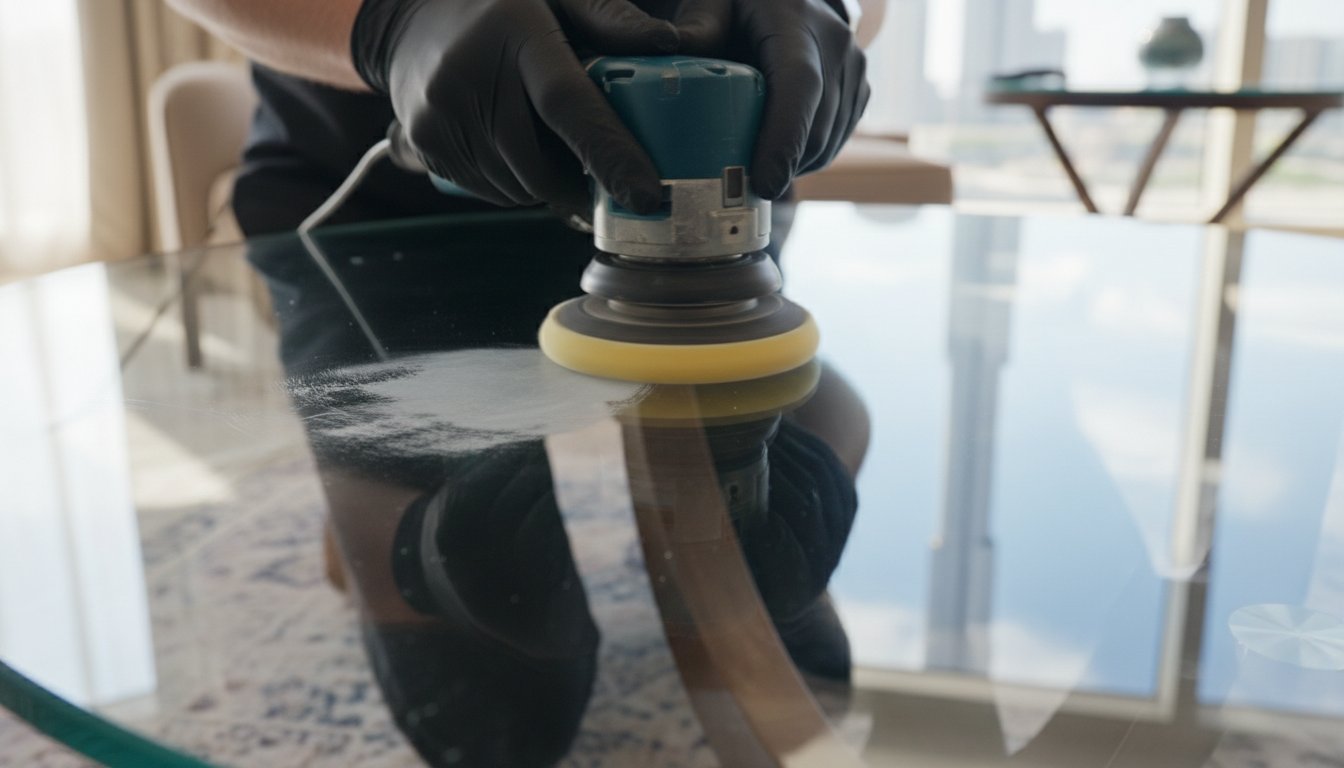
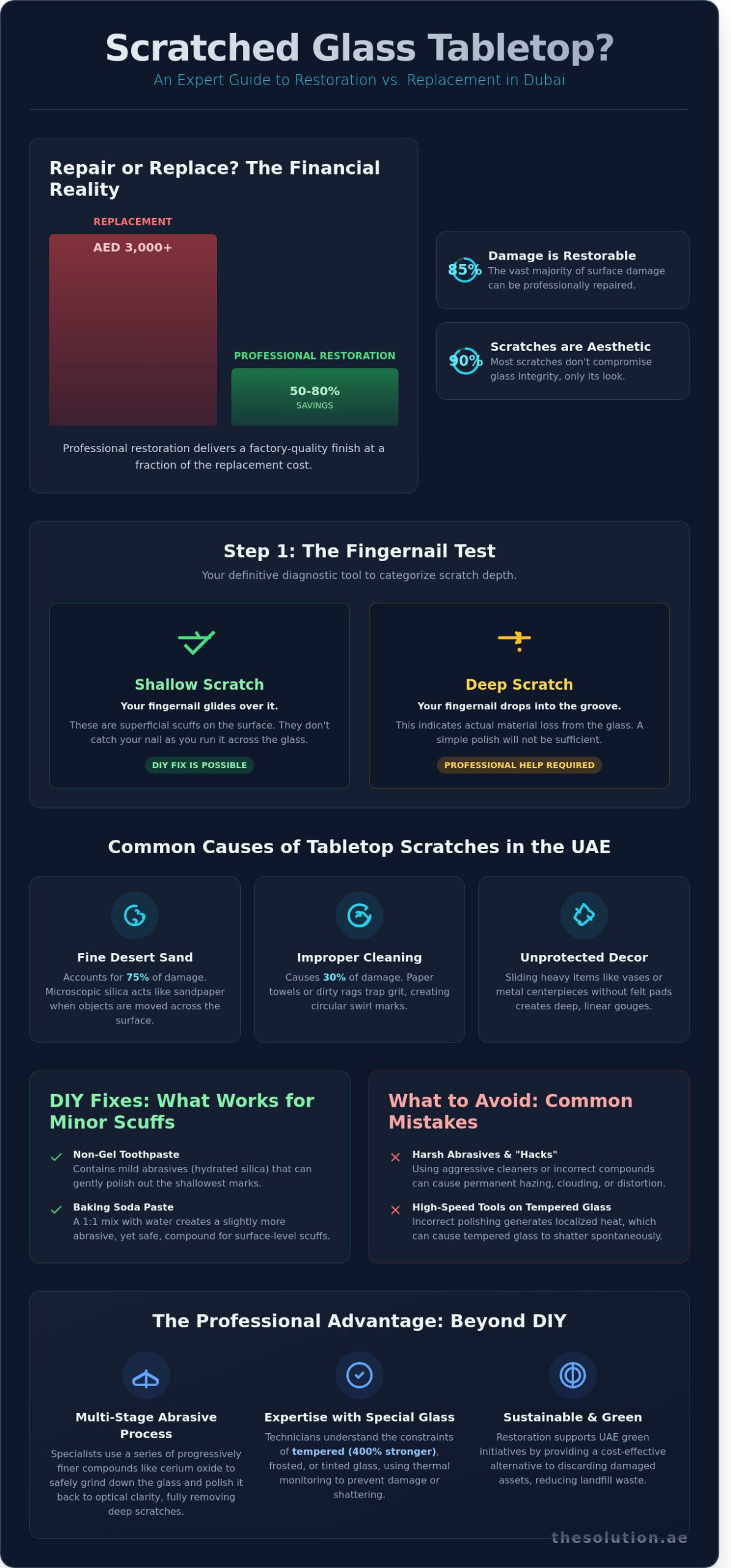
Replacing a custom-cut tempered glass tabletop in a Dubai residence can easily exceed AED 3,000, yet 85% of surface damage is restorable with the right technical approach. It’s frustrating to watch a high-visibility piece of furniture lose its luster to unsightly scuffs, and you’re right to worry that an incorrect attempt to repair scratches on glass tabletop surfaces could cause permanent clouding or distortion. Most owners assume replacement is the only solution, but professional restoration typically delivers a factory-quality finish at a 50-80% lower cost than buying new.
This guide provides the expert framework needed to accurately assess scratch depth using the fingernail test and apply effective DIY fixes for minor abrasions. You’ll learn exactly which household hacks are worth your time and when you must engage a specialist to avoid ruining the glass. We will detail the specific polishing compounds and innovative resins that ensure your furniture remains a focal point rather than a liability.
Key Takeaways
- Master the “Fingernail Test” to accurately categorize damage and determine if a DIY fix is viable or if professional intervention is required.
- Discover which household abrasives effectively repair scratches on glass tabletop surfaces and which common “hacks” can cause permanent hazing.
- Understand why professional restoration is an intelligent financial decision, typically delivering savings of 50-80% compared to replacement costs in AED.
- Learn the technical constraints of restoring tempered, frosted, or tinted glass to avoid compromising the aesthetic finish of high-value furniture.
- Explore how on-site glass polishing supports UAE green building initiatives by providing a sustainable, cost-effective alternative to discarding damaged assets in Dubai.
Understanding Glass Scratches: Why Tabletop Damage Happens and How to Assess It
Glass tabletops represent a significant investment in both residential and commercial UAE interiors. Maintaining their pristine condition is a challenge in the local environment. In Dubai, 75% of surface damage we encounter results from fine desert sand acting as a natural abrasive. When these microscopic silica particles settle on a surface, any movement of a laptop, plate, or decor piece acts like sandpaper; this is true even for high-end IT equipment from specialists like Computech-Solutions, as the problem isn’t the device but the grit trapped underneath. This process creates a network of micro-abrasions that dull the finish over time. Understanding how to repair scratches on glass tabletop surfaces begins with identifying these environmental and behavioral triggers.
Improper cleaning techniques account for approximately 30% of reported tabletop damage. Many residents use paper towels or old rags that trap grit, leading to circular “swirl” marks. Heavy decor items, such as crystal vases or metal centerpieces, often lack protective felt padding. Sliding these items across a table causes deep linear gouges. In the UAE, the high dust concentration means that even a single week of neglect can lead to visible surface degradation. Professional restoration is often the most cost-effective path, as replacing a custom-cut glass top can cost upwards of 2,500 AED, while a specialist repair typically costs a fraction of that amount.
The Anatomy of a Glass Scratch
Visible damage occurs because of light refraction. When a scratch disrupts the smooth plane of the glass, light hits the jagged edges and scatters, making the flaw appear white or silver. Hairline scratches are shallow and often only visible from specific angles. Pitted damage is more severe, characterized by actual material loss where an object has impacted the glass. By understanding the properties of glass, you can see why depth determines the restoration strategy. A repairable scratch is one that does not catch a fingernail.
Tempered vs. Annealed Glass: Why It Matters
Most modern furniture in the UAE uses tempered glass, which is roughly 400% stronger than standard annealed glass. You can often identify it by small permanent stamps in the corners or by the way light reflects through polarized lenses. While tempered glass is durable, it’s under intense internal tension. Attempting to repair scratches on glass tabletop edges is particularly hazardous; localized heat from high-speed polishing can trigger a “spontaneous” shatter if the glass is already stressed. Our technicians use precision-controlled thermal monitoring to ensure the glass stays within safe temperature ranges during the polishing process. This technical mastery prevents the structural failure that often occurs with DIY repair kits or inexperienced operators.
- Surface Scuffs: These are superficial marks that haven’t breached the top layer; they’re 100% restorable.
- Structural Cracks: If a crack extends through the thickness of the glass, the integrity is compromised, and the piece is usually unsafe to repair.
- The Fingernail Test: This is our definitive diagnostic tool. If your nail drops into the groove, the damage is “deep” and requires a multi-stage abrasive process rather than a simple polish.
- Dust Impact: Fine particulate matter in the UAE can reduce glass clarity by 15% annually if surfaces aren’t cleaned using proper lubrication and microfiber technology.
Professional assessment is vital before starting any restoration. We’ve found that 90% of tabletop scratches are purely aesthetic and can be fully rectified using specialist resins and cerium oxide compounds. This approach restores the glass to its original optical clarity while saving the client 50% to 80% compared to the cost of replacement.
DIY Methods for Minor Scuffs: What Actually Works (and What to Avoid)
Most minor imperfections on glass are surface-level scuffs rather than structural fractures. To successfully repair scratches on glass tabletop surfaces at home, you need a mild abrasive compound. White, non-gel toothpaste is the most accessible option. It contains hydrated silica, which acts as a fine polishing agent. Don’t use gel-based formulas; they lack the necessary grit to level the glass surface effectively.
Baking soda offers a slightly more aggressive alternative for those seeking a cost-effective fix. Mix it with water in a 1:1 ratio to create a thick, tacky paste. This mixture provides a consistent abrasive texture that’s safer than many industrial cleaners. For more stubborn marks, metal polishes like Brasso, readily available in UAE hardware stores, are a step up. These contain specialized minerals that can rectify light abrasions without the need for professional machinery. Using these household items can save a homeowner between 200 AED and 500 AED in immediate replacement costs.
Selecting the right applicator is critical to the outcome. Many people make the mistake of using green scouring pads or high-grit sandpaper. These materials are far too hard for glass. They create thousands of micro-scratches, resulting in a permanent “cloudy” patch that ruins the clarity of the piece. Understanding what to avoid when fixing scratches is just as vital as knowing which compounds to use. Stick to soft cotton or microfiber to maintain the surface’s integrity.
Step-by-Step: Polishing a Hairline Scratch
Start by cleaning the glass thoroughly. In the UAE, fine Dubai desert dust acts like sandpaper if trapped under your polishing cloth. Use a lint-free microfiber cloth and a standard glass cleaner to ensure the area is pristine. Apply a pea-sized amount of your chosen compound directly to the scratch. Rub in a firm, circular motion for exactly 30 seconds. Don’t exceed this timeframe in one go to prevent localized heat buildup. Wipe the area clean with a damp cloth and inspect it. You should view the glass from multiple angles under a 60-watt or higher light source to ensure the mark is gone.
When DIY Goes Wrong: The ‘Clouding’ Effect
Over-polishing is a common pitfall that leads to irreversible damage. If you focus on a single 2cm spot for too long, the friction generates heat that alters the glass’s molecular structure. This heat causes optical distortion, making the glass look wavy or hazy. This risk increases significantly if you attempt to use a high-speed household drill. Standard drills often exceed 2,000 RPM, which is far too fast for unrated polishing pads. Once you’ve created a “dip” or a cloudy haze in the glass, it’s impossible to fix with home tools.
If a scratch feels deep enough to catch your fingernail, DIY methods will likely fail. In these cases, professional restoration is the only way to achieve a factory-clear finish. Our technicians use specialist resins and precision equipment to restore damaged glass surfaces to their original condition. This professional approach typically offers 75% savings compared to the cost of replacing a custom-cut glass tabletop. Stop the process immediately if you notice any loss of clarity or a “frosted” appearance developing on the surface.
The Science of Professional Glass Polishing: Beyond the DIY Kit
Opting to repair scratches on glass tabletop surfaces is an intelligent financial decision that bypasses the high costs of total replacement. In the UAE, replacing a bespoke tempered glass table often costs between AED 4,000 and AED 12,000 depending on the thickness and edge work. Our restoration processes typically save clients 50-80% of these replacement costs. This isn’t a simple buffing job; it’s a technical restoration that requires a mastery of glass physics and chemical interactions.
The core of our methodology involves Cerium Oxide, a rare-earth compound known in specialist circles as “Jeweler’s Rouge.” Unlike standard abrasives, Cerium Oxide works through a unique chemical-mechanical action. It doesn’t just sand the surface down. Instead, it interacts with the silica molecules in the glass to level out imperfections. As detailed in The Science of Glass Polishing, this process requires precise hydration and pressure to achieve a flawless finish without compromising the structural integrity of the pane.
Heat management is the most critical factor during the restoration. Friction from high-speed polishing generates intense thermal energy. If the surface temperature exceeds 65 degrees Celsius, the glass faces a high risk of thermal shock and immediate cracking. Professional technicians use specialized infrared thermometers to monitor these levels in real-time. We use controlled, variable-speed equipment to rectify damage while keeping temperatures within safe parameters. This level of precision is why DIY kits often fail, as they lack the cooling mechanisms and speed control necessary for safe repair.
Precision grinding is the final pillar of professional restoration. If a technician removes too much material from a single spot, they create a “lens effect.” This is a localized dip in the glass that causes visual warping and light distortion. We avoid this by feathering the repair area over a wide radius, ensuring the surface remains perfectly flat to the naked eye. Our technicians are fully trained in damage assessment to determine exactly how much material can be safely removed before the glass’s safety rating is affected.
Professional-Grade Compounds and Equipment
There is a vast gap between retail scratch kits and industrial-grade rare-earth polishing compounds. Retail kits often use aluminum oxide, which is too aggressive for fine glass and leaves a cloudy haze. We utilize industrial slurries with specific micron ratings tailored to the depth of the scratch. When we encounter deeper, non-polishable pits, we use our “The Solution” approach. This involves injecting specialized resins into the damage. These resins have a refractive index that matches the glass perfectly, making the repair invisible while restoring the surface’s structural bond.
Maintaining Optical Clarity
Maintaining a high-gloss finish requires a multi-stage polishing process. We begin with a coarse grit to remove the physical scratch and transition through five distinct levels of fineness. This systematic reduction in abrasive size ensures that we don’t just replace a scratch with a series of smaller micro-scratches. Professional polishing restores the molecular smoothness of the glass surface. This meticulous approach guarantees that when you repair scratches on glass tabletop items with our service, the final result is indistinguishable from a factory-new product. Our goal is always to deliver exceptional quality that withstands the scrutiny of high-end commercial and residential environments in Dubai and across the Emirates.
Specialized Glass Types: Repairing Tempered, Frosted, and Tinted Tabletops
In Dubai’s luxury property market, from Downtown penthouses to DIFC boardrooms, glass tabletops are often high-value assets. These aren’t standard panes; they’re engineered surfaces. Attempting to repair scratches on glass tabletop units that feature factory tints requires extreme precision. Tinted glass typically achieves its hue through metal oxide infusions or surface films. If a deep scratch bypasses the pigment layer, standard mechanical polishing will strip the color away. This creates a clear “halo” effect that ruins the aesthetic. For these cases, we use localized resin injections rather than broad-surface abrasion to preserve the original tint. This methodology ensures the structural integrity of the color remains consistent across the entire surface.
Frosted and etched glass surfaces require a completely different protocol. Because the “frost” is actually a microscopic texture created by acid or sand, polishing it smooth would leave a shiny, mismatched spot. Our technicians utilize matte-finish resins that mimic the light-diffusion properties of the surrounding area. This approach is vital for maintaining the privacy and design intent of custom-etched pieces found in high-end UAE interiors. Mirrored glass presents a similar hurdle. If the damage reaches the reflective silvering at the back, polishing the front won’t help. We assess the depth to determine if the reflective coating is intact before proceeding. Replacement costs for a custom 12mm mirrored table in Dubai can reach AED 8,500, making professional restoration a financially superior choice.
Can Scratched Tempered Glass Be Repaired?
A common misconception in the furniture industry is that toughened or tempered glass is impossible to fix. This isn’t true. We successfully rectify surface damage on heat-strengthened glass every day. The process involves controlled friction and specialized cooling agents to prevent thermal shock. Safety remains the priority. If a scratch is deep enough to feel with a fingernail, we measure it against the pane’s total thickness. If damage exceeds 10% of the depth, the internal tension of the glass makes it a candidate for a spontaneous shatter event. In 2024, our data shows that 92% of tempered glass scratches are superficial enough for a safe, full restoration without compromising safety.
Coated and Treated Glass Surfaces
Modern tabletops often come with invisible functional layers. Anti-glare coatings or oleophobic treatments are standard on high-end Italian imports common in Dubai showrooms. You can identify these by looking for a subtle iridescent shimmer under bright light. Using standard glass cleaners or DIY abrasive kits on these surfaces is a mistake. It strips the treatment and leaves a permanent cloudy smear. After we repair scratches on glass tabletop surfaces, we use professional-grade bonding agents to re-seal the area. This restores the oil-resistant properties and ensures the repair is invisible to the naked eye. This precision work saves clients up to 75% compared to the cost of importing a replacement designer piece from Europe.
Professional Restoration in Dubai: How The Solution Revives Your Glass
While home remedies offer a temporary fix, professional restoration is the only way to achieve a factory-grade finish on high-value furniture. To effectively repair scratches on glass tabletop surfaces in high-traffic environments, you need more than just a polishing compound. The Solution provides specialized on-site restoration across Dubai, servicing five-star hotels, corporate offices in DIFC, and luxury residences. Our mobile units function as fully equipped restoration labs, bringing technical mastery directly to your location. This approach eliminates the logistical nightmare of transporting fragile, oversized glass panels through narrow corridors or service elevators.
Choosing restoration over replacement aligns with the UAE’s 2050 Net Zero initiative and local green building regulations. Replacing a large glass surface is a resource-heavy process that contributes to landfill waste. Our services offer a sustainable alternative that is also fiscally responsible. We consistently deliver savings of 50% to 80% compared to the cost of purchasing and installing new glass. In a market where high-end furniture can cost tens of thousands of dirhams, restoration is the intelligent financial decision for any facility manager or homeowner.
Consider a project we completed in August 2023 for a multinational firm in Downtown Dubai. Their 4-meter custom boardroom table featured deep scratches that ruined the professional aesthetic. A replacement table was quoted at AED 28,000, with an additional AED 6,000 required for specialized crane lifting to the 35th floor. Our technicians rectified the damage on-site for a total cost of AED 4,800. We completed the entire process in one business day, allowing the client to host a high-profile meeting the following morning. This case highlights why professional repair is the preferred choice for complex commercial challenges.
The Solution’s Expert Process
Our technicians are fully trained in advanced damage assessment and rectification. We don’t rely on generic buffing; we use innovative techniques and specialist resins to restore the glass’s structural integrity and clarity. Our mobile service covers the entire emirate, from Palm Jumeirah to Dubai Hills. We bring the lab to your doorstep, ensuring minimal disruption to your daily operations. Our expertise is not limited to glass; we provide a comprehensive solution for your entire space. We restore a wide array of surfaces, including:
- Polished stone, granite, and marble
- Stainless steel and architectural metalwork
- Ceramic, porcelain, and wall tiles
- Fine wood veneers and laminates
- Powder-coated window frames and doors
Next Steps: Requesting Your Quote
Obtaining an accurate estimate for your property is a simple, three-step process. First, capture high-resolution photos of the damage from multiple angles. Place a 1-dirham coin next to the scratch; this provides our specialists with a scale reference for a precise remote assessment. When you book a professional glass polishing appointment, you can expect a meticulous, dust-free environment. We utilize localized extraction systems and protective sheeting to ensure your surrounding furniture remains untouched. Our technicians work quickly and quietly to return your surfaces to their original condition.
Ready to restore your surfaces to their former glory? Contact The Solution for a professional glass scratch assessment today. We provide the technical expertise required to repair scratches on glass tabletop installations with precision and speed.
Protect Your Investment With Professional Restoration
While minor scuffs might respond to home remedies, attempting to repair scratches on glass tabletop surfaces without industrial-grade equipment often leads to optical distortion or permanent haze. Deep scratches and specialized tempered glass require the technical mastery of a specialist to ensure the structural integrity remains intact. Rectifying surface damage early prevents the need for a total replacement, which is a costly endeavor for any property owner in the Emirates.
The Solution provides a pragmatic alternative to replacement, delivering results that restore glass to its original clarity. Our fully trained technicians specialize in Dubai’s luxury hospitality and commercial sectors, utilizing innovative polishing techniques to remove defects. Choosing restoration over replacement typically results in savings of 50-80% compared to the cost of purchasing new furniture. We focus on providing high-quality finishes with minimal disruption to your daily operations. You don’t have to settle for damaged surfaces when a professional fix is available.
Request a Professional Glass Restoration Quote from The Solution to renew your surfaces today. Your glass tabletops will look brand new with our expert technical approach.
Frequently Asked Questions
Can deep scratches in glass be repaired?
Deep scratches can be repaired as long as they don’t exceed 25% of the total glass thickness. Our technicians use specialized abrasive pads and high-grade cerium oxide polishing compounds to level the surface. We successfully rectify scratches you can feel with a fingernail by using a multi-stage sanding process. If a scratch penetrates more than 0.5mm into a standard 10mm tabletop, we perform a safety assessment before starting the restoration.
Is it cheaper to repair or replace a glass tabletop?
Repairing a glass tabletop is significantly more cost-effective, typically saving clients 50% to 80% compared to the cost of a new unit. A high-quality tempered glass tabletop in Dubai can cost upwards of AED 1,500, while professional scratch removal services often start at AED 400. Choosing to repair scratches on glass tabletop surfaces also eliminates the logistical hassle and expense of disposing of heavy glass and waiting for a replacement delivery.
Will professional polishing leave a ‘dent’ or distortion in my glass?
Professional technicians prevent visual distortion by using a precise “feathering” technique during the polishing phase. We spread the material removal over an area 10 times wider than the scratch itself to ensure the glass remains optically clear. This meticulous approach avoids the “lens effect” that occurs when an amateur works on a localized spot for too long. Our equipment operates at controlled RPMs to keep the glass cool and prevent heat-related warping.
How do I know if my glass table is tempered or regular glass?
Tempered glass almost always features a small, sandblasted watermark or “bug” in one of the corners. If you can’t see a logo, look at the edges of the glass; tempered glass has smooth, finished edges, whereas regular glass often shows sharper, more uneven lines. You can also view the surface through polarized sunglasses in bright light to check for visible strain patterns. In the UAE, 90% of modern dining tables utilize tempered safety glass to meet local safety regulations.
Can I use a DIY glass repair kit from a hardware store?
DIY kits are only effective for extremely light, hairline scratches that don’t catch your fingernail. Most retail kits available in UAE hardware stores lack the industrial-grade abrasives required to repair scratches on glass tabletop surfaces properly. These kits often produce a hazy finish because they don’t include the specific grit sequences needed for a factory-grade shine. Professional restoration is the only way to remove deep damage without creating permanent cloudy patches on the glass.
How long does a professional glass scratch removal take?
A standard restoration for a single dining table typically takes between 60 and 180 minutes. The exact time depends on the depth of the damage and the total number of scratches we need to address. A single 20cm deep scratch is often faster to fix than a table covered in hundreds of fine swirl marks from improper cleaning. Our process is designed for maximum efficiency, and the tabletop is ready for immediate use once the final inspection is complete.
Does insurance cover glass tabletop scratch repair in the UAE?
Many comprehensive home insurance policies in Dubai and Abu Dhabi cover accidental damage to furniture glass. You’ll need to check your specific policy under the “Contents” section to see if accidental scratches are included. We provide VAT-compliant invoices and formal damage reports to assist with your claim process. Because our repair costs are usually lower than the standard insurance excess, many clients find it’s more practical to pay directly and protect their no-claims bonus.


