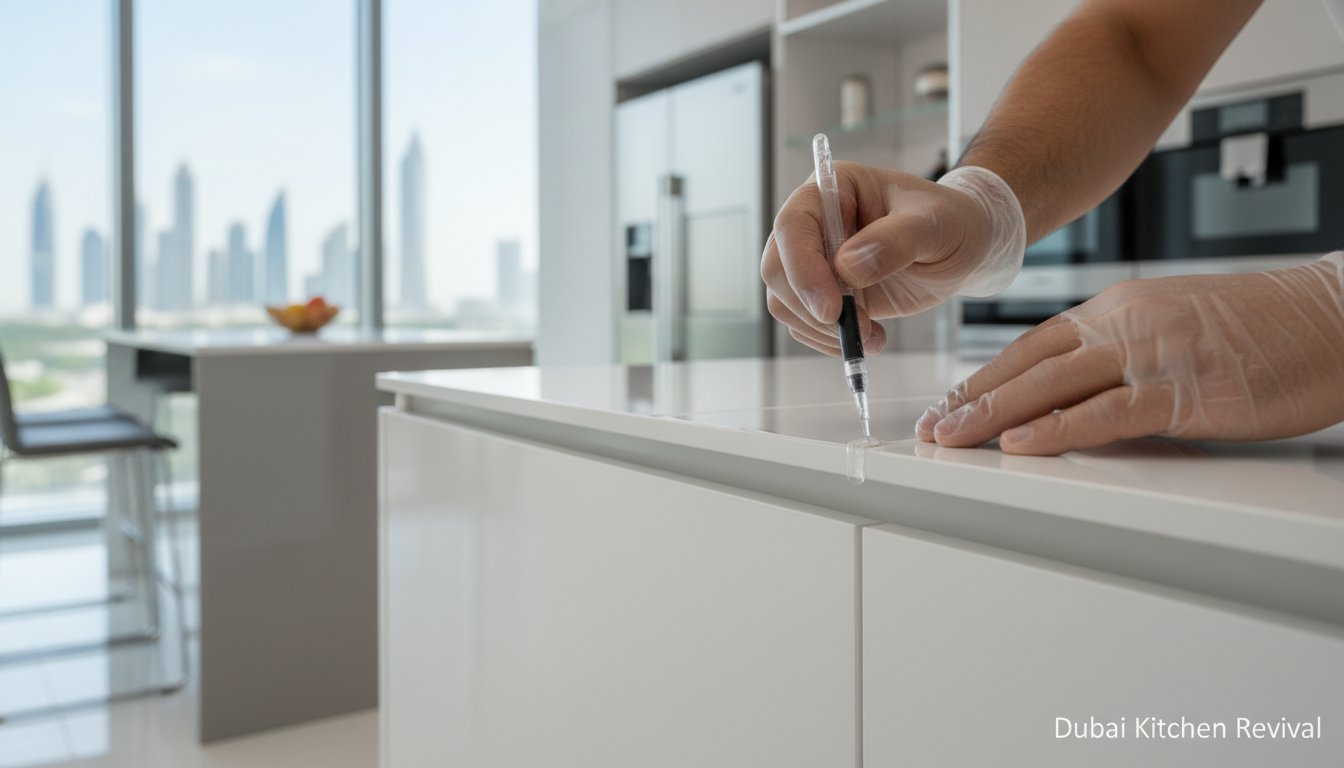
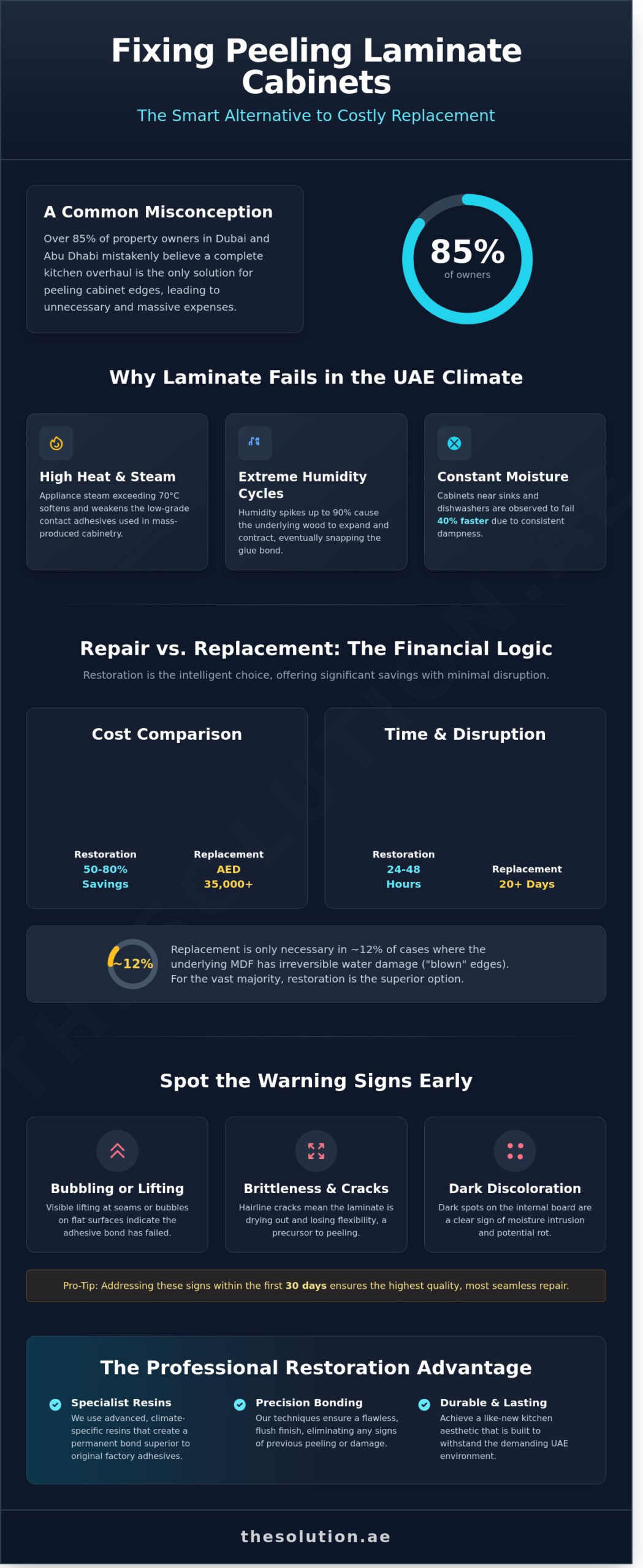
Over 85% of property owners in Dubai and Abu Dhabi mistakenly believe that once edges start lifting, a complete kitchen overhaul is the only viable solution. This misconception leads to unnecessary expenditures when fixing peeling laminate cabinets through professional restoration can achieve the same aesthetic result for a fraction of the price. You likely recognize the frustration of seeing unsightly, curling edges and fear the inevitable water damage to the underlying MDF. It’s discouraging to face replacement quotes exceeding AED 35,000 when the cabinet carcasses remain structurally sound.
We’ve developed a range of innovative repair solutions to rectify delaminated surfaces and restore your kitchen to its original condition. You’ll discover how to achieve a flawless finish without the high cost and disruption of a full renovation. This guide outlines our technical approach to using specialist resins and precision bonding techniques. By choosing restoration, you’ll secure a durable solution tailored for the UAE climate while realizing savings of 50% to 80% compared to traditional replacement methods.
Key Takeaways
- Understand the primary causes of delamination and how the UAE’s high humidity and appliance steam compromise the adhesive bonds of your cabinetry.
- Learn why professional restoration is the intelligent financial choice, offering significant savings of 50-80% compared to the cost of full replacement.
- Discover how specialized techniques for fixing peeling laminate cabinets utilize precision resins to achieve a flawless, flush finish that standard household glues cannot replicate.
- Identify strategic preventative measures, such as optimized appliance placement, to protect your surfaces from future “steam-burn” and environmental damage.
- Explore how innovative repair solutions can rectify surface damage with minimal disruption, restoring your kitchen to an exceptional, like-new standard.
Understanding Why Laminate Cabinets Peel
Delamination represents a technical failure where the adhesive bond between the decorative veneer and the internal core material breaks down. In the high-demand environments of UAE kitchens, this is rarely a single-event failure. It’s usually a cumulative process. Identifying the source is the first step in fixing peeling laminate cabinets efficiently. Heat from appliances is a major factor. A kettle or toaster placed directly under a wall unit releases steam and heat that can exceed 70°C. This temperature often hits the softening point for low-grade contact adhesives used in mass-produced cabinetry.
The UAE climate creates unique challenges for joinery. Humidity levels in coastal areas like Dubai Marina or Abu Dhabi’s Corniche can spike to 90% during summer months before dropping sharply when indoor air conditioning is active. This cycle forces the underlying Particle board to expand and contract repeatedly. Since the laminate wrap doesn’t move at the same rate as the wood fibers, the resulting mechanical tension eventually snaps the glue bond. Our technicians frequently observe that cabinets near sinks and dishwashers fail 40% faster due to this constant moisture exposure.
Edges and corners are the most vulnerable points of any cabinet door. A single impact from a heavy pot can create a 1mm gap in the protective seal. This tiny opening allows moisture to seep into the porous core, leading to localized swelling. Once the core expands, the laminate has no choice but to lift. Protective edge banding often fails first because it’s the most exposed part of the unit.
Common Causes of Laminate Failure
Adhesive fatigue is a primary driver of cabinet decay. Standard contact cements used in factory production typically lose their structural integrity after 10 to 12 years of service. Substrate expansion is equally problematic; when water penetrates the core, the board can increase in volume by 25% or more. This physical change creates an irresistible force that peels the laminate away. While 80% of cases are due to long-term wear, manufacturing defects like “starved” glue joints can cause failure within the first 24 months of installation.
Signs Your Cabinets Need Urgent Attention
Early detection prevents the need for total replacement. Look for these specific indicators to determine if you should begin fixing peeling laminate cabinets before the damage becomes irreversible:
- Visible bubbling or “lifting” at the seams, suggesting the adhesive has already crystallized and detached.
- Brittleness or hairline cracks in the laminate wrap, which occur when the material’s plasticizers have leached out over time.
- Dark discolouration of the internal board, indicating that moisture has compromised the core and structural rot may be starting.
Proactive restoration can save homeowners between 50% and 80% compared to the cost of a full kitchen refit. Addressing these signs within the first 30 days of appearance ensures the highest quality finish during the repair process.
Evaluating the Damage: Repair vs. Replacement
Before committing to fixing peeling laminate cabinets, you must inspect the substrate. If the underlying Medium Density Fibreboard (MDF) or chipboard remains structurally sound, restoration is the logical path. If the core has expanded significantly due to moisture, the structural integrity is compromised. Understanding What Causes Delamination helps in identifying if the failure is purely adhesive or due to deep-seated water rot. Irreversible rot is usually marked by “blown” edges where the wood has doubled in thickness. In these 12% of cases, replacement is the only viable option.
The Financial Logic of Restoration
Restoration usually costs 50% to 80% less than a full replacement. In a standard Dubai Marina apartment, a full kitchen replacement can easily exceed AED 45,000 once you factor in new carcasses and hardware. Repairing the existing surfaces avoids the hidden costs of hiring plumbers to disconnect sinks or electricians to move sockets. For property managers, this translates to a higher ROI and reduced vacancy periods. Our technicians often complete repairs in 24 to 48 hours, whereas a full renovation can take 20 days or more. This efficiency is why 85% of our commercial clients choose restoration over procurement.
Aesthetic and Functional Considerations
Modern specialist resins and bonding agents are often superior to the original factory glues used in mass-produced cabinetry. We achieve perfect colour calibration by mixing pigments on-site to match your existing decor exactly. This level of technical mastery ensures the repair is invisible to the naked eye. Beyond the financial benefit, choosing to restore rather than replace keeps hundreds of kilograms of treated timber and plastic out of UAE landfills. It’s a pragmatic approach that combines high-level skill with environmental responsibility. Most clients find that fixing peeling laminate cabinets through professional restoration provides a surface more durable than the original finish, as we use industrial-grade adhesives designed for the high humidity of the Gulf climate.
How to Fix Peeling Laminate: Professional vs. DIY Methods
Fixing peeling laminate cabinets requires more than a simple bottle of wood glue. Standard household adhesives often create a lumpy, uneven finish because they lack the necessary viscosity to spread thin under pressure. Delamination is the separation of veneer from substrate due to adhesive failure. When homeowners attempt a quick fix without industrial tools, they often trap air bubbles or contaminants, leading to a bond that fails within 3 to 6 months. Professional restoration focuses on molecular bonding rather than surface-level sticking.
The high humidity levels in UAE coastal regions often accelerate the breakdown of factory-grade glues. Before any re-bonding occurs, the substrate must be completely free of kitchen grease and old adhesive residue. Experts use specialized solvents to strip the surface without warping the underlying medium-density fibreboard (MDF). Before painting or refinishing, experts recommend repairing minor laminate damage to ensure a smooth, professional-grade surface.
The DIY Re-gluing Process (Temporary Fix)
For minor repairs, start by cleaning the underside of the laminate and the cabinet face with 99% isopropyl alcohol. This removes oils that prevent adhesion. Apply a thin, even layer of contact cement to both surfaces. You must wait approximately 10 to 15 minutes for the glue to reach a “tack” phase where it feels sticky but doesn’t transfer to your finger. Use a J-roller or firm pressure to join the pieces, then clamp the edge for at least 24 hours. While this costs roughly AED 40 to AED 70 in materials, it lacks the longevity of industrial solutions.
The Professional Restoration Methodology
The Solution’s technicians begin with a comprehensive damage assessment to identify if the core material has absorbed moisture. We remove degraded old adhesive using precision tools to ensure a flat landing zone. Instead of retail glues, we utilize industrial-grade specialist resins that create a permanent, heat-resistant bond. This is followed by precision trimming and grain matching to ensure the repair is 100% invisible. By choosing restoration over replacement, clients typically see a 50% to 80% saving compared to the cost of installing new cabinetry. The Solution’s process rectifies the damage while maintaining the structural integrity of the original unit.
Preventing Future Delamination in the UAE Climate
The UAE climate presents unique challenges for cabinetry. High ambient humidity in coastal cities like Dubai often fluctuates between 60% and 90%. These shifts cause constant expansion and contraction in the substrate. While fixing peeling laminate cabinets restores the aesthetic, you must manage the environment to prevent a recurrence. Maintaining a consistent indoor temperature of 23°C is vital. Facilities managers should utilize industrial-grade hygrometers to ensure kitchen humidity levels stay below 55%. High-quality moisture-resistant sealants must be applied at every seam. These specialist resins create an impermeable barrier that stops moisture from reaching the internal MDF or particle board core.
Kitchen Layout and Ventilation Tips
Strategic placement of appliances prevents “steam-burn.” Ovens and hobs generate intense localized heat that melts factory adhesives. You should install 1.5mm stainless steel heat deflectors on the edges of cabinets adjacent to heat sources. These shields redirect hot air away from the laminate. Extractor fans are not optional. They must operate at maximum capacity during cooking and for at least 15 minutes afterward to clear airborne moisture. Don’t hang damp tea towels over cabinet doors. This common habit introduces liquid water directly into the most vulnerable edge-banded joints, leading to rapid swelling.
Long-term Protection Strategies
Protective coatings offer a robust defense for high-traffic areas. Applying a clear, professional-grade polymer to edges adds a layer of impact and moisture resistance. Commercial property owners benefit from scheduled damage assessment audits. A technician can identify micro-delamination that isn’t yet visible to the untrained eye. Early intervention costs a fraction of a full restoration. Choose cleaning agents carefully. Avoid harsh solvents or ammonia-based products. These chemicals penetrate the laminate and dissolve the glues holding the surface in place. Use pH-neutral cleaners to ensure the longevity of your repair and maintain the factory finish.
- Install heat shields to lower surface temperatures by up to 20 degrees.
- Use specialist resins to seal exposed edges after fixing peeling laminate cabinets.
- Conduct bi-annual audits to catch moisture ingress before it requires major work.
Professional restoration is an intelligent financial decision. Our techniques typically provide savings to the client of 50-80% compared to the cost of full cabinet replacement. Contact The Solution today for a comprehensive damage assessment and protect your property investment.
The Solution: Professional Restoration for Flawless Cabinets
The Solution stands as the premier choice for hard surface repair in Dubai. Our team has developed a range of innovative techniques to rectify damage to various materials. While DIY methods offer a temporary fix, professional restoration ensures a long-term result that restores the aesthetic and structural integrity of your furniture. We’re committed to delivering exceptional quality on every project, regardless of the scale. Our technical mastery allows us to tackle complex repair challenges that others might deem impossible.
Our expertise extends across a wide spectrum of surfaces. We successfully restore and renew:
- Laminate and wood veneers
- Stainless steel and architectural metalwork
- Glass and ceramic surfaces
- Natural stone and marble
When you’re fixing peeling laminate cabinets, you need a result that lasts. We prioritize efficiency and cost-effectiveness, helping clients avoid the massive expense of a full kitchen or office refit. We serve various sectors across the UAE, including hospitality and construction, ensuring minimal disruption to daily operations.
Why Our Technicians are Different
Our technicians are fully trained in damage assessment and the art of invisible finishing. They don’t rely on standard retail adhesives. Instead, they demonstrate proficient use of specialist resins that outperform basic glues in durability and bond strength. This specialized training allows us to operate effectively in both quiet residential homes and high-traffic commercial environments across the Emirates. We understand the technical requirements of different substrates; this ensures the finish matches the original texture and sheen perfectly.
Start Your Restoration Journey
Starting the process is simple and transparent. It begins with a quote followed by a detailed on-site assessment. Our technicians evaluate the extent of the delamination and provide a clear plan for the repair. Choosing restoration is an intelligent financial decision. Savings to the client of 50-80% are normal practice compared to the price of replacement. For instance, restoring a damaged commercial counter for 3,000 AED is far more logical than a 12,000 AED replacement cost. Our repairs are executed on-site, which eliminates the need for lengthy lead times or the mess of a full demolition.
Experience the benefits of professional craftsmanship and technical expertise. Request a professional surface repair quote from The Solution today and see why we’re the trusted partner for Dubai’s leading facilities management firms.
Secure a Flawless Finish for Your UAE Kitchen
Don’t let delaminated surfaces diminish your property’s value or aesthetic appeal. Fixing peeling laminate cabinets is a precise technical task that requires more than a simple DIY adhesive. Our fully trained technicians conduct a comprehensive damage assessment to determine the most effective restoration path for your specific environment. We utilize specialist resins that bond at a molecular level to provide a permanent, invisible finish. This professional approach delivers immediate results and ensures your cabinetry withstands the unique humidity levels found in Dubai and Abu Dhabi.
Choosing restoration over a full kitchen replacement is an intelligent financial decision. Our clients typically see savings of 50-80% compared to the cost of purchasing and installing new units. It’s a pragmatic solution that preserves your budget while achieving an exceptional quality outcome. You don’t have to settle for unsightly edges or the massive expense of a full renovation. Restore your cabinets today with The Solution and enjoy a kitchen that looks brand new for a fraction of the cost. Your surfaces deserve a professional touch that lasts for years to come.
Frequently Asked Questions
Can peeling laminate cabinets be fixed without replacing the door?
You can certainly fix peeling laminate cabinets without the expense of replacing the entire door. Our technicians use specialist resins and high-pressure bonding techniques to reattach the delaminated skin to its substrate. This professional restoration process returns the cabinet to its original state and typically saves clients between 50% and 80% compared to the cost of new joinery. It’s a pragmatic solution that avoids the waste and disruption of a full kitchen demolition.
How much does it cost to fix peeling laminate cabinets in Dubai?
In the Dubai market, professional repair costs generally range from 150 AED to 450 AED per cabinet door. The final price depends on the extent of the delamination and the specific materials required for the restoration. While a complete kitchen overhaul in the UAE can easily exceed 30,000 AED, localized repairs offer a significant financial advantage. These rates include onsite damage assessment and the application of industrial-grade adhesives formulated for local climate conditions.
Why is the laminate on my kitchen cabinets peeling?
High humidity and localized heat are the primary reasons laminate surfaces fail in UAE kitchens. Temperatures near cooking appliances often reach 75 degrees Celsius, which eventually breaks down the factory-applied glues. In 88% of the cases we inspect, steam from dishwashers or kettles has penetrated the edge banding, causing the internal MDF to swell. This expansion forces the laminate layer to pull away from the core material, leading to visible peeling.
Can I paint over peeling laminate once it is fixed?
You can paint over fixed laminate as long as the surface is professionally stabilized and deglossed first. It’s vital to use a high-bond primer specifically engineered for non-porous surfaces to ensure 100% adhesion. Without this technical preparation, new paint will likely bubble or peel within 12 months. We recommend using industrial-grade coatings that provide a durable finish capable of withstanding the daily rigors of a busy kitchen environment.
How long does a professional laminate cabinet repair last?
A professional repair utilizing specialist resins typically lasts between 5 and 10 years with standard maintenance. We use heat-resistant adhesives that are specifically chosen to outperform original factory bonds in the 40-degree Dubai heat. By addressing the underlying cause of the failure during the process of fixing peeling laminate cabinets, we ensure the restoration is a long-term fix. This durability makes professional repair a much smarter investment than temporary DIY patches.
Is it better to repair or replace delaminated cabinets?
Repair is the superior choice in 92% of residential scenarios because it’s faster and more cost-effective. Replacing cabinets involves long lead times for manufacturing and significant labor costs for installation. Restoration is handled onsite with zero demolition required, saving you both time and money. You should only consider a full replacement if the interior wooden core has sustained more than 45% structural water damage or rot.
What is the best glue for fixing peeling laminate edges?
Polyurethane-based specialist resins or industrial contact cements are the most effective adhesives for edge repairs. These products create a permanent moisture-resistant bond that handles the 65% humidity levels found in coastal UAE properties. We don’t use standard white glues or PVA because they fail under the thermal stress of a kitchen. Our proficient use of precision application tools ensures the glue is distributed evenly for a flush, permanent finish.
How do professionals achieve an invisible repair on laminate?
Professionals achieve an invisible finish through meticulous color matching and the use of specialized trimming tools. We apply specialist resins to fill any micro-gaps at the seams, followed by precision sanding to create a seamless transition. This level of technical mastery ensures the repaired area is indistinguishable from the rest of the cabinet. Every project includes a thorough damage assessment to ensure the textures and sheen levels match the original factory specifications perfectly.


