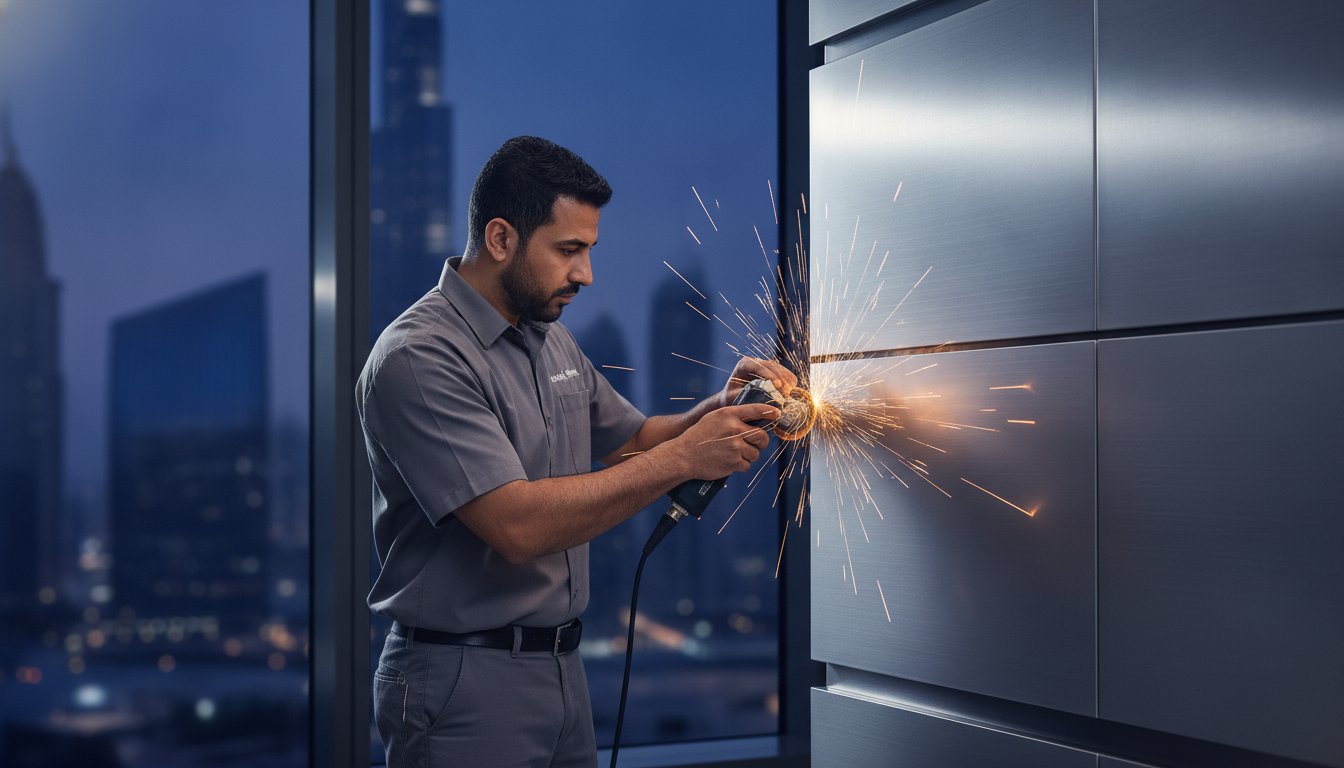
Replacing a damaged architectural panel is often the least efficient way to restore a luxury building’s facade. When deep scratches or dents mar high-traffic areas, the immediate reaction is often to order a replacement, despite the high material costs and long lead times associated with custom cladding. You likely believe that once the factory finish is compromised, it’s impossible to match the original grain. This isn’t the case. Specialized brushed aluminum panel repair allows for the precise restoration of metal surfaces on-site, effectively erasing damage without removing the cladding.
It’s a technical craft that prioritizes both aesthetics and fiscal responsibility. By choosing restoration over replacement, facility managers can achieve a flawless finish while reducing project expenses by as much as 80%. This guide explores the professional methodologies used to match grain patterns and restore surface consistency. You’ll learn how to eliminate visible defects, avoid the logistical nightmare of custom panel fabrication, and ensure your facility maintains its premium appearance with minimal disruption to daily operations. We’ll outline the steps required to achieve a seamless architectural finish that stands up to the closest inspection.
Key Takeaways
- Identify why specialized restoration is a superior financial alternative to the high procurement and installation costs of new architectural cladding.
- Recognize the importance of precise grit matching to ensure a seamless finish that integrates perfectly with existing factory-brushed surfaces.
- Learn how professional brushed aluminum panel repair utilizes advanced planishing techniques to level dents without the need for structural fillers.
- Understand the logistical advantages of on-site repairs, which eliminate the long lead times and operational disruptions typical of panel replacement.
- Discover how targeted metal restoration maintains the aesthetic integrity of high-value commercial properties in demanding environments like the UAE.
Understanding Brushed Aluminum Panel Damage in Commercial Spaces
Brushed metal finishes are a hallmark of contemporary commercial architecture. This specific aesthetic is achieved through a controlled grit-polishing process that creates a consistent, unidirectional grain on the metal surface. While this finish provides a sophisticated, low-luster look that hides fingerprints better than polished surfaces, it remains highly susceptible to physical damage in high-traffic environments. High-end property managers often face visible scuffs and scratches that degrade the premium feel of their facility.
Damage typically accumulates in transition zones where people and equipment move frequently. Elevator interiors, lobby wall cladding, and retail storefronts are primary targets. In a luxury hotel or Grade-A office tower, a single deep scratch on an eye-level panel doesn’t just affect the metal; it compromises the entire brand perception. Neglected surfaces suggest a lack of maintenance, which can negatively impact tenant retention and property valuations. Professional brushed aluminum panel repair offers a way to maintain these assets without the logistical burden of full replacement.
Common Types of Aluminum Surface Damage
- Superficial scratches: These disrupt the light-reflecting properties of the grain, creating dull lines that stand out against the surrounding finish.
- Impact dents and ‘pings’: Often caused by luggage trolleys or heavy cleaning machinery, these deform the metal substrate itself.
- Chemical etching and oxidation: This occurs when janitorial staff use acidic or highly alkaline cleaning agents. These chemicals react with the aluminum, leaving cloudy, permanent stains that cannot be wiped away.
Why Brushed Finishes are Uniquely Challenging
The directional grain is the most significant hurdle in restoration. Unlike a painted surface where you can sand and blend in any direction, aluminum requires precise “re-graining” to match the existing factory finish. Standard polishing techniques used in other industries don’t work here. Attempting to sand a scratch often creates a “flat spot” or a “halo” because the technician has smoothed out the grain texture entirely. Aluminum’s high light-refraction properties mean that even a microscopic mismatch in grain depth or direction becomes glaringly obvious under commercial LED lighting. This is why brushed aluminum panel repair requires a master craftsperson’s touch rather than a general maintenance approach.
The Technical Challenge of Grain Matching and Surface Consistency
Restoring architectural aluminum requires more than just removing a scratch; it involves replicating a specific factory texture. Most high-end panels are finished to strict industry finishing standards, which define the depth and frequency of the linear grain. Technicians must first identify the original grit size used during manufacturing, which typically ranges from 180 to 240 grit. If the repair grit is too coarse, the patch looks dark and heavy. If it’s too fine, it reflects light differently, appearing as a “ghost” or “halo” mark that stands out against the surrounding metal.
Amateur attempts often rely on standard sandpaper or generic scouring pads. These tools lack the precision needed for high-quality brushed aluminum panel repair. Without specialized graining wheels and a steady hand, a repair often results in mismatched patches that are more distracting than the original damage. Successful restoration relies on “feathering” the repair area. This process involves gradually blending the new grain into the original surface, ensuring there is no visible border between the repaired section and the factory finish. It’s a meticulous process where even a slight deviation in angle can ruin the effect.
Identifying Grain Direction and Density
A master craftsperson begins by analyzing the grain’s unique character. They determine if the panel features a long-line finish, a short-brush texture, or a soft satin glow. The technician also measures the depth of the scratch relative to the existing grain. If the damage is deeper than the finish, the substrate must be carefully leveled without “burning through” the thin aluminum layer. This requires technical mastery to maintain the panel’s structural integrity while achieving a flawless aesthetic. For complex architectural features, consulting a specialist in metal finish restoration is the most reliable way to ensure a seamless match.
The Role of Specialized Abrasives
Professional restoration utilizes non-woven abrasives and precision-engineered graining tools. These materials are designed specifically to replicate the linear patterns of architectural metal. Maintaining consistent pressure is vital during this stage. Any fluctuation in force causes “chatter marks” or uneven ridges that catch the light. Technicians also utilize specialized lubricants during the process. These fluids manage heat generated by friction, preventing the aluminum from discoloring or warping under the abrasive wheel. This level of detail ensures the restored area is indistinguishable from the rest of the facade.
Brushed Aluminum Repair vs. Replacement: A Financial Analysis
Choosing between restoration and replacement is a critical fiscal decision for property owners. In 2026, the construction sector has seen significant price volatility; some manufacturers announced a 15% price increase for aluminum products in May alone. This surge makes procurement for full panel replacement increasingly expensive. When you factor in the cost of high-grade architectural panels, which can reach over $100 per square meter for specialized profiles, the financial case for brushed aluminum panel repair becomes clear. Restoration typically saves between 50% and 80% compared to the total cost of sourcing and installing new cladding.
Beyond the sticker price of the metal, replacement carries substantial hidden expenses. Logistics, specialized shipping for oversized panels, and the labor required for safe removal and disposal add significant weight to a maintenance budget. There is also the inherent risk of damaging adjacent surfaces or waterproof seals during the extraction of old panels. On-site restoration eliminates these variables. Technicians work directly on the existing substrate, removing the need for heavy machinery or complex site logistics. This pragmatic approach ensures that budgets are spent on visible quality rather than invisible overheads.
The “Downtime Factor” is perhaps the most overlooked cost in commercial facilities. A lobby or elevator bank out of service for weeks while waiting for custom-fabricated panels represents a loss in operational efficiency and tenant satisfaction. Professional brushed aluminum panel repair can often be completed in a fraction of the time required for a replacement cycle. This efficiency allows hotels, malls, and office towers to maintain their premium aesthetic without disrupting the daily flow of guests and residents.
The Cost Efficiency of On-Site Restoration
On-site restoration bypasses the long lead times associated with custom-fabricated metal. While ordering a new panel might take weeks or months depending on the specific finish and profile, a restoration team can often mobilize within days. Many of the techniques used in stainless steel finish restoration apply directly to aluminum. Both processes prioritize the preservation of the original material, using specialized abrasives to match the factory grain. This circular approach is not only cost-effective but also more sustainable; it reduces the carbon footprint associated with manufacturing and transporting new metal components.
When Replacement Might Actually Be Necessary
While most cosmetic damage is repairable, certain conditions necessitate full replacement. If the structural integrity of the panel is compromised, such as through severe impact that has cracked the metal or damaged the mounting system, restoration may not be feasible. Deep creases that exceed the metal’s natural “memory” or thickness can also make it impossible to achieve a perfectly flat finish through planishing. Extensive core corrosion, often seen in older panels or those exposed to harsh marine environments without proper maintenance, usually requires a complete swap to ensure long-term building safety. For these reasons, a professional assessment is essential before committing to a brushed aluminum panel repair strategy.
The Professional On-Site Restoration Process
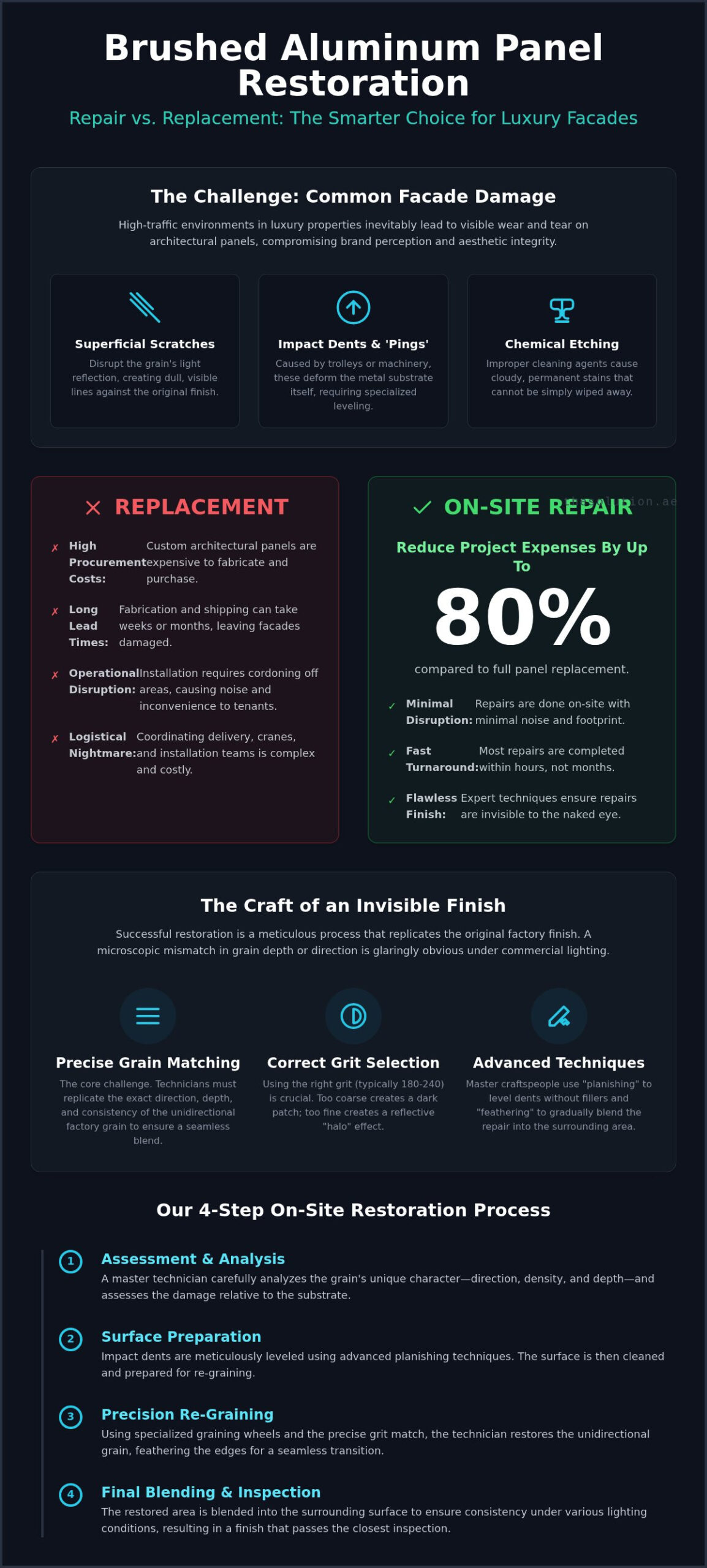
Executing a successful brushed aluminum panel repair requires a disciplined, multi-stage approach. Unlike automotive repairs that rely on heavy fillers and paint, architectural restoration focuses on manipulating the existing metal to return it to its factory state. This surgical process ensures the repair remains invisible even under the unforgiving lighting found in luxury lobbies and commercial showrooms. The methodology is structured to preserve the substrate’s integrity while achieving a perfect aesthetic match.
- Step 1: Surface decontamination: Technicians begin by removing all environmental pollutants, oils, and previous protective coatings. This ensures that abrasives don’t drive contaminants deeper into the metal pores.
- Step 2: Substrate planishing: Any physical deformations are addressed using specialized pulling tools. This levels the surface without the need for structural fillers.
- Step 3: Progressive sanding: Using the grit sizes identified during the initial assessment, the technician removes the scratch by gradually refining the surface texture.
- Step 4: Grain restoration: This is the most critical phase. The master craftsperson uses precision graining wheels to replicate the linear pattern of the original factory finish.
- Step 5: Protection: The process concludes with the application of architectural-grade sealants or anti-fingerprint coatings to ensure long-term durability.
Levelling the Surface Without Fillers
In the architectural sector, using body filler for dents is a fundamental error. Fillers are opaque and cannot be brushed to match the surrounding metal; they will always appear as a dull, flat patch. Instead, professional restoration utilizes specialized metal-pulling technology designed for thin-gauge architectural panels. Technicians must carefully manage the “work hardening” property of aluminum. As the metal is manipulated, it becomes more rigid and brittle. Expert planishing requires a delicate balance of force and precision to flatten the base perfectly before the re-graining process begins. If the base isn’t 100% flat, the graining wheel will skip, creating “chatter marks” that ruin the finish.
Achieving the Flawless Final Grain
The hallmark of a master restoration is a grain that flows seamlessly from the repaired area into the original panel. For long-line finishes, technicians use a “continuous stroke” technique. Any hesitation or stop-start motion during the brushing phase creates visible lines where the grain changes depth. Feathering is equally vital; the technician must gradually reduce the pressure of the abrasive wheel as they move away from the repair site. This blends the new texture into the old. To verify the quality of the work, a final inspection is performed using high-intensity grazing light. This light source is placed at a sharp angle to the surface, highlighting even the smallest inconsistencies in the grain. If you need to restore the premium appearance of your facility’s facade, you can book a professional metal assessment to determine the best restoration path.
Specialized Metal Restoration in Dubai: Why Choose The Solution
Dubai’s architectural landscape is defined by its use of high-value materials and innovative designs. Maintaining these surfaces requires more than general maintenance; it demands a deep understanding of how local environmental factors like extreme heat and airborne salinity affect metal finishes. The Solution has established itself as a leading partner for property managers by providing expert brushed aluminum panel repair that meets the rigorous aesthetic standards of the UAE’s luxury real estate sector. Our methodology is refined to handle the specific alloys and finishes common in the region’s iconic towers and commercial hubs.
Our approach is built on technical mastery and operational efficiency. We understand that in the hospitality and retail sectors, downtime is not an option. Our teams are trained to perform complex restorations during off-peak hours, ensuring that hotels and malls remain fully functional and visually pristine for guests. This commitment to minimal disruption, combined with our ability to achieve significant cost savings compared to replacement, makes us a pragmatic choice for large-scale facility management. We don’t just fix surfaces; we restore the asset’s value through meticulous craftsmanship.
Serving Dubai’s High-Traffic Commercial Sectors
We provide tailored solutions for environments where first impressions are critical. From the lobby cladding of a five-star hotel to the sleek storefronts of a luxury mall, our expertise ensures every surface reflects the brand’s quality. Our capabilities extend beyond metal; we offer a unified approach to hard surface repair that covers wood, ceramic, and stone. This allows property managers to address multiple maintenance needs through a single, reliable partner. Our technicians also specialize in glass polishing and restoration, providing a comprehensive suite of services to maintain the entire building envelope.
Get Your Professional Restoration Assessment
Starting the restoration process is straightforward. We recommend that clients document surface damage with high-resolution photography under clear lighting to facilitate an accurate remote assessment. For complex projects, we offer on-site sampling. This allows us to demonstrate the quality of our grain-matching and planishing techniques on a small section of the damaged panel before the full project begins. This transparent process provides facility managers with the confidence that brushed aluminum panel repair is the most intelligent financial and aesthetic decision for their property. Contact The Solution today to schedule your technical assessment and discover the benefits of specialized architectural restoration.
Restore Your Architectural Assets with Technical Precision
Maintaining the premium aesthetic of a commercial facility doesn’t require the logistical burden and high expense of full cladding replacement. As established throughout this guide, the key to successful brushed aluminum panel repair lies in the master craftsperson’s ability to match factory grain patterns with surgical accuracy. By prioritizing on-site restoration, you eliminate the long lead times of custom fabrication and avoid the risk of damaging adjacent structures during removal. It’s a pragmatic decision that preserves both the building envelope and your maintenance budget.
Choosing restoration over replacement offers a clear financial advantage, often resulting in up to 80% cost savings. This technical mastery is why the UAE’s leading facility managers trust specialized on-site experts to handle their most visible architectural challenges. You can protect your property’s value and brand perception while ensuring minimal disruption to daily operations. If you’re ready to erase surface defects and restore your metal panels to their original condition, Request a Professional Metal Restoration Quote today. Your facility’s flawless finish is achievable through expert restoration.
Frequently Asked Questions
Can deep scratches in brushed aluminum panels really be made invisible?
Yes, specialized restoration can make deep scratches virtually invisible by matching the original factory grain. Unlike superficial polishing, this process involves re-graining the metal surface to ensure the linear pattern is consistent across the entire panel. By identifying the exact grit size, such as 180 or 240, and feathering the repair area into the surrounding material, technicians eliminate the visual “ghosting” effects often seen in amateur attempts.
How long does a typical on-site aluminum panel repair take?
The duration of a repair varies based on the severity of the scuffs or dents, but most on-site projects are completed within a few hours. A single panel with superficial scratching might take 2 to 4 hours to restore to a factory finish. This efficiency is a significant advantage for commercial facilities, as it allows for repairs during off-peak windows without the multi-week lead times required for panel fabrication and delivery.
Is aluminum repair cheaper than replacing the panel in Dubai?
Restoration is a highly cost-effective alternative to replacement in the Dubai market. On-site brushed aluminum panel repair typically saves facility managers between 50% and 80% compared to the total cost of procurement and installation. These savings are achieved by eliminating the high expenses associated with custom metal fabrication, shipping logistics, and the labor-intensive process of removing damaged cladding and disposing of waste materials.
Will the repaired area oxidize or change color over time?
Professional repairs are designed to be permanent and resistant to environmental changes. By removing contaminants and applying architectural-grade sealants during the final stage of restoration, the metal is protected against oxidation. This is particularly important in the UAE’s saline and high-heat environment. Using correct technical methodologies ensures that the repaired section maintains the same luster and color consistency as the rest of the facade for years to come.
Can you repair brushed aluminum elevator doors without removing them?
Yes, we specialize in performing on-site repairs for elevator doors and interiors without removing the panels from their tracks. This approach minimizes downtime for essential building services. Technicians use precision hand tools and dust-containment systems to restore the finish in situ. This is an ideal solution for luxury hotels and office towers where maintaining elevator availability is a priority and removing doors would cause significant logistical disruption.
What is the difference between repairing stainless steel and aluminum panels?
While the grain-matching principles are similar, aluminum is significantly softer than stainless steel and more prone to “work hardening” during the planishing process. This means the metal becomes more brittle as it is manipulated, requiring a more delicate touch from the technician. Aluminum also reflects light differently, so the grit-matching process must be even more precise to prevent visible patches. Our master craftspeople are trained to handle these specific metallurgical differences.
Do you provide anti-fingerprint coatings after the restoration?
Yes, we offer high-performance anti-fingerprint coatings as an optional final step in the restoration process. These specialized treatments are particularly beneficial for high-traffic areas like elevator control panels, lobby wall cladding, and retail storefronts. The coating creates a protective barrier that reduces the visibility of oils and smudges, making daily janitorial maintenance easier while preserving the pristine, low-luster look of the newly restored brushed aluminum surface.
Are your repair processes suitable for outdoor aluminum facades in the UAE climate?
Our restoration methodologies are specifically engineered to withstand the unique architectural challenges of the UAE. This includes resistance to extreme UV exposure, high humidity, and airborne sand particles. By using site-specific abrasives and industrial-grade protective sealants, we ensure that outdoor facades remain aesthetically flawless. This specialized brushed aluminum panel repair process is a reliable way to maintain the building envelope in demanding commercial and marine environments.


