
The final phase of a construction project in the UAE is a critical race against time. A single scratch on a glass panel or a chip in a newly installed countertop can escalate a simple snagging list into a source of significant financial penalties and project delays. The traditional approach of replacing high-value items is not only a costly endeavour, often running into thousands of Dirhams, but also a logistical challenge that threatens your handover deadline. This is where mastering the process of construction handover damage repair becomes a crucial operational advantage, turning potential liabilities into a demonstration of quality and efficiency.
This guide provides contractors with a pragmatic framework to achieve a zero-defect finish. We will detail how to identify and efficiently rectify common surface damages using innovative techniques, bypassing the high cost and extended timelines of full replacement. By implementing these strategies, you can significantly shorten your snagging list, avoid liquidated damages, and deliver a flawless final product that enhances your company’s reputation. Prepare to transform your handover process, securing substantial cost savings and ensuring complete client satisfaction on every project.
Key Takeaways
- Master the snagging process to protect your project’s profitability, as minor defects can cause significant delays and financial penalties at handover.
- Evaluate on-site repair versus full replacement to see how modern techniques can dramatically reduce rectification costs and avoid budget overruns in AED.
- Pinpoint the most vulnerable project stages and surfaces for damage, allowing you to implement preventative measures before the final client inspection.
- Learn how to integrate a specialist construction handover damage repair program into your workflow, shifting from a costly reactive approach to a planned, zero-defect strategy.
The High Stakes of Handover: Why Minor Damage is a Major Problem
In the construction industry, it is a well-established principle that the final 5% of a project determines 95% of client satisfaction. This critical final stage is dominated by the handover process, where the client inspects the work and compiles a ‘snagging list’ or ‘punch list’ of defects. Seemingly minor issues-a scratch on a glass panel, a chip in a marble floor, or a scuff on a door frame-can quickly populate this list, derailing an otherwise successful project. These small imperfections become major obstacles, capable of delaying completion, straining client relationships, and eroding profit margins. For discerning project managers, professional on-site construction handover damage repair is not a last-minute fix; it is a strategic tool to ensure a seamless and profitable project conclusion.
The Financial Impact: Beyond the Repair Cost
Unresolved damages at handover trigger significant financial consequences that extend far beyond the material cost. In the UAE market, delays often invoke liquidated damages or penalty clauses, costing thousands of dirhams per day. Furthermore, a poor finish can complicate the defect liability period, withholding retention money and creating disputes over issues that may become latent defects. Consider the direct costs:
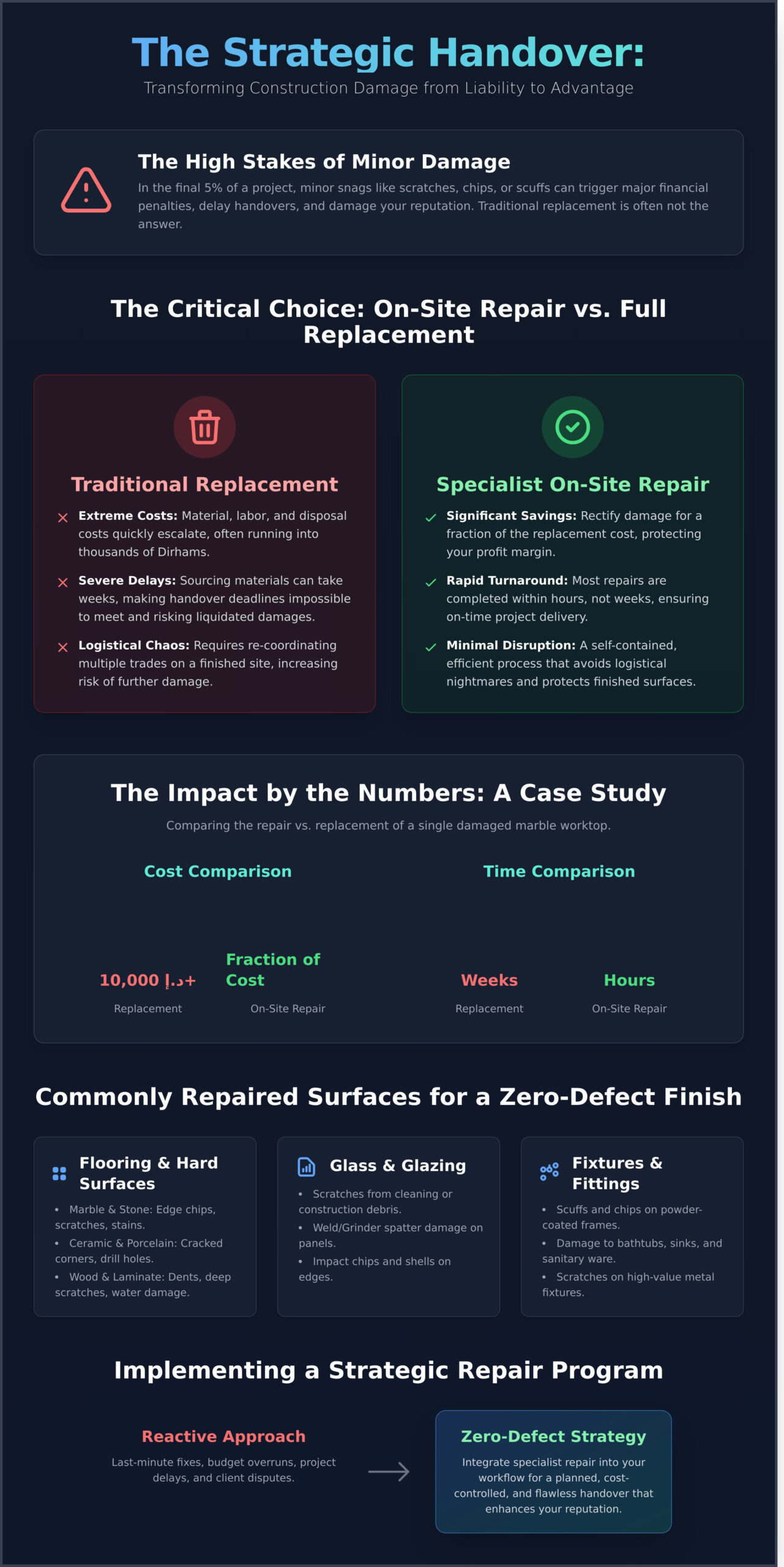
- Replacement vs. Repair: Replacing a damaged marble worktop could cost upwards of د.إ 10,000 and take weeks. A specialist on-site repair can rectify the damage for a fraction of that cost, often within hours.
- Hidden Costs: Delays accumulate expenses from extended labour, equipment rental, and site management, directly impacting your project’s profitability.
Effectively managing these project finances and mitigating risks requires specialized expertise. Many successful contractors in the region work with firms like Reflechir Consultancy to optimize their financial strategies and ensure long-term profitability.
The Reputational Risk for Contractors
The final, finished state of a project is your company’s last handshake with the client. It is a tangible representation of your commitment to quality. A flawless handover, free from visible defects, showcases meticulous attention to detail and builds immense trust. In a competitive landscape, your reputation is your most valuable asset. A successful handover generates positive word-of-mouth, client testimonials, and ultimately, future contracts. Conversely, a project marred by last-minute issues suggests a lack of quality control, damaging brand loyalty and future business prospects.
Of course, building a strong reputation starts with a solid business foundation. For those looking to establish or formalize their operations in the UAE’s competitive market, it can be helpful to explore Company Formation Services to ensure a smooth and compliant setup.
Leading firms in the region understand this principle well. For example, the commitment to quality demonstrated by a general contractor like ELAF International General Contracting Co is central to their success and client relationships across major projects.
The Logistical Nightmare of Last-Minute Replacements
Opting for replacement over repair introduces a cascade of logistical challenges on a near-complete site. Sourcing a specific type of glass panel, bespoke joinery, or imported stone can involve lead times of several weeks, making timely handover impossible. This process requires re-coordinating multiple trades-installers, painters, cleaners-creating organisational chaos and increasing the risk of causing further accidental damage to adjacent, finished surfaces. An expert construction handover damage repair service eliminates this entire logistical chain, providing a swift, self-contained solution with minimal disruption.
Identifying Common Handover Damages: A Surface-by-Surface Checklist
On any active construction site in the UAE, incidental surface damage is an operational reality, not a sign of poor workmanship. The final project phases-including fit-out, deep cleaning, and initial client walk-throughs-are the most vulnerable periods. With multiple trades working in close proximity and high foot traffic, the risk of chips, scratches, and scuffs increases exponentially. A systematic approach to damage assessment is fundamental to an efficient construction handover damage repair strategy, ensuring a flawless finish without costly delays or replacements.
A proactive methodology involves regular inspections of high-traffic zones. To streamline this process, we have categorized common damages by surface type, allowing for swift and accurate identification.
Damage to Flooring and Hard Surfaces
Floors bear the brunt of construction activity. From dropped tools to dragged equipment, the potential for damage is constant. Our technicians are proficient in rectifying these common issues:
- Marble & Stone: Edge chips on tiles and countertops, surface scratches from abrasive debris, and persistent grout or sealant stains.
- Ceramic & Porcelain Tiles: Cracked corners from impact, incorrectly placed drill holes, and chipped glazing that compromises the finish.
- Wood & Laminate: Dents from dropped tools, deep scratches from moving furniture, and swelling or discolouration from water damage.
Damage to Fixtures and Fittings
Newly installed fixtures are often susceptible to damage during the final push to completion. These high-value items require specialist repair techniques to restore their original condition.
- Sanitaryware: Chips on the enamel of bathtubs and sinks, often from tools, and fine scratches on acrylic surfaces.
- Kitchen Countertops: Chips along vulnerable edges, heat marks from equipment, and scratches left by blades or tools.
- Doors & Cabinetry: Dents on door faces, deep scuffs from site traffic, and delamination of vinyl wrap or laminate on edges.
Damage to Glass and Metal Surfaces
Modern UAE architecture features extensive glass and metal, which demand a perfect, blemish-free finish. Even minor flaws can detract from the final aesthetic and require precise restoration.
- Glass Panels & Windows: Scratches caused by improper cleaning techniques, weld splatter from nearby works, and small chips on edges.
- Stainless Steel: Scuffs and scratches on elevator doors, kitchen appliances, and decorative cladding.
- Aluminum Frames: Scratches, dents, and powder-coating abrasions on window and door frames.
By implementing this structured checklist, site managers can effectively identify and document issues, paving the way for a targeted and cost-effective construction handover damage repair program that guarantees a perfect handover.
The Critical Choice: On-Site Repair vs. Full Replacement
In the high-stakes environment of project handover, the default solution for many contractors facing surface damage is to rip and replace. This traditional approach is not only costly and slow but is increasingly outdated. Modern repair technology offers a superior alternative, positioning professional on-site repair as the smarter, faster, and more sustainable choice for meeting project deadlines and protecting budgets. For project managers, understanding when to repair versus replace is a critical decision that directly impacts the bottom line.
The Cost-Benefit Analysis
The most compelling argument for on-site repair is the significant financial savings. It is normal practice for clients to see savings of 50-80% compared to the cost of full replacement. Consider a chipped marble countertop-a common issue in the final stages of a project.
A full replacement involves multiple expenses:
- Material Sourcing: Procuring a matching slab can cost upwards of 3,000 د.إ.
- Labour: Removal of the old top and installation of the new one adds significant labour costs.
- Disposal: Fees for responsible disposal of the damaged material.
The total replacement cost can easily exceed 5,000 د.إ. In contrast, a professional on-site repair can be completed for a fraction of that price, restoring the countertop to its original condition with no discernible trace of damage. Get a quick cost comparison for your project.
The Timeline Advantage: Hours vs. Weeks
Time is a critical resource in construction. While sourcing, delivering, and installing a replacement item can take weeks or even months in the UAE market, most on-site repairs are completed by our specialist technicians within a few hours on a single visit. This speed is invaluable for any construction handover damage repair scenario, eliminating delays, preventing penalties, and ensuring the project is delivered on schedule without compromising on quality.
The Quality and Durability of Modern Repairs
A common misconception is that repairs are a temporary or purely cosmetic fix. This is no longer the case. Using advanced techniques, specialist resins, and precision colour-matching technology, our repairs are permanent and blend seamlessly with the original surface. We don’t just conceal the damage; we rebuild the affected area, restoring its structural integrity and ensuring it withstands daily use. The result is a flawless finish that meets the exacting standards of any client inspection, ensuring a perfect handover every time.
Implementing a Strategic Repair Program for a Zero-Defect Handover
Achieving a flawless project handover requires a fundamental shift in mindset: from reactive, last-minute fixes to a proactive restoration strategy. The traditional snagging process can be chaotic and costly, involving multiple trades and significant delays. By integrating a specialist partner early, you streamline the entire final stage, transforming it into a controlled, efficient process. The Solution acts as your single point of contact for all hard surface damages, ensuring a consistent, high-quality finish across the entire project.
Step 1: Pre-Handover Damage Assessment
The optimal time for a professional damage assessment is immediately after the final deep clean but before the client or consultant walk-through. At this stage, one of our highly skilled technicians will conduct a meticulous survey of the property, using their expertise in damage assessment to identify and log every surface defect-from minor chips in marble flooring to scratches on glass balustrades. You then receive a single, consolidated quotation and a clear action plan to rectify all issues, simplifying your budget and schedule management.
Step 2: Coordinated On-Site Execution
Our on-site execution is designed for maximum efficiency and minimal disruption. Technicians work seamlessly around other final trades, ensuring project momentum is never compromised. Using innovative, low-noise, and dust-free techniques, we restore damaged surfaces in situ. This eliminates the significant costs and logistical challenges of replacement. Each repair is meticulously completed to an invisible, factory-standard finish and signed off individually, providing you with complete quality assurance throughout the process.
Step 3: The Final Snag-Free Walk-Through
Implementing a strategic program for construction handover damage repair culminates in the final client presentation. Imagine walking your client through a property with the complete confidence that every surface is flawless. This zero-defect approach not only enhances your professional reputation but also prevents costly post-handover call-backs. As a partner who guarantees the quality and durability of our work, we provide the peace of mind needed to close out a project successfully.
Elevate your handover process from a challenge to a showcase of quality. Schedule a pre-handover assessment with our team.
From Defect to Perfection: Mastering the Final Handover
Ultimately, a flawless project handover is not a matter of chance, but of strategy. As we’ve explored, minor surface damage can lead to significant delays and budget overruns, while the choice between repair and replacement directly impacts profitability. Adopting a proactive repair program is the definitive path to a zero-defect finish that protects your bottom line and enhances your professional reputation.
For contractors across the UAE, expert construction handover damage repair is the most intelligent financial decision. The Solution is trusted by the region’s leading developers to rectify damage with unparalleled precision. Our specialist technicians for glass, metal, stone, wood, and ceramics deliver exceptional results, achieving typical cost savings of 50-80% compared to full replacement.
Don’t let last-minute defects undermine your project’s success. Deliver the pristine finish your clients expect and deserve.
Ensure a Flawless Handover. Get Your Project Assessed Today.
Frequently Asked Questions
How quickly can your team be on-site to fix handover damages in Dubai?
We understand the critical timelines of construction projects in Dubai. Our rapid response team can typically be on-site within 24 to 48 hours of your request. For large-scale projects with extensive snagging lists, we coordinate with your site manager to schedule our specialist technicians for maximum efficiency, ensuring we meet your handover deadlines without causing delays. Our goal is to provide swift, effective solutions that keep your project on track.
Are the surface repairs truly invisible and how do you match complex finishes?
Yes, our repairs are meticulously finished to be undetectable. Our highly skilled technicians use a proprietary system of specialist resins, fillers, and pigments to rebuild the damaged area. For complex surfaces like wood grain or marble, they are experts in replicating the original pattern by hand-painting intricate details, veins, and textures. This level of craftsmanship ensures the restored area blends seamlessly with the surrounding surface, passing even the closest inspection.
What is the typical cost saving of repairing a damaged item versus replacing it on a construction site?
Repairing a damaged surface consistently provides significant financial benefits over replacement. Clients typically experience savings of 50-80%. For instance, repairing a chipped marble countertop might cost 1,200 AED, whereas a full replacement could exceed 7,000 AED plus installation and disposal costs. Our service eliminates these ancillary expenses, delivering a restored finish for a fraction of the replacement cost and avoiding delays in sourcing new materials.
Is your repair work durable enough to withstand the final stages of construction and client inspection?
Absolutely. Our repair methodology is engineered for permanence and durability. We use advanced polymers and resins that chemically bond to the original substrate, often creating a repaired area that is as strong, if not stronger, than the surrounding material. The finish is cured to be resistant to wear, cleaning chemicals, and impact, ensuring it withstands the final deep clean, polishing, and rigorous client scrutiny during the handover inspection process without any degradation.
How do you work with main contractors on large-scale projects with extensive snagging lists?
We integrate seamlessly into the main contractor’s workflow to manage extensive snag lists efficiently. A dedicated project manager is assigned to coordinate our teams, systematically addressing each item. We provide clear, daily progress reports and work in tandem with other trades to minimize disruption. Our streamlined process for construction handover damage repair ensures that all surface defects are rectified swiftly, helping you achieve a zero-snag handover on schedule and within budget.
What types of severe damage are typically beyond repair and would require replacement?
While our techniques can rectify most forms of damage, certain severe cases necessitate replacement. This includes shattered tempered glass, as its structural integrity is completely compromised. Items with deep structural damage, such as a wooden door that is split entirely through, are also typically unrepairable. Additionally, widespread chemical or fire damage that has fundamentally altered the material’s composition across a large area may be beyond the scope of a cosmetic and structural repair.


