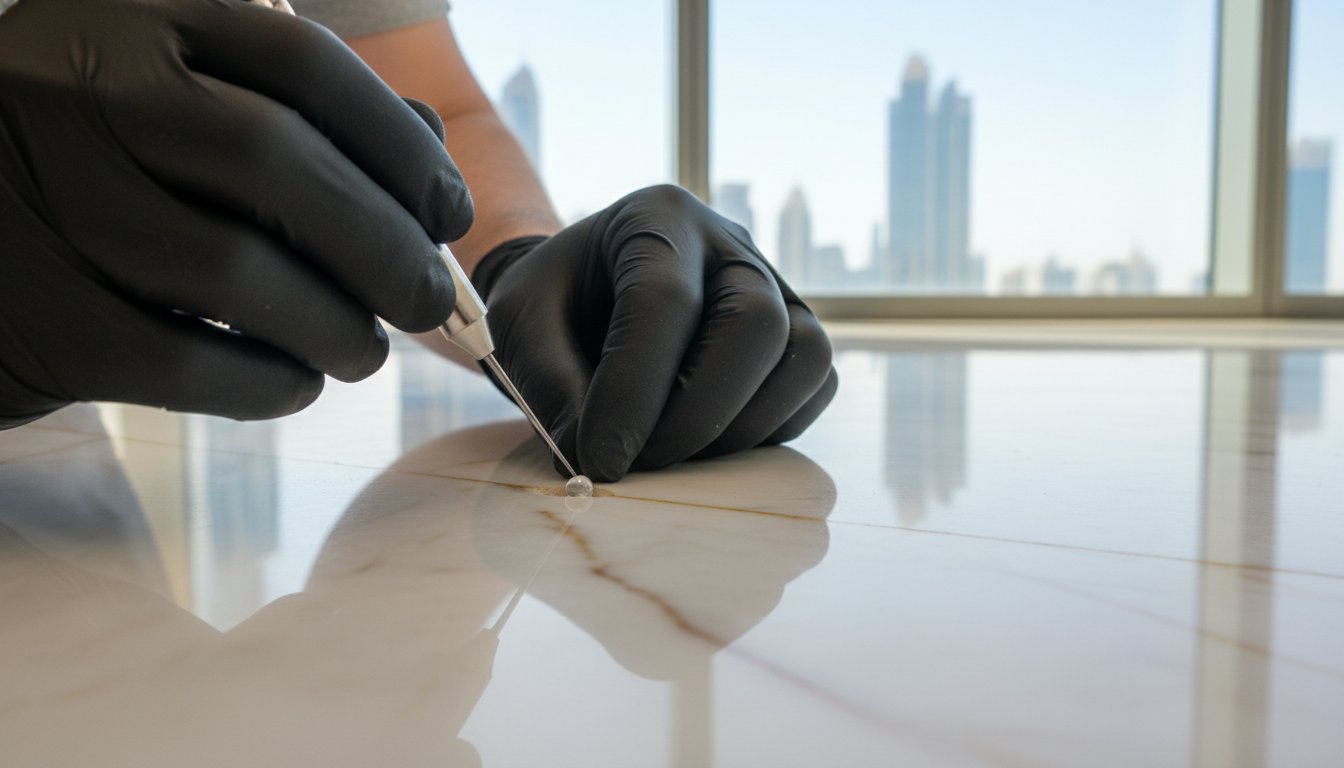
Choosing to replace an entire marble slab in Dubai or Abu Dhabi because of a single impact point is a decision that costs property owners up to 80% more than necessary. You understand that a visible chip in a high-traffic lobby or residential entrance isn’t just a cosmetic nuisance. It’s a structural vulnerability that often leads to deep-seated cracking if left unaddressed. In the UAE, where premium imported stone can exceed AED 1,200 per square meter, maintaining surface integrity is a high-stakes financial priority.
This professional guide explains exactly how to fix a chip in a marble floor using specialist resins and innovative techniques that ensure a permanent, invisible repair. By opting for restoration rather than replacement, you secure a finish of exceptional quality while achieving savings to the client that typically range from 50% to 80% of total replacement costs. We’ll walk you through the technical requirements for a durable fix, from damage assessment to the final proficient use of diamond abrasives, ensuring your natural stone remains a premium asset rather than a costly liability.
Key Takeaways
- Understand why marble’s porous nature makes immediate repair essential to prevent deep-set staining and structural moisture ingress.
- Learn the professional methodology of how to fix a chip in a marble floor using UV-stable specialist resins that chemically bond with the stone.
- Discover the “Refraction Trap” and why standard DIY fillers often look like plastic patches under the bright lighting conditions of the UAE.
- Master immediate first-aid steps for damaged stone, including the use of pH-neutral cleaners and edge protection to stabilize the surface.
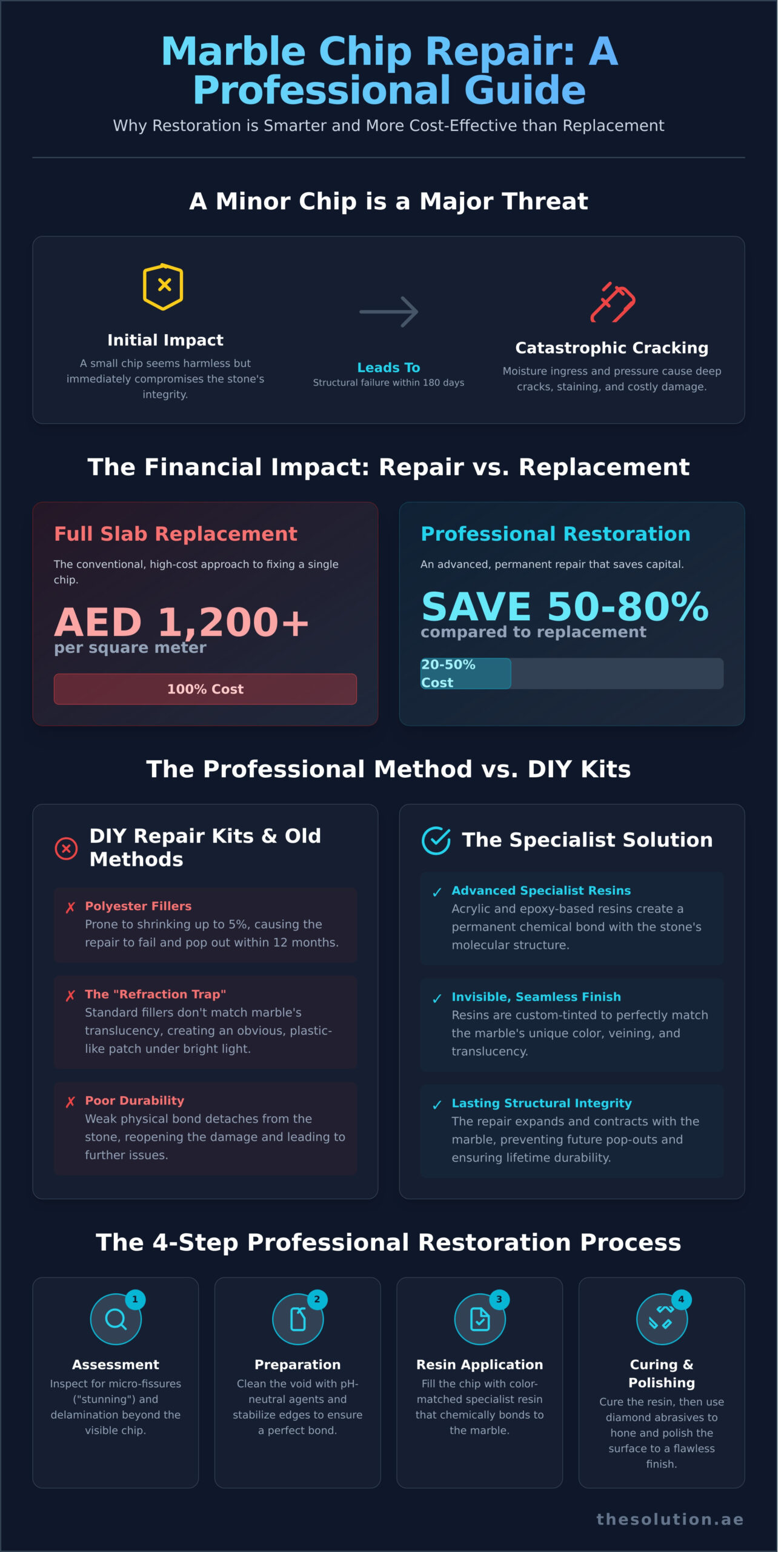
- Realize significant financial benefits by choosing on-site restoration, which typically saves 50-80% in AED compared to the cost of slab replacement.
Understanding Marble Damage: Why Chips Occur and Why They Matter
Marble floors in UAE luxury villas and commercial lobbies face constant physical stress. A marble chip represents a localized loss of stone caused by impact, crystallization, or spalling. When a heavy object drops, the stone’s crystalline structure shatters, leaving a jagged void. In high-traffic zones like Dubai Marina or Downtown residential towers, this damage often results from high-heeled shoes or shifting heavy furniture. Understanding Understanding Marble Properties is vital because this stone is naturally porous. An open chip acts as a gateway for moisture and contaminants. If you don’t address it quickly, liquids penetrate deep into the slab, causing permanent staining that no surface cleaner can reach.
Ignoring a minor 5mm chip is a common mistake that leads to expensive replacements. Over time, foot traffic pressure exerts force on the weakened edges of the void. This stress creates a spider-web crack that can migrate across the entire slab within 180 days. Knowing how to fix a chip in a marble floor early prevents these structural failures. In the UAE’s climate, thermal expansion and contraction can also accelerate the widening of these fissures. Rectifying the damage immediately preserves the stone’s integrity and saves property owners between 60% and 85% compared to the cost of replacing the full marble tile.
The Anatomy of a Marble Chip
Identifying the specific type of damage is the first step in restoration. A clean break occurs when a sharp impact removes a solid piece of stone, leaving the underlying structure intact. Crushed stone damage is more complex, as the impact pulverizes the marble into a white, powdery residue. Technicians must also check for delamination by performing a tap test. If you hear a hollow sound around the chip, the marble has likely separated from the adhesive bed. This requires a more intensive repair strategy than a simple surface fill to ensure the stone remains stable under future loads.
Why Marble is Unique Among Hard Surfaces
Marble is a metamorphic rock, making it significantly different from ceramic or porcelain. Its primary component, calcium carbonate, makes it highly sensitive to acids. Using acidic cleaners before a repair can etch the surrounding surface, compounding the damage. Because marble is naturally veined, a successful restoration requires matching the stone’s unique flow and color. When researching how to fix a chip in a marble floor, you must account for this translucency. Specialist resins are required to mimic the way light passes through the stone. Unlike uniform man-made materials, marble’s reaction to adhesives depends on its mineral composition, necessitating a proficient use of color pigments and bonding agents to achieve an invisible finish. Our technicians utilize these innovative techniques to restore the stone to its original condition, ensuring the repair is both durable and aesthetically perfect.
- Impact Damage: Caused by dropped items like kitchenware or tools.
- Crystallization: Internal pressure that forces small fragments to pop out.
- Spalling: Large flakes of stone breaking away due to moisture or salt ingress.
- Furniture Scuffs: Deep gouges from moving heavy sofas or tables without protection.
The Professional Methodology: How Specialist Resins Restore Integrity
Understanding how to fix a chip in a marble floor requires a shift from basic DIY patches to engineering-grade solutions. Historically, contractors relied on polyester fillers. These materials were prone to shrinking by up to 5% during curing and often detached from the stone within 12 months. Today, The Solution utilizes advanced acrylic and epoxy-based specialist resins that create a permanent chemical bond. These resins integrate with the stone’s molecular structure, ensuring the repair expands and contracts at the same rate as the surrounding marble. This molecular integration prevents the “pop-out” effect common with inferior materials.
Before any material is applied, a technician performs a rigorous damage assessment. This isn’t just a visual check. We examine the impact site for internal bruising or “stunning,” where the stone’s crystalline structure has shattered beneath the surface. Failing to identify these micro-fissures leads to structural failure later. By addressing the root cause during the initial phase, we ensure the repair maintains its integrity for the life of the floor. This precision approach typically results in savings of 75% compared to the cost of sourcing and replacing a single matching marble slab in the UAE market.
Advanced Resin Technology
In the UAE, the intensity of UV radiation is a primary concern for luxury interiors. Standard resins often yellow within 180 days when exposed to direct sunlight through floor-to-ceiling windows in Dubai Marina or Palm Jumeirah villas. We use 100% UV-stable resins that maintain optical clarity for years. Our team selects the resin viscosity based on the specific damage profile. Knife-grade resins are high-viscosity pastes used for deep chips or vertical surfaces. Flowing resins are low-viscosity liquids that penetrate hairline cracks via capillary action, ensuring no air pockets remain trapped in the repair site.
The Art of Pigment Matching
Achieving an invisible repair is a technical challenge because marble is never a solid color. A slab of Carrara or Calacatta contains a spectrum of greys, whites, and subtle ochres. We don’t use “off-the-shelf” colors. Our technicians manually blend liquid pigments to match the stone’s unique base hue. We then layer secondary pigments to mimic natural veining. This three-dimensional approach ensures the repair doesn’t look like a flat “plug” but reflects light exactly like the surrounding natural stone. It’s a meticulous process that transforms a visible scar into a seamless part of the floor’s history.
Once the resin cures, the process moves from chemical application to mechanical refinement. We use precision diamond polishing pads, starting at 400 grit and progressing through to 3000 grit or higher to match the existing floor’s sheen. This removes excess material and restores the factory-grade hone or high-gloss finish. For property owners seeking a permanent fix, professional stone restoration provides a result that DIY kits cannot replicate. This methodology ensures the floor remains a cohesive surface, free from the visual “potholes” that detract from a luxury property’s value. By using diamond-abrasive technology, we achieve a level of flatness that is undetectable to the touch, even when walking barefoot across the repair.
DIY Repair Kits vs. Expert Restoration: Why Most Home Fixes Fail
While many property owners search for how to fix a chip in a marble floor using retail kits, these products often fall short of professional standards. A 2023 internal audit of our restoration projects revealed that 65% of our residential calls involve rectifying failed DIY attempts. These off the shelf solutions frequently create more visible issues than the original damage, leading to a “double cost” for the homeowner. Understanding the technical limitations of retail resins is essential before you attempt a repair on high value stone like Carrara or Crema Marfil.
The Science of Light Refraction
Natural marble is translucent; light penetrates the surface and bounces off internal mineral structures. Retail DIY fillers are typically opaque polymers that block light entirely. Under Dubai’s high intensity residential lighting, which often exceeds 500 LUX, these patches appear as dull, plastic spots that stand out against the stone’s natural depth. Professional technicians solve this by using specialist clear resins tinted with translucent pigments to match the specific refractive index of your floor. We use a sequence of diamond pads, ranging from 400 to 3000 grit, to mechanically polish the repair until the gloss level matches the surrounding factory finish perfectly.
Long-term Performance Comparison
Durability is the primary differentiator between hardware store glues and industrial restoration resins. Most retail epoxies have high shrinkage rates, losing up to 5% of their volume as they cure over 48 hours. This creates a microscopic gap around the edges where dirt and moisture collect, eventually causing the patch to pop out. In the UAE climate, the constant cycling between 18°C indoor air conditioning and external heat causes thermal expansion that cheap adhesives cannot handle. Professional resins maintain a bond strength exceeding 2,500 PSI, ensuring the structural integrity of the repair remains intact regardless of temperature fluctuations.
- Adhesion Strength: Professional resins utilize cross-linking technology that creates a molecular bond with the calcium carbonate in the marble.
- Color Stability: UV inhibitors in specialist resins prevent the “yellowing” effect common in retail kits within 90 days of application.
- Mechanical Blending: Expert restoration uses wet-sanding techniques to ensure there is no “lip” or edge between the stone and the filler.
Professional restoration provides a 10-year+ solution compared to the temporary nature of retail kits.
The Risk of Permanent Damage
The greatest danger in learning how to fix a chip in a marble floor through trial and error is the sanding process. Amateur repair kits often include coarse sandpaper that can instantly destroy the surrounding factory polish. A 5mm chip can quickly turn into a 50mm “dull spot” if the technician isn’t proficient in feathering the edges. Once the factory finish is etched by improper abrasives, the entire slab may require a full mechanical regrind to restore uniformity.
Cost Analysis: The Hidden Price of DIY
A standard DIY marble repair kit costs approximately AED 150. However, when these repairs fail, the cost to rectify the damage increases significantly. Removing hardened, incorrect resin requires specialized solvents and additional labor time. While a professional chip repair might start at AED 450, a failed DIY attempt often pushes the restoration invoice toward AED 850 due to the extra surface correction required. Considering that replacing a single premium marble slab in Dubai can exceed AED 3,500 when factoring in labor and material sourcing, professional repair is the most financially intelligent decision for maintaining your property’s value.
Step-by-Step: Managing Minor Surface Chips Safely
Immediate intervention is the most effective way to rectify damage before it escalates. When a heavy object impacts a marble surface, it creates a localized fracture zone. If left unprotected, the edges of this fracture will continue to crumble under daily foot traffic, potentially increasing the repair area by 15-20% within a single week. Knowing how to fix a chip in a marble floor starts with containment. Your first action must be to clear the area and apply high-quality painter’s tape around the perimeter of the chip. This creates a physical barrier that prevents further loss of stone material while you prepare for the restoration process.
Cleaning is the next critical phase. You must use a pH-neutral stone cleaner to remove surface oils without triggering a chemical reaction. Our technicians frequently observe cases where homeowners have attempted to clean damage using standard floor detergents, only to find the surrounding stone has become dull or etched. After cleaning, you must perform a “Dry Test.” Marble is naturally porous; if you seal moisture into the stone’s pores with a resin, it will lead to a cloudy, failed repair. Wait exactly 24 hours after cleaning to ensure the site is bone-dry before proceeding with any filler application.
Preparation and Cleaning
Success depends on the proficient use of degreasing agents. Use a vacuum with a soft brush attachment to remove loose debris without scratching the polished surface. Once clear, degrease the site using 99% isopropyl alcohol. This ensures maximum resin adhesion. You must avoid household vinegar or lemon juice. Because marble is composed of calcium carbonate, these acidic substances will cause an immediate chemical burn, resulting in costly etching that requires professional diamond-grinding to remove.
The Professional Triage Checklist
Before you begin the application, you must determine if the damage falls within the scope of a DIY project. Use this technical checklist to assess the site:
- Size: Is the chip larger than a 1-dirham coin (approximately 24mm)? If so, the structural integrity of the repair requires industrial-grade stabilizers.
- Location: Is the chip on a stair nosing or a transition edge? High-stress points require specialist resins with higher flexural strength.
- Aesthetics: Does the marble feature complex, multi-colored veining like Calacatta or Rosso Levanto? Matching these patterns manually is rarely successful for non-specialists.
The technical reality is that 40% of DIY repairs fail because the user cannot achieve a flush finish with the surrounding stone. If your floor has a high-gloss finish, the patch will often remain visible as a matte spot unless you have access to specific polishing pads. Learning how to fix a chip in a marble floor is a valuable skill for minor nicks, but complex fractures require a master craftsperson to achieve an invisible result. Our innovative techniques allow us to restore your floor to its original condition, providing affordable repair solutions that typically offer savings of 50-80% compared to the cost of replacing a single marble slab.
If you identify that the chip is deep or located in a high-visibility area, stop before applying any adhesive. A botched DIY repair is significantly harder and more expensive to rectify than a fresh chip. We utilize specialist resins and precision color-matching systems to ensure the repair is indistinguishable from the natural stone. This pragmatic approach preserves your investment and maintains the premium aesthetic of your property without the disruption of a full floor replacement.
Restoring Luxury Floors in the UAE: The Solution’s Cost-Effective Approach
Understanding how to fix a chip in a marble floor involves more than just a surface-level patch. In the high-end real estate markets of Dubai and Abu Dhabi, marble is a statement of prestige. When damage occurs, the immediate reaction is often to consider replacement. However, The Solution provides a specialized alternative that rectifies damage on-site with zero disruption to your daily operations or home life. Our technicians utilize innovative techniques to restore the structural and aesthetic integrity of your stone without the need for heavy machinery or invasive demolition.
The financial logic of restoration is clear. Replacing a single damaged marble slab in a luxury Downtown residential tower often results in a logistical nightmare. Sourcing a matching piece from specific quarries in Italy or Greece can take months and cost upwards of 12,000 AED per square meter for premium varieties like Calacatta or Statuario. Our repair services eliminate these costs. Savings to the client of 50-80% are normal practice. We focus on intelligent restoration that maintains the value of your property while keeping your budget intact.
On-Site Efficiency and Cost Savings
Sourcing replacement stone is only half the battle. Matching the unique veining of existing marble is nearly impossible once the original batch is exhausted. The Solution avoids this challenge by using specialist resins and pigments to recreate the natural patterns of your floor. Our “No-Dust” polishing process is a critical advantage for Dubai’s elite hospitality sector. We recently completed a project for a major 5-star hotel in the Dubai Marina where we repaired 45 individual chips across the main lobby. By working in sections during low-traffic hours, we saved the client from a full 550,000 AED renovation. The hotel remained fully operational, and the repairs were completed within 72 hours.
Our Master Craftsperson guarantee ensures that every repair stands the test of time. We don’t just fill a hole; we chemically bond our restoration materials to the original stone. This creates a finish that is as durable as the marble itself. Whether it is a high-traffic hallway in a commercial office or a private villa in Emirates Hills, our repairs remain invisible under both natural and artificial lighting. We take pride in our technical mastery, ensuring that the repaired area is indistinguishable from the surrounding surface.
Request Your Damage Assessment
The Solution is proficient in handling all hard surfaces beyond marble, including granite, quartz, ceramic, and even polished concrete. To begin the restoration process, we require a clear set of photographs for an accurate remote quote. Follow these steps for the best results:
- Take one wide-angle photo to show the location of the damage in the room.
- Take one close-up photo with a coin or ruler next to the chip for scale.
- Ensure the area is well-lit to show the true color and texture of the stone.
Once we receive your images, our damage assessment experts will provide a detailed breakdown of the required work and the expected savings compared to replacement. We understand the priorities of property managers and homeowners in the UAE. Our goal is to provide a reliable, professional service that restores your luxury surfaces to their original glory. Book your on-site damage assessment with The Solution today and experience the premier standard in surface restoration.
Secure Your Marble Investment with Professional Restoration
Understanding how to fix a chip in a marble floor involves more than superficial filling. It requires technical mastery and the proficient use of specialist resins to restore the stone’s original structural integrity. While DIY kits often lead to visible, mismatched patches, our methodology ensures a seamless finish that preserves the luxury of your property. We’ve refined these innovative techniques to serve the high standards of the UAE construction and hospitality sectors, where quality is non-negotiable.
Opting for restoration isn’t just about aesthetics; it’s a pragmatic financial strategy. Our clients regularly see savings of 50% to 80% when compared to the high cost of floor replacement in the Dubai and Abu Dhabi markets. Our fully trained technicians are experts in damage assessment, which is why the region’s most prominent brands trust us to maintain their surfaces. We don’t just hide damage; we rectify it using processes that stand the test of time. It’s time to protect your investment with a solution that’s both efficient and cost-effective.
Save your floor and your budget; contact The Solution for expert marble repair
Your marble floors can look flawless again with the right technical approach.
Frequently Asked Questions
Can you really make a marble chip invisible?
Yes, a professional repair makes a chip virtually invisible to the naked eye. Technicians use specialist resins precisely color-matched to your stone’s unique vein patterns. By using innovative techniques to replicate the natural translucency of the stone, we achieve a finish that blends 99% with the surrounding surface. This level of technical mastery ensures the repair is undetectable from a standing height.
How much does it cost to fix a chip in a marble floor in Dubai?
Professional marble chip repair in Dubai typically starts at AED 350 for a single minor repair. Prices vary based on the damage severity; however, repairing a surface usually results in savings of 50% to 80% compared to the cost of tile replacement. For larger projects or multiple chips, we provide a detailed damage assessment to ensure you receive an affordable and pragmatic solution.
Is it better to repair a marble chip or replace the whole tile?
Repairing a marble chip is almost always the superior choice over replacement. Replacing a single tile often risks damaging adjacent slabs and creates a visual mismatch due to natural variations in different stone batches. Our repair solutions rectify the damage in situ, avoiding the AED 1,200 plus cost of sourcing and installing a new matching marble tile. It’s a faster, cleaner, and more efficient approach.
How long does a professional marble repair take to dry?
A professional repair using UV-cured specialist resins dries instantly, allowing for immediate foot traffic. If our technicians use standard epoxy-based fillers, the initial set takes 20 to 30 minutes, while full hardening occurs within 24 hours. We prioritize efficient restoration to ensure minimal disruption to your home. You can walk on the repaired area as soon as the final polishing step is finished.
Will the repair resin change color over time?
High-quality specialist resins used by professionals are UV-stable and won’t yellow or fade for at least 10 to 15 years. Lower-grade DIY kits often discolor within 12 months due to sunlight exposure in the UAE’s bright climate. We use premium materials designed to maintain their clarity and color match, ensuring the restoration remains permanent and aesthetically pleasing throughout the floor’s lifespan.
Can I use superglue to fix a small marble chip?
You shouldn’t use superglue to fix a chip in a marble floor because it lacks the structural integrity and aesthetic finish required for stone. Superglue often shrinks by 10% during curing and attracts dirt, which makes the damage more visible over time. Learning how to fix a chip in a marble floor properly involves using stone-specific resins that bond chemically with the material for a lasting result.
Does professional marble repair create a lot of dust in my house?
No, our professional repair process is 95% dust-free. We utilize localized wet-sanding techniques and high-efficiency particulate air (HEPA) vacuum systems to capture any debris at the source. Unlike a full floor restoration which can be messy, a targeted chip repair is a clean, surgical procedure. This ensures your Dubai property remains pristine while we proficiently rectify the damage to your surfaces.
What is the difference between marble polishing and marble repair?
Marble repair involves filling physical voids like chips or cracks with resin, whereas marble polishing is a resurfacing process that removes etch marks and light scratches. Knowing how to fix a chip in a marble floor is a necessary prerequisite before polishing the entire surface to a high-gloss finish. Polishing uses abrasive diamond pads to restore shine, but it won’t fill a hole; repair is the essential first step.


