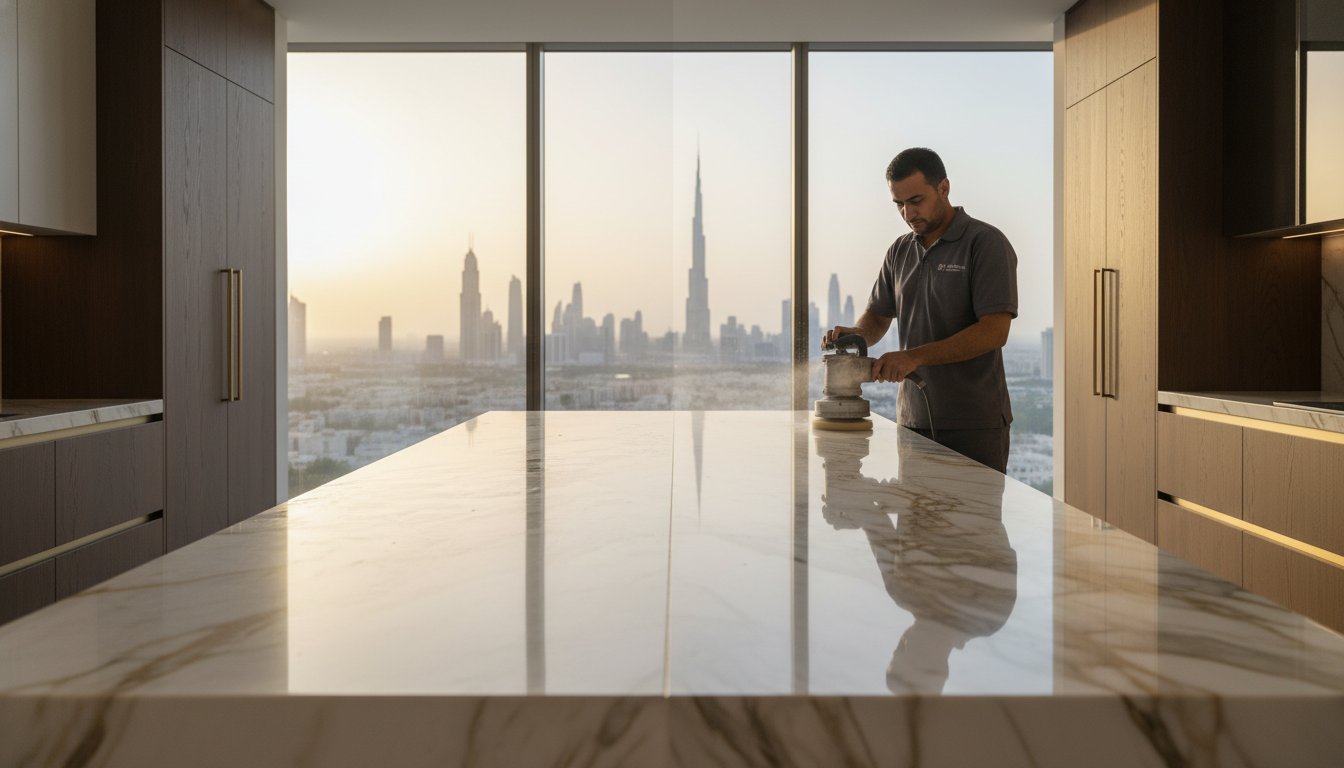
The decision to rip out and replace etched or cloudy marble surfaces isn’t just a logistical burden; it’s often an unnecessary expenditure that overlooks the technical capabilities of modern restoration. You likely invested in high-end stone for its timeless luxury, but daily use and Dubai’s unique environmental factors can quickly lead to a dull, cloudy appearance. When acidic spills cause visible etching, the immediate reaction is often to consider a full renovation. However, a professional marble countertop polishing service provides a precise, technical solution that restores the original luster of your stone without the disruption of a construction site.
We understand that maintaining asset value is a priority, especially with the introduction of Law No. (3) of 2026, which mandates strict quality and safety standards for buildings in Dubai. This article explains how advanced polishing and sealing techniques can restore a mirror-like finish while saving you up to 80% compared to replacement costs. You’ll learn about the specific methodologies used to eliminate deep scratches and how to ensure your surfaces comply with the latest Dubai Municipality and RERA maintenance requirements with minimal downtime for your kitchen or commercial space.
Key Takeaways
- Understand the financial advantages of choosing restoration over replacement, which typically results in savings of up to 80% while avoiding the hidden costs of plumbing and disposal.
- Learn how a professional marble countertop polishing service utilizes technical diamond abrasive grinding to eliminate deep etching and surface imperfections.
- Identify how Dubai’s desalinated hard water and high-traffic environments accelerate the degradation of premium stone surfaces.
- Discover the ‘Water Bead Test’ to quickly assess whether your stone’s protective seal has been compromised and requires technical intervention.
- Explore the specialized multi-step process that restores a mirror-like finish with significantly less downtime than a full kitchen or lobby renovation.
Why Luxury Marble Countertops Lose Their Luster in the UAE
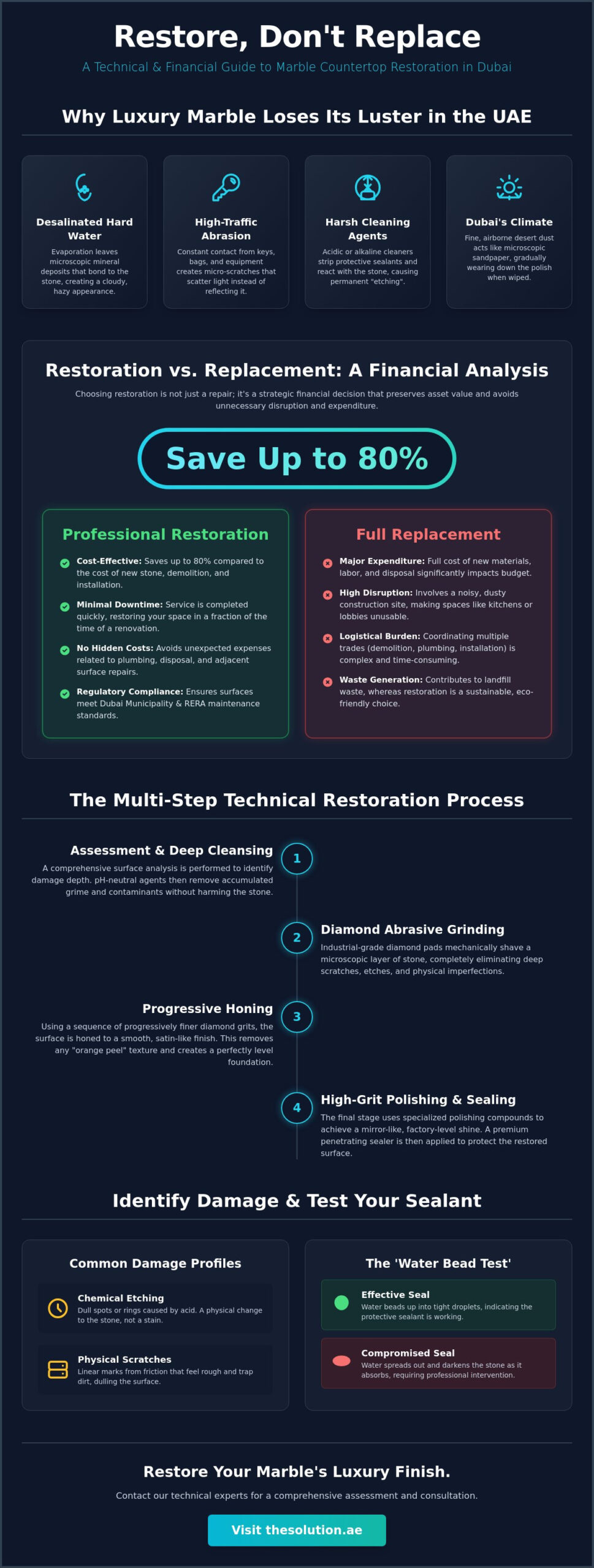
Marble is a metamorphic rock composed primarily of recrystallized carbonate minerals. To understand why its finish degrades, it helps to look at what is marble on a structural level. Because it consists of calcium carbonate, it’s highly sensitive to acidic substances and physical friction. In the high-demand environments of Dubai, these surfaces face a combination of environmental and chemical stressors that standard cleaning cannot resolve. Over time, these factors strip away the factory finish, leaving a surface that looks “cloudy” or “hazy” regardless of how often it’s wiped down.
One of the most significant contributors to stone degradation in the UAE is the mineral content of desalinated hard water. When water sits on a countertop, it interacts with the stone’s surface tension. As the water evaporates, it leaves behind microscopic mineral deposits that bond to the pores of the marble. In commercial settings, the problem is compounded by high-traffic abrasion. Constant contact with bags, keys, and equipment creates micro-scratches that scatter light instead of reflecting it. When this happens, a specialized marble countertop polishing service is the only way to mechanically level the surface and restore its reflective properties.
Common janitorial practices often accelerate this decline. Many general-purpose cleaners are either too acidic or too alkaline for natural stone. These chemicals strip away protective sealants and react with the calcium in the marble, causing “etching.” This isn’t a stain that can be washed off; it’s a physical change in the stone’s surface. Regular cleaning with the wrong products eventually creates a buildup of residue that traps dirt, making the surface look permanently dull.
Environmental Factors Unique to Dubai
Dubai’s climate presents specific challenges for stone maintenance. Constant air conditioning removes moisture from the air, which can dry out the stone and affect its internal moisture equilibrium. Additionally, fine desert dust acts as a microscopic abrasive. Even in high-rise apartments, this silica-rich dust settles on surfaces. If wiped away with a dry cloth, it acts like fine-grit sandpaper, gradually wearing down the polish. Rapid humidity fluctuations between indoor and outdoor spaces also put stress on the stone’s crystalline structure, leading to premature wear.
Common Countertop Damage Profiles
Identifying the type of damage is the first step in restoration. Chemical etching typically appears as dull “rings” or spots where a glass or bottle sat. Physical scratches, on the other hand, are linear and often feel rough to the touch. If left untreated, these imperfections progress into deep-seated staining as the stone’s pores become exposed to contaminants. It’s vital to avoid DIY polishing kits found in retail stores. These products often use generic abrasives or wax-based coatings that provide a temporary shine but trap grime and cause permanent surface yellowing. Professional intervention ensures the stone is treated according to its specific mineralogical needs.
The Technical Process of Marble Countertop Polishing
Effective restoration requires a systematic approach that moves beyond superficial cleaning. The process begins with a comprehensive surface assessment to identify the depth of etching and the presence of any structural fissures. We use pH-neutral deep cleansing agents to remove accumulated oils and biological contaminants without damaging the stone’s delicate chemistry. This preparation ensures that the subsequent mechanical stages act directly on the stone rather than on surface grime. By removing these impurities first, we prevent them from being ground deeper into the stone’s pores during the abrasive stages.
Once the surface is prepared, we initiate the diamond abrasive grinding phase. This stage is critical for removing physical damage. We use industrial-grade diamond pads to systematically shave away a microscopic layer of the stone. Because of the unique properties of marble, this mechanical resurfacing is the only way to eliminate deep scratches and chemical “burns” caused by acidic spills. We then transition to honing, using progressively finer grits to create a smooth, satin-like foundation that is perfectly level across the entire slab. This eliminates the “orange peel” texture often found on worn surfaces.
The final stages involve high-grit polishing to achieve the desired level of reflectivity. For a mirror-like finish, we utilize specialized polishing compounds that react with the stone to create a high-gloss shine. To prevent future damage, we apply professional-grade impregnating sealers. Unlike topical waxes, these sealers penetrate below the surface to provide a hydrophobic barrier against liquids. If you are looking to restore your surfaces, choosing a specialized on-site surface damage repair expert ensures these technical steps are executed with precision. A professional marble countertop polishing service is not just about aesthetics; it’s about reinforcing the stone’s structural integrity.
Advanced Wet-Polishing Technology
Our methodology utilizes advanced wet-polishing equipment designed specifically for indoor environments. By using water as a lubricant and cooling agent during the grinding process, we completely eliminate airborne dust. This is a significant advantage for luxury residential settings where air quality and cleanliness are paramount. We use specialized hand-held tools for countertop edges and splashbacks, ensuring that every centimeter of the installation receives the same level of technical attention as the main surface. This precision avoids the rounding of edges often seen with less sophisticated equipment.
Achieving the Desired Finish
Restoration vs. Replacement: A Financial Analysis
Choosing restoration over replacement is a calculated financial move for any property owner. The direct cost of sourcing and installing new marble slabs in the UAE is substantial. In contrast, a professional marble countertop polishing service typically costs a fraction of the price of new material. This approach allows you to reallocate your budget while achieving the same high-end aesthetic results. Beyond the material costs, replacement involves several hidden expenses that are often overlooked during initial planning. It’s a complex logistical undertaking rather than a simple swap.
Demolition and disposal of old stone require specialized labor and transport. Removing an existing countertop often necessitates the removal of the backsplash and the disconnection of plumbing fixtures. These secondary tasks add layers of complexity and expense. Restoration avoids these complications entirely. It is a non-invasive process that works within the existing footprint of your kitchen or lobby. You don’t have to worry about matching a new stone to old cabinetry or risking damage to expensive millwork during a tear-out. We focus on technical mastery to ensure the surrounding environment remains untouched.
Time is a critical asset, especially in commercial sectors. A full replacement can take weeks from templating to final installation. A restoration project is usually completed in a matter of hours or a few days. This minimal downtime is essential for hotels, restaurants, and active households that cannot afford a non-functional kitchen. Additionally, restoring existing stone is the more sustainable choice. It reduces the carbon footprint associated with quarrying and shipping new stone across the globe. By following industry standards for professional stone care, you extend the lifecycle of the material indefinitely.
The ROI of Surface Restoration
In the competitive Dubai real estate market, the condition of stone surfaces directly impacts property valuation. Etched or dull marble suggests neglect, whereas a mirror-like finish reinforces a sense of luxury. Investing in a marble countertop polishing service provides an immediate aesthetic upgrade that appeals to high-end tenants and buyers. Professional sealing also reduces long-term maintenance requirements. It prevents stains from penetrating the stone, which lowers the frequency of deep-cleansing interventions and protects your initial investment.
Decision Framework for Facilities Managers
Determining when marble is truly “beyond repair” requires technical expertise. Most surface-level issues, such as etching, hazy spots, and light scratches, are easily rectified through mechanical polishing. Only structural failures, like deep cracks that compromise the slab’s stability, might necessitate replacement. For commercial entities, budgeting for preventative maintenance is more cost-effective than reactive restoration. Our approach focuses on hard surface repair to ensure your assets remain in peak condition without the need for capital-intensive renovations.
Identifying When Your Countertops Need Professional Care
Determining the health of your stone surfaces doesn’t require specialized equipment. You can perform a simple ‘Water Bead Test’ to assess the integrity of your marble’s protective seal. Place a few drops of water on various sections of the countertop, particularly in high-use areas near the sink or food preparation zones. If the water beads up and remains on the surface, your seal is still functioning. If the water absorbs into the stone within a few minutes and leaves a dark spot, the marble is porous and vulnerable to deep-seated staining. This is a clear indicator that the surface requires professional intervention to prevent permanent damage.
Visual cues often provide the first warning signs of surface degradation. Cloudiness or a “hazy” appearance that persists after cleaning usually indicates microscopic abrasion. You might also notice “rings” or dull spots where glasses or bottles have sat; these are chemical etches, not simple stains. Lighting plays a critical role in this assessment. Use a flashlight or your phone’s torch held at a low angle across the surface. This side-lighting reveals micro-scratches, pitting, and uneven sheen that are invisible under standard overhead light. When these imperfections become widespread, a marble countertop polishing service is necessary to mechanically level the stone and restore its clarity.
The frequency of professional maintenance depends on the environment. Commercial spaces, such as hotel lobbies or restaurant bars, typically require a marble countertop polishing service every 6 to 12 months due to high-volume use. Residential kitchens may only need professional care every 2 to 3 years, provided daily maintenance is performed correctly. If you wait until the stone is visibly gray and rough to the touch, the restoration process becomes more intensive and time-consuming.
The Surface Integrity Checklist
- Pitting: Look for tiny holes or “flea bites” in the surface, which indicate the calcium structure is breaking down.
- Stain Evaluation: Determine if dark spots are oil-based (darkens the stone) or biological (food/coffee) to choose the correct poultice treatment.
- Seam Condition: Inspect the joins between slabs. If the epoxy is cracking or receding, it can trap moisture and lead to structural weakness.
Preventative Maintenance Tips
Daily care is the best way to extend the life of your polish. Use a clean, soft microfiber cloth and a stone-specific, pH-neutral cleaner. You must avoid ‘lemon’, ‘vinegar’, or any ammonia-based cleaners entirely. These acidic substances react instantly with the marble, creating fresh etches that dull the finish. Always utilize coasters for drinks and cutting boards for food prep. Even “mild” acids like tomato juice or citrus can damage the stone in seconds. For surfaces that have already lost their luster, you can book an on-site surface damage repair to restore the factory finish without the need for replacement.
The Solution: Expert Marble Restoration in the UAE
The Solution operates on a strict “repair over replacement” philosophy. We recognize that luxury surfaces are significant capital investments. Replacing them due to surface-level wear or chemical etching is financially inefficient and often unnecessary. Our technicians undergo rigorous training and assessment to meet high industry standards. This ensures that every marble countertop polishing service we provide is executed with technical precision. We don’t just clean; we restore the crystalline structure of the stone to its original factory finish. This methodology focuses on asset preservation through advanced engineering rather than temporary aesthetic fixes.
Our on-site service delivery is designed for the high-pressure environments of Dubai. We understand that hotels, malls, and private residences require a clean-site environment. We use specialized wet-polishing equipment that operates with minimal noise and zero airborne dust. This allows us to work in active commercial spaces or occupied homes without causing significant disruption. We also provide customized maintenance plans. These schedules are tailored to the specific traffic patterns and environmental stressors of your property. By establishing a proactive care cycle, we ensure long-term protection and prevent the need for more intensive reactive repairs in the future.
Why The Solution Leads in Technical Restoration
The Solution is a comprehensive resource for technical restoration across a wide array of architectural finishes. Our versatility makes us a preferred partner for complex commercial projects in the UAE. Our expertise often involves multi-surface projects where we combine stone care with stainless steel finish restoration to revitalize entire lobbies or industrial kitchens. This integrated approach ensures a consistent standard of quality across all materials. Our technical capabilities include:
- On-site surface damage repair for various stone and synthetic substrates
- Stainless steel finish restoration for commercial appliances and features
- Glass polishing to remove scratches and mineral deposits
- Floor restoration for marble, granite, and limestone
- Ceramic and tile repair for high-end bathrooms and kitchens
- Wood repair for bespoke furniture and millwork
- Quality spray paint services for architectural metalwork
Get a Professional Assessment Today
Requesting an on-site damage assessment is the first step toward restoring your surfaces. Our master craftspeople will visit your location in Dubai to evaluate the specific damage profile of your stone. We check for etching, deep scratches, and seal integrity using the technical methods discussed earlier in this guide. During this first consultation, we provide a clear technical breakdown of the required restoration steps and a transparent cost comparison against replacement. You receive a pragmatic solution focused on efficiency and high-quality results. Book your marble countertop assessment with The Solution to secure your asset’s value and restore its mirror-like finish today.
Secure Your Stone’s Value with Professional Restoration
Maintaining the mirror-like finish of your marble is a strategic investment in your property’s asset value. You’ve learned that most surface damage, including deep etching and cloudy abrasion, is reversible through technical mastery. Utilizing a professional marble countertop polishing service ensures significant savings compared to the logistical burden and high cost of full replacement. Our expert technicians are trained to international standards, providing the precision required to meet the UAE’s latest building quality regulations.
Our specialized on-site repair methodology uses advanced wet-polishing technology to eliminate airborne dust and suppress noise. This ensures your surfaces are restored with zero mess and negligible downtime for your commercial or residential space. Don’t permit dull or etched stone to diminish the luxury of your environment when a pragmatic, cost-effective solution is ready for deployment. You can protect your investment and reclaim the original luster of your stone today.
Request a Professional Marble Restoration Quote
We’re ready to help you restore the timeless elegance of your stone surfaces with meticulous care and technical expertise.
Frequently Asked Questions
How long does the marble countertop polishing process take?
Most residential marble restoration projects are completed within four to eight hours. The exact duration depends on the total square footage and the severity of existing surface damage. Because our marble countertop polishing service is conducted on-site without the need for demolition, you can typically resume using your kitchen or commercial space the same day. This efficiency is a primary advantage over full replacement, which can take weeks to coordinate.
Will the polishing process create a lot of dust in my kitchen?
No, our technical process is designed to maintain a clean-site environment. We utilize a wet-polishing methodology where water acts as a continuous lubricant and dust suppressant. This prevents particulates from becoming airborne, protecting your indoor air quality and surrounding cabinetry. Our technicians use specialized industrial vacuums to manage the slurry immediately, ensuring your luxury residence or commercial facility remains spotless throughout the restoration.
Can you remove deep stains or ‘rings’ from my marble countertop?
Yes, we can effectively remove chemical etches, often seen as dull “rings,” and most deep-seated stains. Rings are physical changes in the stone’s surface caused by acid; we eliminate them through mechanical diamond grinding that levels the stone. For deep biological or oil-based stains, we may apply a specialized poultice to extract the contaminant from the stone’s pores before beginning the final polishing stages.
How often should I have my marble countertops professionally polished in Dubai?
Residential countertops usually require professional attention every two to three years to maintain their protective seal and luster. Commercial environments in Dubai, such as hotel lobbies or high-traffic restaurants, should schedule a marble countertop polishing service every six to twelve months. Regular maintenance is necessary to combat the accelerated wear caused by fine desert dust and the mineral deposits found in desalinated water.
Is professional marble polishing better than using a DIY kit?
Professional restoration is significantly superior to retail DIY kits, which often rely on topical waxes or harsh chemicals. These consumer products provide a temporary shine that traps grime and can cause the stone to yellow over time. Our master craftspeople use industrial-grade diamond abrasives to mechanically resurface the stone. This technical approach achieves a permanent, mirror-like finish that DIY products simply cannot replicate.
Does polishing make the marble more resistant to future stains?
Polishing alone levels the surface, but the critical step for stain resistance is the application of professional-grade impregnating sealers. We include these high-performance sealers as part of our restoration process. These specialized compounds penetrate below the surface to create a hydrophobic barrier. This protection gives you more time to wipe away spills before they can penetrate the stone’s pores and cause permanent staining.
Can you repair chips and cracks during the polishing service?
Yes, we provide comprehensive on-site surface damage repair for chips, pits, and small fissures. We use technical, color-matched resins to fill the damaged areas. Once cured, these repairs are ground down and polished flush with the rest of the countertop. This results in a seamless finish where the previous damage is virtually invisible to the naked eye, reinforcing the structural integrity of the slab.
What is the difference between marble honing and marble polishing?
The primary difference lies in the grit level of the abrasives used and the final light reflectivity. Honing uses lower-grit diamonds to create a smooth, matte, or satin finish that is highly scratch-resistant and ideal for high-use areas. Polishing continues the process with much higher-grit diamonds and specialized compounds to achieve a high-gloss, mirror-like finish. Both methods provide a smooth surface, but polishing maximizes the stone’s color depth and shine.


