The most expensive way to fix a damaged architectural facade isn’t the repair itself; it’s the decision to replace it. With over 60% of global infrastructure utilizing steel, the demand for high-quality maintenance has never been more critical. Many property managers believe that they must replace specialized cladding to maintain a building’s aesthetic integrity. It’s a common frustration to face long lead times for imported materials and the high costs of full-scale construction. You might assume it’s impossible to repair dents in metal panels without leaving a visible mark, but modern restoration techniques have changed that reality.
In the high-density urban landscape of Dubai and Abu Dhabi, metal surfaces are foundational to architectural identity. Specialized firms such as Techno Specialist, known for Tensile Fabric Structure Design, demonstrate how engineering precision is required for modern building envelopes. From the brushed stainless steel of premium elevator cabs to the powder-coated aluminum cladding of high-rise facades, these materials are everywhere. To effectively repair dents in metal panels across such a diverse range of assets, a technician must understand the specific environmental and mechanical stresses each surface faces. High-traffic commercial zones require more than just a superficial fix. They need a durable, technically sound restoration that maintains the asset’s value under constant use.
We understand that your priority is a flawless finish with minimal disruption to your daily operations. You want a solution that is both fiscally responsible and technically superior. This guide demonstrates how professional on-site restoration provides an invisible finish while saving you significant capital compared to replacement. We’ll examine the technical differences between these two approaches, highlighting how specialized methodology can restore your surfaces to their original condition in a fraction of the time. You’ll discover why choosing restoration is the intelligent choice for your facility’s long-term value.
In this guide, you will find:
- The technical distinctions between architectural and automotive metals and why specialized restoration is required for commercial facades.
- Professional methodologies used to repair dents in metal panels on-site, ensuring an invisible finish without the need for material removal.
- A strategic analysis of the cost-benefit ratio between restoration and replacement, focusing on tangible capital savings and reduced lead times.
- Key commercial applications where expert metal repair preserves the value and aesthetic of stainless steel and aluminum assets.
- The Solution’s approach to technical mastery, delivering high-quality results with minimal disruption to your business operations.
Why Dents in Metal Panels Require Specialized Technical Restoration
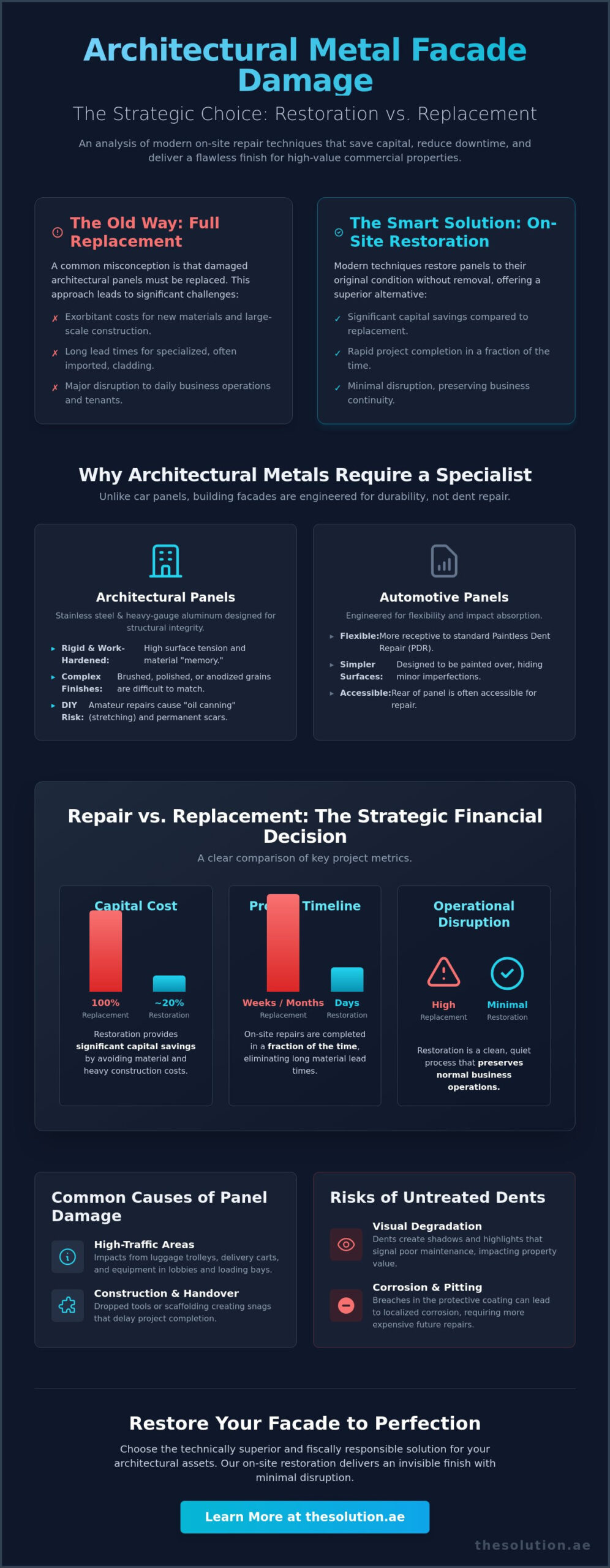
To effectively repair dents in metal panels, you can’t rely on generic methods. Automotive panels are engineered for flexibility and impact absorption, making them more receptive to standard Paintless Dent Repair (PDR) techniques. In contrast, architectural panels are often rigid and work-hardened during the manufacturing process. Attempting to “hammer out” a dent, a common DIY suggestion, typically results in “oil canning” or permanent stretching of the metal. This amateur approach causes the metal to expand, creating a protruding high spot that’s impossible to flatten without specialized tools. It also destroys the factory-applied grain or finish, leaving a permanent scar on the material.
Common Causes of Metal Panel Damage in Commercial Spaces
Most damage occurs during high-activity periods. In luxury hotels, luggage trolleys and heavy delivery carts frequently impact elevator doors and lobby panels. We also see significant damage during the final handover phase of construction projects. Tools or scaffolding dropped by contractors can create unsightly “snags” that delay project completion and affect final payments. In high-traffic office buildings, accidental impacts in elevator cabs or loading bays remain the primary source of surface degradation. These impacts often occur in areas where the back of the panel is inaccessible, making traditional repair methods impossible.
The Aesthetic and Structural Risks of Untreated Dents
Even a minor indentation can become a major visual flaw. Polished or brushed surfaces are particularly sensitive to light refraction. A small dent creates a shadow or a highlight that draws the eye, signaling poor maintenance to tenants and visitors. Beyond the look, there’s a structural risk. If a dent is deep enough to breach a protective coating or the grain of stainless steel, it creates a site for localized corrosion. This eventually leads to pitting that requires much more expensive intervention. For facilities managers, these imperfections directly impact property valuation and the perceived quality of the asset. Addressing these issues early is a strategic financial decision that prevents the need for total panel replacement later.
Advanced Techniques to Repair Dents in Metal Panels On-Site
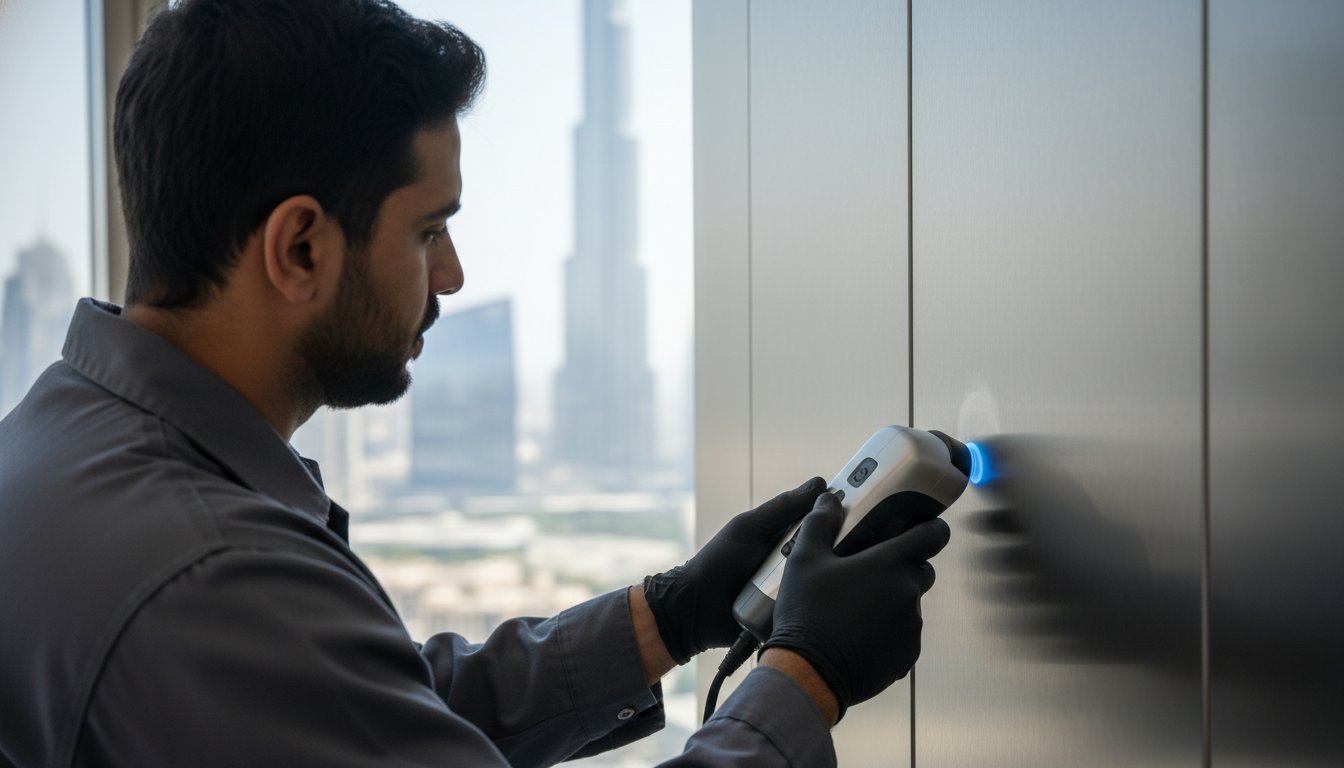
Successfully executing a strategy to repair dents in metal panels requires a shift from traditional demolition to technical restoration. Most commercial panels are fixed to internal structures, making the rear side entirely inaccessible. Our methodology focuses on external manipulation. We use specialized tools designed to work from the face of the panel, eliminating the need for costly dismantling or facade removal. This approach maintains the structural seal of the building while providing an invisible result that matches the surrounding material perfectly.
While foundational metal body repair techniques provide the basis for understanding material behavior, architectural restoration requires a higher degree of precision to match factory-specific finishes. We don’t just remove the dent; we restore the surface’s optical properties. Whether the panel is mirror-polished stainless steel or a specific matte-anodized aluminum, the repair must account for how light interacts with the metal’s grain. Our technicians use a combination of mechanical pulling and thermal stabilization to ensure the metal doesn’t “rebound” or lose its shape over time.
Precision Dent Pulling and Massaging
We utilize advanced glue-pulling systems specifically engineered for the high-tension environment of architectural cladding. Unlike suction-based tools, these systems allow for micro-adjustments across the dent’s surface. Heat induction plays a vital role here. By applying controlled, localized heat, we can relax the metal’s molecular structure. This makes the material more pliable and prevents the finish from cracking during the pulling process. For panels where rear access is possible, such as elevator interiors, we use internal massaging techniques to gently move the metal back to its original plane without stretching the alloy.
Surface Levelling and Re-finishing
Sharp creases or deep gouges often require more than just pulling. In these instances, we employ technical fillers and metal-bonding compounds that expand and contract at the same rate as the base material. This prevents the repair from failing during temperature fluctuations. The most critical step is the re-graining process. For stainless steel, we use specialized abrasive pads to recreate the exact linear grain of the factory finish. If the panel is powder-coated, we perform precision color-matching and spot-spraying. Choosing on-site surface damage repair ensures that these complex finishes remain consistent across the entire facade, making the repair site indistinguishable from the original panel.
Repair vs. Replacement: The Strategic Financial Decision
Choosing to replace a damaged architectural feature is often a reactive decision rather than a strategic one. In the UAE’s high-stakes commercial property market, the direct cost of a new panel is only the beginning of the expenditure. When you decide to utilize hard surface repair instead of replacement, you are optimizing your facility’s operational budget. Replacement involves a complex chain of logistics, including international shipping, customs duties, and specialized labor for demolition. These hidden costs frequently double or triple the initial quote for the material itself.
Restoration offers a more streamlined path to maintaining asset value. It aligns with 2026 sustainability standards by reducing construction waste and adhering to circular economy principles. Instead of sending high-grade aluminum or steel to a landfill, we preserve the existing material. This approach is not just environmentally responsible; it’s a fiscally sound methodology that protects the bottom line during critical periods, such as the final handover of a major construction project. Choosing to repair dents in metal panels on-site ensures your capital is spent on technical expertise rather than logistical overhead.
Eliminating Lead Times and Logistical Hurdles
Replacement often forces facilities managers into an 8 to 12 week waiting period for imported metal cladding. This delay is unacceptable in 24/7 environments like international airports, luxury hotels, or Grade A office towers. On-site restoration eliminates this downtime completely. We can repair dents in metal panels during off-peak hours, ensuring zero disruption to your tenants or guests. Additionally, replacing a single panel carries a high risk of color-matching failure. New batches of powder-coated or anodized metal rarely match the weathered patina of existing installations perfectly. Professional restoration avoids this patchwork look by working directly with the original material.
Tangible Savings for Large-Scale Projects
The financial benefit of restoration is most evident in large-scale applications. Technical restoration can save up to 80% compared to the total cost of full replacement. This is largely due to avoiding the domino effect. In many modern cladding systems, removing one damaged panel requires the dismantling of several adjacent, undamaged sections. This increases the risk of further damage and inflates labor costs. By choosing restoration, you bypass these structural complications. Our technicians focus solely on the affected area, providing a surgical fix that maintains the integrity of the entire facade while delivering significant and measurable capital savings.
Typical Applications: Where Professional Metal Repair is Vital
In the high-density urban landscape of Dubai and Abu Dhabi, metal surfaces are foundational to architectural identity. From the brushed stainless steel of premium elevator cabs to the powder-coated aluminum cladding of high-rise facades, these materials are everywhere. To effectively repair dents in metal panels across such a diverse range of assets, a technician must understand the specific environmental and mechanical stresses each surface faces. High-traffic commercial zones require more than just a superficial fix. They need a durable, technically sound restoration that maintains the asset’s value under constant use.
Dubai’s unique climate and architectural standards demand specialized care. The intense heat and humidity can exacerbate the visibility of surface imperfections, as light reflects differently off distorted metal. This makes the role of stainless steel finish restoration critical for maintaining the prestige of commercial towers and luxury hotels. We don’t just pull the dent; we ensure the protective properties and the optical grain of the metal are fully reinstated. This precision is vital for surfaces that are subjected to the scrutiny of high-profile tenants and international visitors.
Elevator Doors and Lobby Entrances
Elevator lobbies serve as the “handshake” of a building, forming the first impression for every visitor. Delivery trolleys, luggage carts, and heavy foot traffic frequently cause impact damage to elevator doors and frames. These high-visibility stainless steel surfaces are notoriously difficult to repair without leaving visible marks. Our technical mastery allows us to erase these dings and restore the original factory grain on-site. By focusing on these entrance portals, we help facilities managers maintain a pristine aesthetic for luxury residential and commercial towers without the disruption of replacing entire door skins.
External Cladding and Decorative Panels
Exterior facades present a different logistical challenge. Many Dubai structures utilize Aluminum Composite Panels (ACP) or decorative powder-coated window frames. Impact damage from window cleaning cradles or construction accidents often occurs at height. Traditionally, fixing these would require massive scaffolding or expensive panel replacement. Our on-site methodology allows us to repair dents in metal panels while they remain installed. We use specialized access equipment to rectify damage to cladding and facade elements, avoiding the need for heavy site infrastructure. This keeps the building operational and ensures that the facade remains flawless. If your property’s exterior has suffered impact damage, you should contact us for on-site surface damage repair to restore your building’s facade to its original specification.
Restoring Perfection: The Solution’s Expert Approach in the UAE
The Solution provides a level of technical mastery that transforms how facilities managers in the UAE approach surface damage. We don’t view a dent as a reason for demolition. Instead, we see it as a technical challenge that requires precision engineering and an expert eye for detail. Our commitment to flawless, invisible restoration is what sets us apart in a market where the standard is often replacement by default. By choosing to repair dents in metal panels through our specialized on-site service, you’re opting for a solution that prioritizes both aesthetic perfection and fiscal responsibility.
Our team undergoes rigorous training to handle a wide array of metal alloys, including high-grade stainless steel, anodized aluminum, and powder-coated surfaces. We understand the unique needs of Dubai’s construction and hospitality sectors, where the margin for error is non-existent. A single visible imperfection in a five-star hotel lobby or a Grade A office tower is a failure. We ensure that every project we undertake meets the highest international quality standards, delivering results that are indistinguishable from the original factory finish.
Meticulous Workmanship and Quality Standards
Our restoration process is structured and disciplined. It begins with a comprehensive assessment of the material’s grain, tension, and finish. We then employ precision tools to manipulate the metal back to its original plane. This isn’t a generic repair; it’s a bespoke process tailored to the specific alloy and coating of your panels. We use advanced compounds and specialized abrasive systems to recreate textures, ensuring the repair site is optically perfect. This meticulous approach is why we are the preferred partner for premium properties across the UAE, providing a reliable alternative to the logistical nightmare of replacement.
Get Started with a Professional Assessment
Determining whether a panel is a candidate for restoration depends on the depth of the crease and the integrity of the base material. Most architectural dents, even those on high-level cladding or in high-traffic elevator portals, can be successfully rectified on-site. Our quoting process is designed for the speed of the Dubai business environment. We provide clear, technical evaluations that allow you to make an informed financial decision quickly. If you’re ready to restore your assets and eliminate the high costs of replacement, you should Contact The Solution for an expert metal repair consultation. Our on-site team is ready to demonstrate the technical mastery that defines our brand and ensures your surfaces remain in pristine condition.
Secure the Value of Your Commercial Facade
Technical restoration is the most efficient way to manage surface damage in the UAE’s competitive property market. By choosing to repair dents in metal panels on-site, you eliminate the logistical burden of importing materials and the high costs associated with full-scale replacement. Our specialized team focuses on the high-end commercial sector in Dubai, delivering invisible results through expert re-graining for stainless steel and precise thermal manipulation of aluminum alloys.
We’ve established that restoration is an intelligent financial decision that preserves the architectural integrity of your building. You don’t have to settle for the disruption of construction or the patchwork look of mismatched panel batches. The Solution provides a master craftsperson’s approach to every challenge, ensuring your surfaces return to their original factory specification with minimal downtime. This process maintains your asset’s value while adhering to modern sustainability standards.
Protect your bottom line and maintain your building’s premium aesthetic. Request a Professional Metal Repair Quote Today and experience the benefits of technical mastery. We look forward to helping you restore perfection to your facility.
Frequently Asked Questions
Can dents in stainless steel elevator doors be completely hidden?
Yes, professional restoration can achieve an invisible finish on stainless steel elevator doors. We use specialized abrasive techniques to match the original factory grain exactly. This process ensures that light refracts uniformly across the surface, eliminating the shadows that typically reveal a dent. It is the most effective way to repair dents in metal panels without compromising the aesthetic of a high-end lobby.
How long does it take to repair a typical dent in a metal wall panel?
Most individual repairs are completed within a few hours on-site. This is significantly faster than the alternative of ordering replacement parts, which often carries an 8 to 12 week lead time for imported materials in the UAE. Because the work is performed in situ, we can schedule repairs during off-peak hours. This efficiency minimizes operational downtime for busy commercial facilities and ensures your assets are restored quickly.
Is on-site metal repair messy or disruptive to my office/hotel?
On-site restoration is a clean, non-invasive process that causes minimal disruption to your daily operations. Unlike replacement, there is no demolition, heavy machinery, or construction debris involved. Our technicians work within a small footprint using specialized hand tools and localized extraction. This makes the service ideal for occupied hotels, corporate offices, and luxury residential towers where maintaining a quiet, clean environment is a priority.
Will the repair hold up in the UAE’s high-humidity and heat conditions?
Yes, our repairs are engineered to withstand the extreme temperature fluctuations and high humidity of the UAE climate. We use technical compounds and bonding agents that match the thermal expansion rates of the base metal. This prevents the repair from cracking or delaminating during peak summer heat. Our methodology ensures a long-term, durable result that maintains its integrity in both indoor and outdoor environments.
Can you fix dents in powder-coated or painted metal panels?
We can successfully restore powder-coated and painted surfaces using precision color-matching techniques. After the physical dent is removed, our technicians apply high-quality spray paint finishes to blend the repair site with the surrounding area. This results in a seamless look that preserves the original design intent of the panel. It’s a cost-effective way to repair dents in metal panels while avoiding the batch-matching issues common with replacement.
Is there a limit to how large or deep a dent can be for a repair to be successful?
Success depends on the severity of the metal’s deformation rather than just the size of the dent. If the metal has been torn or severely stretched beyond its elastic limit, restoration may be more complex. However, even deep or creased dents can often be rectified through thermal stabilization and technical fillers. A professional assessment is the only way to determine if a specific panel is a candidate for restoration.
Why shouldn’t my general maintenance team try to fix the dent themselves?
General maintenance teams often lack the specialized tools and technical training required for architectural metal restoration. Amateur attempts to hammer out a dent usually result in permanent stretching or oil canning, which makes the damage worse. Professional technicians understand material memory and surface tension. They use controlled methods to return the metal to its original plane without destroying the factory-applied finish or grain.
Do you provide repair services for construction handover snags in Dubai?
Yes, we specialize in rectifying surface damage during the final handover phase of major construction projects in Dubai. We work closely with contractors and developers to resolve snags on stainless steel and aluminum panels. Our on-site service ensures that projects meet the rigorous standards required for final sign-off. This protects the developer’s bottom line and ensures the property is delivered to the client in pristine condition.


