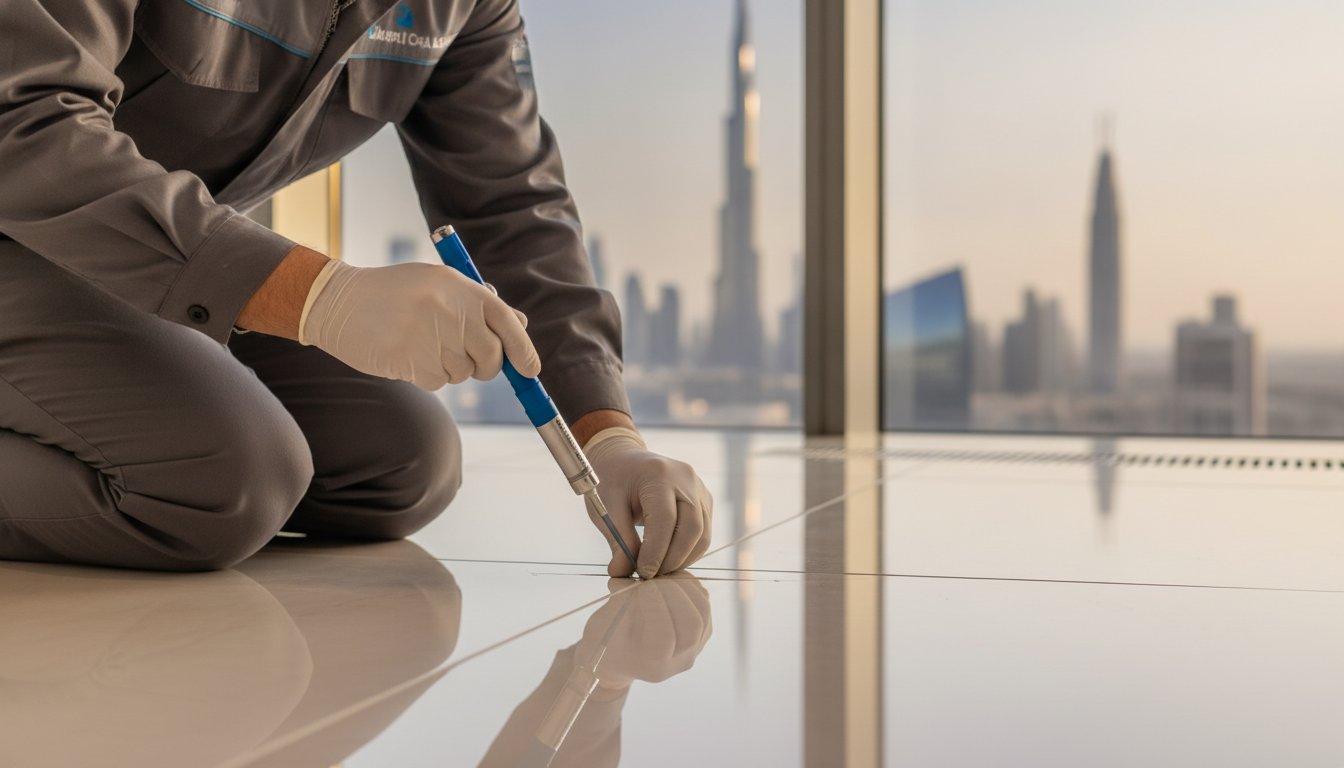
What if that hollow “clink” under your feet isn’t a signal to demolish your floor, but an opportunity to save thousands in restoration costs? Most property owners assume that loose or hollow tiles require a full, messy replacement. It’s a daunting prospect when you consider the inevitable dust, the disruption to your business, and the difficulty of matching discontinued tile patterns. You’re likely already feeling the pressure of a market where construction material prices have surged by up to 71% in the last year alone.
Professional tile crack injection repair offers a sophisticated, non-invasive alternative that restores floor stability without lifting a single tile. By choosing this forensic restoration technique, you can achieve a solid, silent floor and invisible repairs in a fraction of the time required for traditional replacement. This guide explores the technical precision of resin injection, the implications of Dubai’s 2026 building quality and safety laws, and why this methodology is the most intelligent financial decision for modern property maintenance.
Key Takeaways
- Understand how tile crack injection repair utilizes high-strength, low-viscosity resins to permanently bond hollow tiles to the substrate without removal.
- Realize significant cost savings of 70-80% compared to full floor replacement by choosing technical restoration over demolition.
- Learn about the acoustic mapping and micro-injection techniques that allow for rapid repairs with zero downtime for commercial operations.
- Explore how professional tile restoration ensures compliance with Dubai’s 2026 building safety regulations and mandatory quality inspections.
What is Tile Crack Injection Repair? Solving the “Drummy” Floor Problem
Tile crack injection repair is a specialized restoration process designed to stabilize floor finishes that have detached from their substrate. Unlike traditional replacement, which requires destructive demolition, this technique involves the precision delivery of high-strength, low-viscosity resins into the voids beneath debonded tiles. By filling these “drummy” areas, we restore the structural bond between the tile and the slab. This approach aligns with the broader philosophy of historic preservation, focusing on maintaining the integrity of original materials while correcting internal failures. It is a surgical solution for a structural problem.
When a tile loses its bond, it creates a hollow pocket. You’ll often recognize this by the distinct, echoing sound it makes when walked upon. If left untreated, the tile will eventually crack under foot traffic or heavy furniture. In the UAE, this issue is exacerbated by extreme temperature fluctuations. Concrete and ceramic expand at different rates. Without a perfect bond, these materials work against each other, leading to a total failure of the adhesive layer. What begins as a slightly loose grout line quickly evolves into a fractured tile that is impossible to match.
Identifying Hollow Tiles: The Broomstick Test
Relying on knuckle tapping is inefficient for large-scale commercial facilities like hotel lobbies or malls. We utilize acoustic resonance testing, often called the “broomstick test,” to conduct a comprehensive site-wide audit. By dragging a weighted sounding rod across the floor, our technicians can instantly identify changes in frequency. This method allows us to map “failure zones” with high precision. Once identified, these areas are marked for targeted tile crack injection repair. This ensures that only the compromised sections are treated while the rest of the floor remains undisturbed and open for use.
Causes of Tile Debonding in the UAE
Thermal expansion is the primary driver of tile failure in Dubai. The intense external heat affects the structural slab, while air-conditioned interiors keep the tile surface cool. This thermal gradient creates significant stress on the adhesive layer. Additionally, many properties suffer from poor initial installation, specifically the “dot and dab” method. This shortcut leaves large voids under the tile corners, providing zero support. In high-rise towers, subfloor vibration and minor building settlement further stress these weak points. Without a full bed of adhesive, the tile is essentially floating, waiting for a heavy load to cause a permanent fracture.
The Science of Resin Injection: Why It Beats Traditional Re-Tiling
Traditional re-tiling relies on mechanical bonds that often fail due to environmental stress or improper initial application. Tile crack injection repair introduces a high-performance chemical bond that frequently exceeds the tensile strength of the original mortar. While industry-standard installation methods provide the framework for new construction, restoration requires a more surgical approach. By utilizing engineered resins instead of cementitious adhesives, we can address the root cause of “drummy” floors without the destructive footprint of a full renovation.
The structural integrity of a floor depends on the total contact between the tile and the substrate. When air pockets form, the tile becomes a bridge that eventually collapses under weight. Injected resins cure into a rigid, non-shrink mass that provides 100% support across the entire surface area. This restores the floor’s load-bearing capacity, making it capable of handling heavy foot traffic, industrial machinery, or commercial displays. Beyond structural stability, the resin acts as a permanent moisture barrier. It seals the void entirely, preventing water ingress from cleaning or spills that would otherwise lead to mold growth or further adhesive degradation.
Low-Viscosity Resins vs. Standard Adhesives
The success of the injection process depends on the physics of capillary action. We use low-viscosity resins that possess a water-like consistency during the application phase. This allows the material to flow into the tightest crevices and reach the furthest edges of a hollow zone. Standard epoxies are often too thick to penetrate these micro-voids effectively. These advanced resins also offer rapid curing times. Most floors are ready for full service within hours, not days. This chemical resistance ensures the repair outlasts original mortars, especially in environments exposed to harsh cleaning agents or high humidity.
Restoring the Bond: Substrate Compatibility
Modern injection materials are engineered for high compatibility with diverse subfloors, including concrete slabs, sand-cement screeds, and even stable wooden substrates. This versatility is essential for the ceramic and tile repair of high-end porcelain or natural stone. The injection process stabilizes the “floating” sensation common in debonded floors, creating a monolithic structure that feels solid underfoot. If your property is experiencing these symptoms, consulting with technical restoration experts can prevent a minor hollow spot from becoming a major structural failure.
By choosing resin injection, you’re opting for a solution that addresses the physics of the problem. It’s a pragmatic choice for property managers who prioritize longevity and minimal disruption. The result is a floor that doesn’t just look restored; it is technically superior to its original state.
Tile Injection vs. Full Replacement: An Intelligent Financial Decision
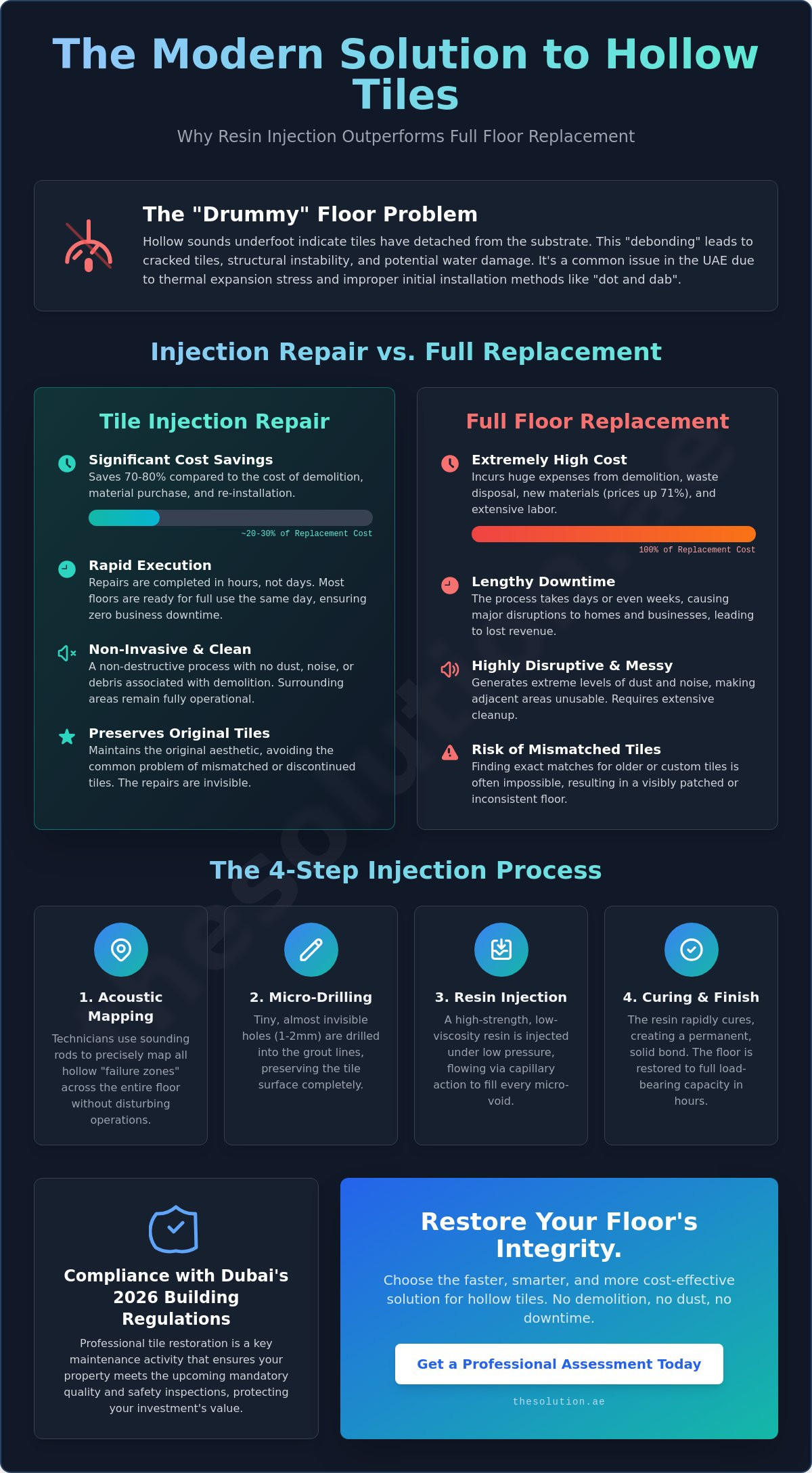
For facility managers and property owners, the decision to repair or replace is rarely just about aesthetics. It’s a calculated assessment of risk, cost, and operational uptime. While some critics argue that injection is a temporary fix, modern resin technology proves otherwise. Choosing tile crack injection repair over full replacement typically results in cost savings of 70-80%. These savings aren’t just in labor and materials; they represent the avoidance of a massive logistical undertaking that would otherwise paralyze a commercial space.
The efficiency of this methodology is unmatched. A professional team can restore a 50sqm hotel lobby in a single day, whereas a full demolition and re-tiling project could easily span two weeks. Beyond the timeline, restoration is the more sustainable choice. It significantly reduces construction waste by keeping existing materials in place. It also mitigates the risk of accidental damage to sensitive subfloor systems. During demolition, jackhammers often puncture underfloor heating coils or waterproofing membranes, leading to secondary repair costs that far exceed the original budget.
The ROI of Restoration for Facilities Managers
Calculating the true return on investment requires looking at the “hidden costs” of demolition. You must account for dust protection, noise complaints from tenants, and the potential for total business closure during the works. This is why injection is the preferred method for hard surface repair in active commercial environments. This approach aligns with international standards for technical restoration, much like the guidelines for using substitute materials in preservation, which prioritize the use of high-performance modern resins to save original structures. It’s often the only viable solution when dealing with discontinued tile patterns where replacement is physically impossible.
Minimal Disruption: The “Silent Repair” Advantage
The injection process is often referred to as a “silent repair.” It eliminates the need for heavy machinery, jackhammers, or industrial skips parked outside your entrance. Because the process is minimally invasive, businesses can remain fully operational while the work is performed. There’s no clouds of silica dust or disruptive vibrations. You maintain the aesthetic continuity of the original design without the risk of mismatched dye lots or grout colors. It is the most pragmatic way to ensure a solid, silent floor while respecting the bottom line and the comfort of your occupants.
The Professional Tile Injection Process: Precision Without Destruction
Executing a successful tile crack injection repair requires a disciplined, multi-stage methodology. It is not a simple case of filling a hole; it is a surgical procedure designed to restore the structural relationship between the finish and the substrate. We follow a rigorous protocol that ensures every hollow pocket is identified, treated, and permanently sealed. This structured approach is what separates a professional restoration from a temporary patch. By following these precise steps, we guarantee a result that is both structurally sound and aesthetically perfect.
The process begins with the acoustic mapping mentioned earlier, creating a definitive blueprint of the failure zones. Once the hollow areas are marked, our technicians perform strategic micro-drilling. We focus exclusively on the tile grout lines to avoid compromising the tile surface itself. Using specialized high-pressure equipment, we inject the low-viscosity resin through these ports. The resin is pumped until the entire void is saturated, displacing air and creating a new, monolithic bond. After the resin has cured, we conduct a second round of structural testing to confirm the “drummy” sound has been eliminated before moving to the final aesthetic stage.
Micro-Drilling and Port Placement
Precision is critical during the drilling phase. We use micro-drill bits that are smaller than the width of the grout joint. This technique maintains the integrity of the tile edges and prevents chipping or cracking. The number of ports is determined by the size of the hollow zone and the flow characteristics of the substrate. We calculate the optimal placement to ensure maximum resin coverage with the fewest possible entry points. This careful planning ensures that the resin reaches every corner of the debonded area, providing total support for the tile above.
Invisible Finishing and Color Matching
The hallmark of a master craftsperson is the ability to make the repair completely indistinguishable from the surrounding floor. Unlike generic services that leave visible drill holes, we utilize custom-blended fillers to match the exact color and texture of your existing grout. This requires a high level of skill and an eye for detail. We meticulously fill each injection port and then perform a final polishing and cleaning. The result is a floor that looks as though it was never damaged. If you want to see how we achieve these invisible restoration results for your property, our team is ready to provide a technical assessment.
Choosing “The Solution” for Expert Tile Restoration in Dubai
Navigating the technical landscape of UAE construction requires more than just standard repair skills. It demands a deep understanding of how local climate conditions and subfloor dynamics impact material longevity. At The Solution, we position ourselves as the leading choice for complex restoration challenges. Our expertise in tile crack injection repair allows us to address structural defects that others might deem irreparable. We understand that in the high-stakes environment of Dubai real estate, reliability and technical mastery are the only acceptable standards.
Our business-to-business focus is designed to meet the rigorous demands of the commercial sector. We serve a high-profile client base including international hotel chains, luxury malls, and commercial towers. We recognize that for these entities, downtime is a direct financial loss. Our processes are engineered for speed and efficiency, ensuring that your facility remains operational while we restore its integrity. This pragmatic approach extends across our entire service range, from floor restoration to stainless steel finish restoration. We are a comprehensive resource for any technical surface problem.
Construction Handover and Snagging Specialists
Meeting handover deadlines is a critical priority for contractors in the UAE. Hollow tiles are a common “snag” that can delay project completion and trigger significant penalties. We help contractors meet these deadlines by fixing hollow tiles overnight, providing a rapid solution that avoids the need for costly rework. Our repairs provide documented proof of structural stability, which is essential for quality control assessments. With the introduction of the March 2026 building quality and safety law in Dubai, having professional restoration that meets municipality standards is more important than ever. We ensure your project receives its Quality and Safety Certificate without delay.
The Master Craftsperson Guarantee
The personality of our brand is that of a master craftsperson. We are competent, meticulous, and proud of the work we deliver. High-profile UAE clients trust us because we treat their surfaces as valuable assets, not just building materials. Whether it’s a cracked porcelain tile in a lobby or a damaged glass facade, we apply the same level of rigorous training and assessment. Our specialized tile crack injection repair methodology is a testament to this commitment. Choosing professional restoration is an intelligent financial decision that prioritizes long-term value over temporary patches. Contact our team today for a forensic site audit and a detailed repair quote to secure the future of your property.
Securing Your Assets with Technical Restoration
Maintaining the structural integrity of your flooring is a critical component of professional facility management. You’ve seen how tile crack injection repair transforms a compromised, hollow surface into a solid, high-performance floor without the mess of demolition. By choosing resin technology over full replacement, you reduce project costs by up to 80% and eliminate the dust that threatens sensitive commercial environments. This methodology is the most pragmatic way to meet Dubai’s 2026 building safety standards while keeping your operations running at full capacity.
Request a Professional Site Audit for Your Tile Repair and experience a zero-demolition process that prioritizes your bottom line.
Frequently Asked Questions
Is tile injection a permanent repair for loose floors?
Tile injection provides a permanent structural bond between the tile and the slab. The low-viscosity resins are engineered to resist the mechanical stresses of building movement and the thermal fluctuations common in the UAE. Unlike original cementitious adhesives that can become brittle, these polymers maintain their integrity over time, ensuring the floor remains solid and silent for its entire lifecycle.
Will the drill holes be visible after the injection is finished?
The injection ports are completely indistinguishable from the rest of the floor once the process is finished. By drilling exclusively into the grout lines and using custom-pigmented fillers, our technicians replicate the exact texture and shade of your existing grout. This meticulous attention to detail ensures that the repair does not disrupt the aesthetic continuity of high-end finishes.
How long does the resin take to cure before I can walk on the tiles?
You can walk on the floor within four to six hours of the application. The resin achieves a high percentage of its total strength rapidly, allowing for minimal disruption to commercial or residential activities. For heavy loads or industrial equipment, we recommend a 24-hour curing period to ensure the structural bond has reached its maximum load-bearing capacity.
Can injection repair fix tiles that are already cracked?
Injection repair is highly effective at stabilizing tiles that have already sustained cracks. By filling the hollow pocket beneath the fracture, the resin stops the “bridging” effect that causes tiles to flex and break further. While the resin doesn’t “heal” the visible crack itself, it provides the necessary support to keep the remaining pieces firmly in place and prevents the damage from spreading.
Is injection suitable for all types of tiles, including marble and porcelain?
This methodology is compatible with all hard floor surfaces, including dense porcelain, ceramic, and natural stones like marble or granite. The high-strength resins are designed to adhere to both porous and non-porous materials. This versatility makes it an ideal solution for luxury properties in Dubai that feature high-end, large-format stone slabs that would be prohibitively expensive to replace.
How much does tile crack injection repair cost compared to replacement?
Opting for tile crack injection repair is an intelligent financial decision that typically results in substantial savings compared to a full replacement. You avoid the high costs of new tile procurement, the labor-intensive demolition process, and the expenses associated with waste disposal. Furthermore, you eliminate the risk of damaging underfloor systems, which often leads to unforeseen secondary repair costs.
Can this method be used for tiles in wet areas like showers or pool decks?
The resins used in this process are naturally waterproof and highly effective in wet environments. In areas like showers or pool decks, the injection seals the subfloor and prevents water from pooling in hollow pockets. This stops the cycle of moisture ingress that typically degrades original adhesives and leads to mold growth or structural decay.
What happens if the hollow tiles are not repaired?
Ignoring hollow tiles inevitably leads to complete floor failure. As the debonded area is subjected to foot traffic, the lack of support causes the tile to flex until it shatters. Beyond the aesthetic damage, loose tiles can lead to grout loss, moisture entrapment, and trip hazards. Addressing the issue early with technical restoration prevents a localized problem from becoming a site-wide safety concern.


