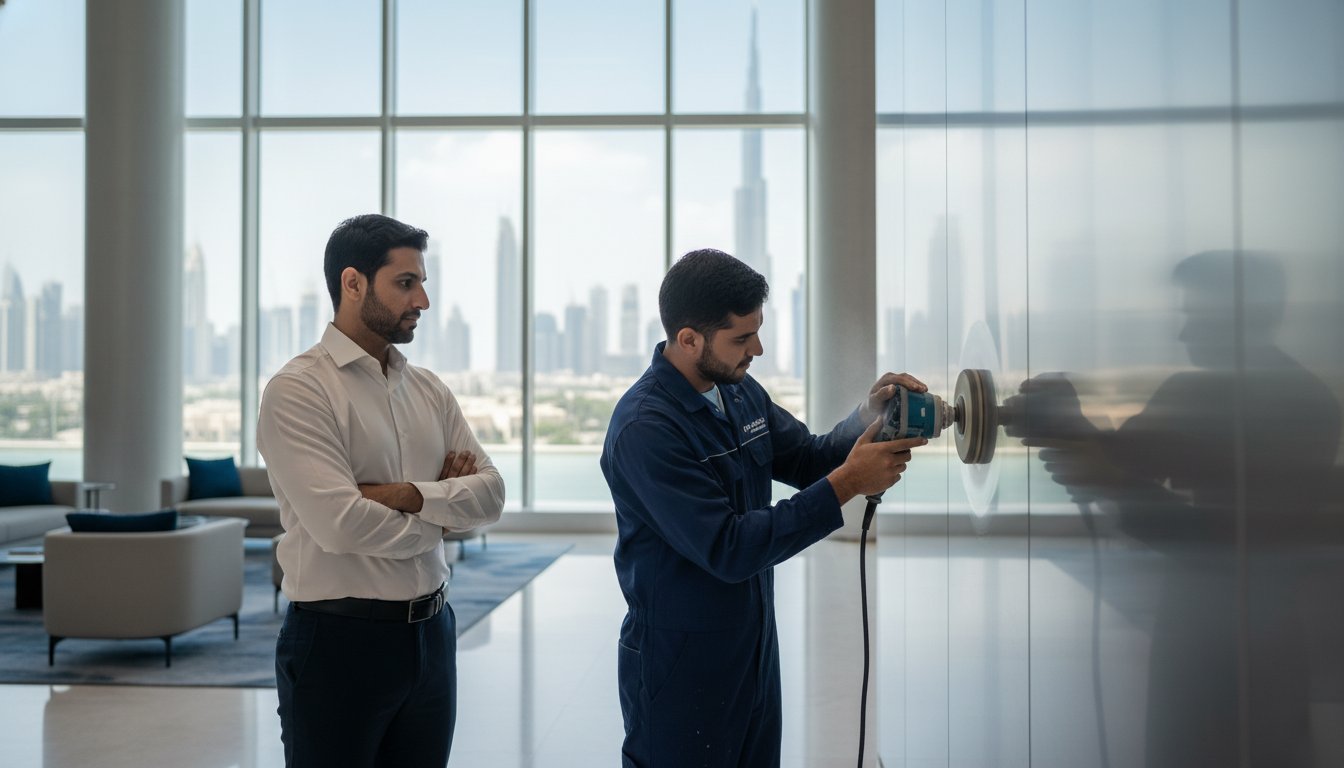
Would you intentionally hand over 80% of your maintenance budget to international suppliers when a superior result is available locally for a fraction of the cost? In a market where hard services account for 60.92% of the UAE’s $23.86 billion facility management sector, the pressure to maintain pristine assets while managing tight margins is immense. You likely face the constant struggle of high import costs and long lead times for bespoke fixtures, all while navigating the strict requirements of Dubai Law No. (3) of 2026. Understanding how to justify repairing over replacing is no longer just a cost saving tactic; it’s a strategic necessity to avoid fines that can reach AED 1,000,000 for non compliance with building quality standards.
We understand that your stakeholders demand clear financial proof before deviating from traditional replacement cycles. This guide provides the exact ROI framework you need to master surface restoration, allowing you to save 50-80% on renovation costs while hitting Al Sa’fat 2.0 sustainability targets. We will examine the technical methodology behind professional repairs and show you how to eliminate operational downtime through on-site restoration of wood, glass, and stainless steel.
Key Takeaways
- Shift from reactive replacement to strategic asset management to secure immediate 50-80% savings on your maintenance budget.
- Master the data-driven framework on how to justify repairing over replacing when presenting business cases to finance directors and property owners.
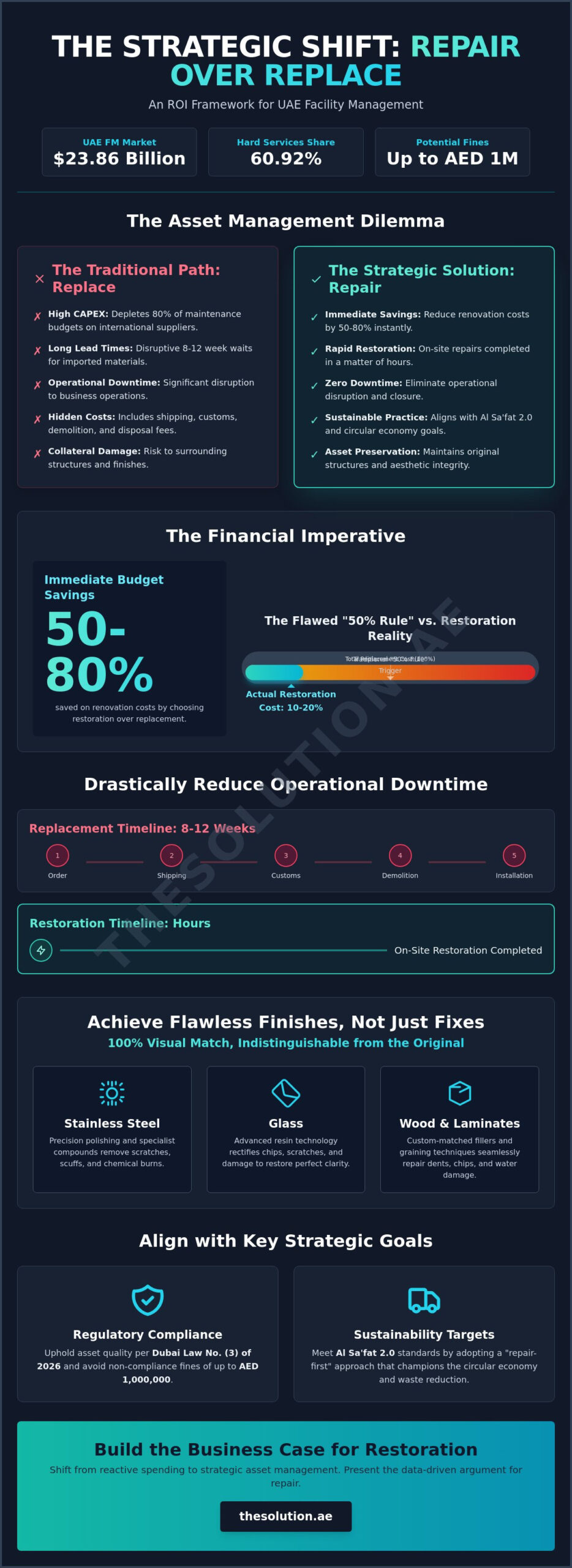
- Drastically reduce operational downtime by contrasting 8-12 week lead times for imported materials with on-site restoration solutions that take only hours.
- Understand the technical capabilities of specialist resins and precision polishing to rectify damage on stainless steel, glass, and wood surfaces.
- Align your facility management strategy with Al Sa’fat 2.0 sustainability standards by adopting a “repair-first” circular economy approach.
The Repair vs. Replace Dilemma in Commercial Asset Management
Asset management in the UAE has evolved beyond simple maintenance. In a market valued at $23.86 billion, facility managers must treat every surface as a long term financial commitment rather than a disposable commodity. The “buy new” mentality is largely a legacy of high volume manufacturing, but it fails in the context of bespoke architectural fixtures. When a marble floor is chipped or a stainless steel elevator panel is scratched, the default reaction to replace the item ignores the logistical reality of the Dubai market. You aren’t just buying a new part; you’re paying for international shipping, customs clearance, and the labor required for demolition and reinstall. This is exactly how to justify repairing over replacing to your board. You’re choosing a surgical restoration over a disruptive construction project.
To make an informed decision, you must utilize a Whole-life cost analysis. This framework accounts for every expense from acquisition to disposal. For high stakes sectors like hospitality, marine, and construction, the “disposal” phase of a replacement often carries hidden costs like landfill fees and environmental impact penalties. In the construction sector specifically, where handover deadlines are non negotiable, the time saved by repairing a damaged surface on-site can be the difference between a successful project delivery and a massive late delivery fine under Dubai’s strict building regulations.
The 50% Rule vs. The Restoration Reality
Traditional asset management often relies on the 50% rule, which suggests that if a repair costs more than half the price of a new item, you should replace it. This logic is flawed for architectural elements. A replacement often triggers collateral damage to surrounding structures. For instance, ceramic and tile repair avoids the need to rip out plumbing or neighboring tiles that are no longer in production. While a new tile might be cheap, the labor and risk of replacing it are not. Professional surface restoration typically costs only 10-20% of the total replacement value, making the 50% rule obsolete in modern facility management.
Aesthetic Integrity: When “Good Enough” Isn’t Enough
Dubai’s luxury market demands perfection. There’s a common misconception that repairs leave visible scars, but modern technical mastery has changed that. Using innovative specialist resins and precision polishing, we achieve a 100% visual match that is indistinguishable from the original surface. This level of quality is essential for 5-star hotels and high-end commercial properties where aesthetic flaws directly impact brand reputation. We don’t just “fix” a problem; we rectify the damage to restore the asset’s original premium finish, ensuring your property remains compliant with the highest quality standards mandated by Law No. (3) of 2026.
Financial Justification: Calculating the Real ROI of Restoration
Quantifying value for stakeholders requires moving beyond simple invoice comparisons. To implement effective maintenance strategies, you must demonstrate how restoration protects the bottom line by preserving capital. When you analyze how to justify repairing over replacing, the most compelling evidence is the immediate reduction in capital expenditure. Traditional replacement often creates a “sunk cost” scenario where perfectly functional structures are destroyed to fix surface level damage. By opting for hard surface repair, you shift the financial burden from high-cost CAPEX to manageable OPEX budgets.
The financial benefit isn’t limited to the repair itself. Repairing existing assets allows you to bypass the 5% to 10% service charge allocations typically reserved for sinking funds. Instead of depleting these reserves for major capital works, you can maintain building quality through targeted restoration. This approach keeps the building’s “Quality and Safety Certificate” in good standing under Dubai Law No. (3) of 2026 without the massive financial shock of a full scale renovation. If you’re currently facing budget constraints, you can consult with our technicians to identify which assets offer the highest return on restoration.
The Replacement Cost Iceberg
Most facility managers only see the “tip” of the replacement cost: the price of the new item. Below the surface lies a massive “iceberg” of indirect expenses. In the UAE, this includes 5% customs duties on imported bespoke materials and high shipping fees for heavy items like stone or glass. You must also account for environmental levies. Dubai’s waste management regulations have become stricter, and disposing of bulky construction waste now incurs significant fees. Repairing on-site eliminates these logistical and regulatory costs entirely.
Restoration ROI Case Study
Consider a high-traffic hotel lobby where several large marble floor slabs have sustained deep impact damage. The table below illustrates why restoration is the superior financial choice.
| Cost Factor | Full Replacement | Professional Restoration |
|---|---|---|
| Material Cost | High (Imported Stone) | Minimal (Specialist Resins) |
| Labor | Demolition & Re-installation | Precision Technical Repair |
| Downtime | 7-10 Days (Area Closure) | 4-6 Hours (No Closure) |
| Disposal Fees | Applicable | Zero |
Savings to the client of 50-80% are normal practice for onsite repairs. This data provides the concrete evidence needed to convince finance directors that restoration isn’t a compromise, but a sophisticated financial hedge against supply chain volatility.
Evaluating Operational Disruption and Supply Chain Risks
In the UAE’s fast paced commercial environment, time is often more expensive than materials. When an asset is damaged, the immediate impulse to order a replacement ignores the logistical reality of the Middle East supply chain. Bespoke architectural elements, such as high grade stone or specialized glazing, often carry lead times of 8 to 12 weeks. For a 5 star hotel or a Grade A office tower, having a central area cordoned off for three months is not an option. When you analyze how to justify repairing over replacing, the elimination of these delays is a primary factor. On-site technical restoration typically takes between 4 and 8 hours, allowing you to return the area to service the same day.
The risk of collateral damage is another critical consideration for facility managers. Replacing a built-in fixture is rarely an isolated event. Removing a damaged ceramic basin often risks cracking the surrounding marble vanity; replacing a single floor tile can lead to the damage of adjacent slabs that are no longer in production. This “domino effect” turns a minor aesthetic issue into a major renovation project. Our technicians use non invasive techniques to rectify damage in situ. We preserve the structural integrity of the surrounding environment, ensuring that the repair remains localized and the risk to your property is zero.
For construction firms approaching a handover, the stakes are even higher. Under Dubai’s Law No. (3) of 2026, buildings must pass rigorous quality audits to receive a “Quality and Safety Certificate.” A deep scratch on a prominent stainless steel panel or a chipped glass facade can stall the entire handover process. Late delivery penalties in the UAE can be financially devastating. By opting for professional restoration, you can resolve these defects within 24 hours, ensuring the project stays on schedule and avoids the fines associated with non compliance or delayed occupancy.
Lead Time as a Decision Driver
High traffic assets like elevators and storefronts cannot afford long periods of downtime. Waiting for a replacement panel to arrive from an international manufacturer can stall an entire renovation. We provide immediate relief through stainless steel finish restoration, which removes scratches and tea staining without removing the panel. Similarly, our glass polishing and restoration services address deep scratches on storefronts or balconies, bypassing the 12 week wait for bespoke glazing and keeping your facility looking pristine.
Sustainability and the Circular Economy in the UAE
Sustainability is now a legal mandate in Dubai. With the Al Sa’fat 2.0 Silver rating becoming mandatory for new permits in 2026, facility managers must find ways to reduce their environmental impact. Repairing existing assets directly supports the UAE Net Zero 2050 goals by keeping materials out of landfills. Every surface we restore represents a significant reduction in the carbon footprint associated with manufacturing and shipping new materials. This circular economy approach isn’t just good for the planet; it’s a key requirement for modern green building certifications and corporate ESG reporting.
Technical Feasibility: What Can Actually Be Repaired?
Technical feasibility is the final pillar in understanding how to justify repairing over replacing to skeptical stakeholders. Many decision makers believe that once a hard surface is chipped, scratched, or etched, its structural and aesthetic integrity is permanently compromised. This is a misconception rooted in outdated DIY methods. Modern restoration utilizes innovative techniques and specialist resins to rectify damage on a molecular level. Our technicians are fully trained in damage assessment, ensuring that every repair meets the high standards required for Dubai’s luxury commercial sector.
Before committing to a costly replacement, use this “Repairability Assessment” checklist to evaluate your assets:
- Surface vs. Structural: Is the damage limited to the top 2-3mm of the material? If the structural integrity is sound, the surface can almost always be restored.
- Material Rarity: Is the fixture bespoke or imported? If lead times exceed 8 weeks, repair is the logical priority.
- Location: Is the item built-in? If removal requires demolition of surrounding structures, in-situ restoration is the only pragmatic choice.
- Finish Reproducibility: Can the texture and grain be replicated? Skilled technicians can match wood grains, stone veining, and metal brushing with 100% accuracy.
We have developed a range of specialist solutions for almost every hard surface found in UAE facilities, including wood, ceramic, stainless steel, glass, and natural stone. If you are unsure if your damage can be rectified, request a technical assessment to receive a professional viability report.
Stone and Ceramic Restoration
In high traffic areas like hotel lobbies and commercial plazas, stone surfaces bear the brunt of daily wear. We specialize in fixing deep chips in marble, granite, and quartz without leaving visible seams. For floor surfaces, a marble polishing company in dubai can rectify surface etching caused by acidic cleaning agents or heavy footfall. While deep staining may require chemical poultices, most surface damage is fully repairable, saving you from the logistical nightmare of matching stone batches from different quarries.
Glass and Metal Precision Work
Restoring glass and metal requires a high level of technical mastery. We use precision polishing to remove deep scratches from tempered glass panels without causing optical distortion. This is vital for maintaining the “Aesthetic ROI” of storefronts and balconies. For metalwork, we focus on grain restoration. Brushed stainless steel elevator doors often suffer from “tea staining” or scratches that ruin the premium feel of a building. We don’t just buff the surface; we restore the original grain to ensure a flawless finish. Repair is only impossible when the damage is truly structural, such as a full thickness crack in tempered glass or significant corrosion that has compromised the metal’s thickness.
Building the Business Case for “The Solution”
The final step in mastering how to justify repairing over replacing is the presentation of data to your Finance Director or property owner. Stakeholders in the UAE’s high pressure real estate market respond to clear financial evidence and risk mitigation. When building your case, frame restoration as a strategic hedge against supply chain volatility. You aren’t merely fixing a surface; you’re protecting the organization’s capital budget and ensuring compliance with the building quality standards mandated by Law No. (3) of 2026. Highlight the 50-80% savings benchmark as a primary driver for shifting from a “buy new” culture to a “restore first” methodology.
To ensure long term success, you must integrate these practices into your facility’s Standard Operating Procedures (SOPs). A “Restoration Feasibility Check” should be mandatory before any replacement purchase order is approved. This simple change in protocol forces a pause in the procurement cycle, allowing for a technical assessment of the damage. By making repair the default option, you align your facility management strategy with the circular economy goals of the UAE Net Zero 2050 initiative while maintaining the aesthetic excellence expected in Dubai’s luxury sector.
Selecting a Specialist Partner
General maintenance teams and cleaning contractors often lack the technical mastery required to rectify complex surface damage. They frequently suggest replacement because they don’t possess the specialist resins, precision polishing equipment, or color matching proficiency needed for a flawless finish. Choosing a specialized partner ensures that the repair is indistinguishable from the original surface. Damage assessment is the critical first step in justifying restoration, as it provides a technical roadmap for the asset’s recovery. Working with fully trained technicians guarantees that the structural and aesthetic integrity of your fixtures remains uncompromised.
Long-Term Asset Protection
Restoration should be viewed as a core component of a preventative maintenance strategy. Addressing minor chips, scratches, or etching immediately prevents them from developing into structural failures that necessitate total replacement. For example, regular tile grout maintenance is essential for commercial bathrooms to prevent water ingress and tile delamination. Consistent care extends the life of your assets by decades. This proactive approach keeps your facility in peak condition while significantly reducing the frequency of major capital expenditures. Contact The Solution for a professional damage assessment today.
Protect Your Assets with Strategic Surface Restoration
The transition from a replacement-heavy model to a restoration-first strategy is a hallmark of sophisticated facility management. You now have the data to prove that the financial evidence is undeniable. Savings of 50-80% are normal practice when you bypass the hidden costs of import duties and environmental disposal fees. By prioritizing on-site repair, you eliminate the 8 to 12 week lead times that frequently stall UAE projects. This ensures your property remains compliant with the stringent Quality and Safety Certificate requirements of Law No. (3) of 2026.
Mastering how to justify repairing over replacing allows you to protect your CAPEX budget while maintaining the aesthetic excellence expected in 5 star facilities. Our specialist technicians use innovative restoration resins and precision techniques to achieve a 100% visual match. We are proud to be trusted by Dubai’s leading luxury hotels and developers to rectify complex damage with minimal disruption. Don’t let damaged surfaces deplete your maintenance reserves or delay your handovers. Start restoring your property’s value today.
Get a Professional Damage Assessment and Quote
Frequently Asked Questions
How much can I realistically save by repairing instead of replacing?
Understanding how to justify repairing over replacing starts with recognizing that savings of 50-80% are normal practice for on-site repairs. You avoid the high cost of imported replacement materials and the 5% UAE customs duties. These savings are achieved by eliminating the need for demolition, disposal fees, and the procurement of bespoke architectural fixtures. It represents a significant reduction in capital expenditure for any organization.
Will the repair be visible to guests or clients?
Professional restoration achieves a 100% visual match that is indistinguishable from the original surface. Our technicians utilize innovative techniques to replicate textures, wood grains, and stone veining with absolute precision. This ensures that the aesthetic integrity of 5 star environments remains uncompromised, allowing you to maintain premium standards without the disruption or mess of a full replacement project.
How long does a typical on-site surface repair take?
Most on-site surface repairs are completed within 4 to 8 hours. This is a massive operational advantage compared to the 8 to 12 week lead times often required for bespoke glass or stainless steel fixtures in Dubai. Rapid restoration allows you to return high traffic areas like elevators or hotel lobbies to service on the same day, preventing lost revenue and operational bottlenecks.
Is repairing surfaces better for the environment?
Repairing surfaces is a core component of the circular economy and directly supports UAE Net Zero 2050 goals. By choosing restoration, you prevent bulky construction waste from entering landfills and eliminate the carbon footprint associated with manufacturing and shipping new materials. This approach is essential for meeting the mandatory Al Sa’fat 2.0 Silver sustainability ratings for buildings in Dubai.
Can scratched glass really be restored to its original state?
Scratched glass can be restored to a flawless state through precision technical polishing. We remove deep scratches from tempered or laminated glass without causing optical distortion. This process is far more efficient than replacing entire glazing units, especially for storefronts or balconies where bespoke sizes would require months of waiting for international delivery and specialized installation crews.
What types of surfaces are not suitable for repair?
Surfaces with deep structural damage or full thickness cracks in tempered glass are generally not suitable for repair. If the integrity of the material is compromised to the point where it poses a safety risk, replacement is necessary. Our technicians provide a detailed damage assessment to confirm if a surface can be rectified or if it requires a full replacement to meet safety codes.
How do I justify the cost of a specialist repair technician to my boss?
You can learn how to justify repairing over replacing by presenting a “Total Cost of Ownership” analysis to your leadership. Contrast the immediate 50-80% cost reduction with the logistical risks of ordering new parts. Highlight that restoration is a strategic decision that preserves building quality while avoiding the massive fines associated with non compliance under Dubai’s 2026 building laws.
What happens if the repair fails after a few months?
Professional repairs using specialist resins are designed to be permanent solutions. These advanced materials are often harder and more durable than the original surface once they have fully cured. When applied by fully trained technicians, the restoration will not peel, crack, or discolor over time. This reliability ensures that your assets remain protected and aesthetically perfect for the remainder of their functional lifecycle.


