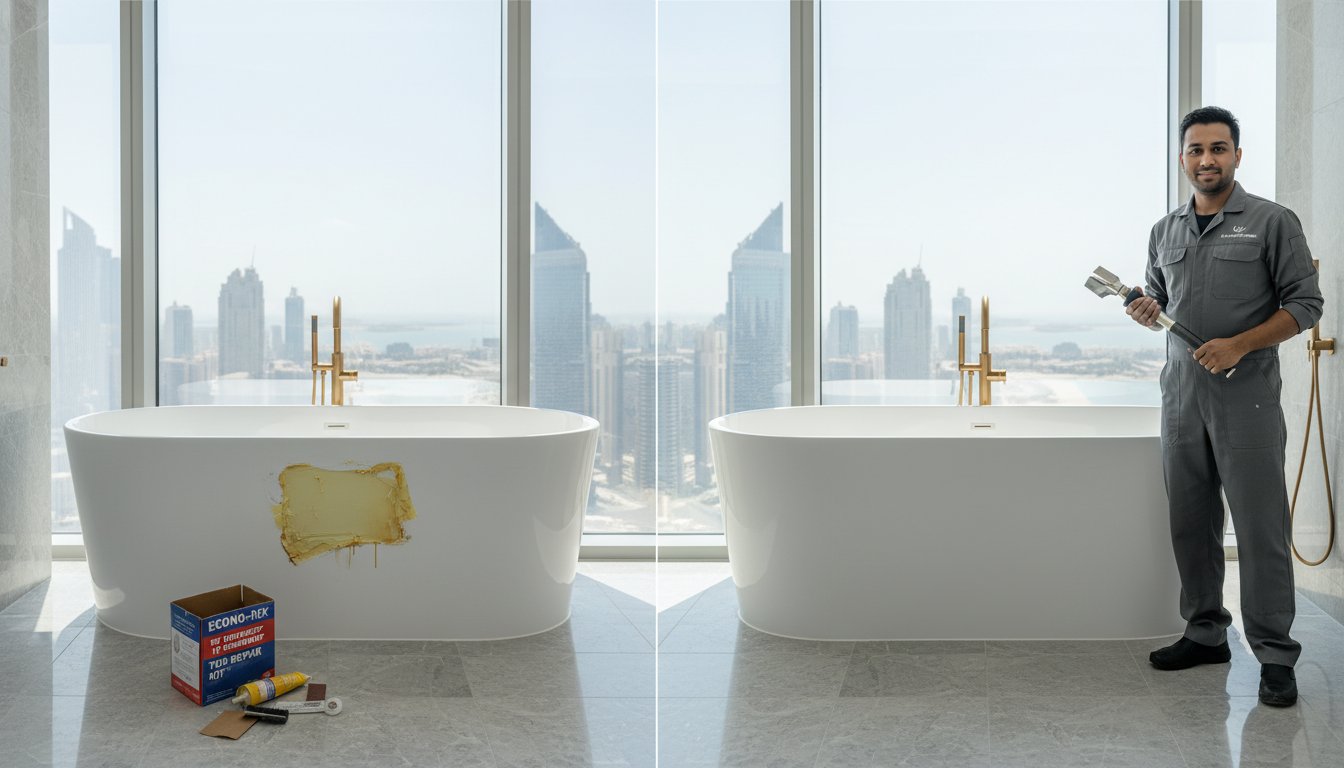
The 50 AED “quick fix” is often the most expensive mistake a homeowner can make. Spending a small amount on a hardware store kit to cover a bathtub chip frequently leads to a 5,000 AED replacement bill just a few months later. It’s understandable why you’d want an immediate solution when a yellowing patch or a rust spot ruins your bathroom’s aesthetic. You need a repair that looks seamless and prevents structural decay without the mess of a full renovation. However, the choice of bathtub enamel repair kit vs professional restoration isn’t just about the initial price; it’s about surface adhesion and technical durability.
Untreated chips on cast iron tubs can begin to rust within two to four weeks. While DIY epoxy kits offer a temporary mask, they often leave visible patches that peel under standard use. This article examines the technical differences between retail resins and professional grade systems that extend a tub’s life by 10 to 15 years. You’ll discover how choosing specialized restoration delivers a flawless finish while providing savings of 60% to 80% compared to the cost of a full replacement.
Key Takeaways
- Understand why enamel is a specialized glass-to-metal coating and how chemical etching compromises its structural integrity over time.
- Evaluate the technical gap between a bathtub enamel repair kit vs professional restoration to ensure your finish lasts years instead of weeks.
- Learn the “10-fils rule” for assessing damage size and identifying when cast iron tubs face an immediate risk of oxidation and rust.
- Discover the precision cleaning and specialist resin techniques used by master craftspeople to achieve 100% invisible surface repairs on-site.
- Gain a clear framework for choosing restoration over replacement to secure significant financial savings without compromising on bathroom aesthetics.
Understanding Bathtub Enamel: Why Damage is More Than Cosmetic
Bathtub enamel is a sophisticated composite material, not a simple layer of paint. In traditional cast iron or steel tubs, this finish is actually a layer of powdered glass fused to the metal substrate at temperatures exceeding 800 degrees Celsius. In modern acrylic or fiberglass units, it consists of high-grade polymer coatings designed for extreme durability. This non-porous barrier serves two purposes: providing a hygienic, easy-to-clean surface and protecting the underlying structure from the corrosive effects of water and oxygen. When you weigh the options of a bathtub enamel repair kit vs professional restoration, you’re deciding how to best reinstate this vital technical shield.
Damage to this surface rarely happens without a specific catalyst. Impact fractures occur when heavy objects, such as handheld showerheads or glass bottles, strike the surface with enough force to crack the glass layer. Chemical etching is another common culprit, caused by the repetitive use of abrasive cleaners that strip away the glossy topcoat. Finally, thermal shock happens when the material expands and contracts too rapidly during extreme temperature shifts. Bathtub refinishing is the specialized process of rectifying these failures to prevent total fixture degradation.
Neglecting even a minor chip is a calculated risk that rarely pays off. Untreated chips on cast iron or steel tubs can begin to rust within two to four weeks. Once oxidation starts, it spreads beneath the surrounding enamel, causing large sections to flake off and eventually compromising the tub’s structural integrity. In fiberglass units, cracks allow water ingress into the porous core, which can lead to mold growth and expensive subfloor damage. Enamel repair is a precision restoration of the protective barrier.
The Science of Surface Adhesion
Enamel is naturally non-porous, which makes it an incredibly difficult surface for standard coatings to grip. Most retail products fail because they rely solely on “mechanical keying,” which involves scratching the surface with sandpaper to create a physical bond. Professional restoration utilizes innovative techniques to create a chemical bond at the molecular level. This is particularly important in UAE bathrooms, where high humidity and temperature fluctuations cause surfaces to expand and contract. Without a proficiently applied bonding agent, a DIY patch will likely delaminate within months of application.
Common Damage Profiles: Chips, Cracks, and Stains
Identifying the specific type of damage is the first step in damage assessment. Surface-level scratches might only affect the light-reflective properties of the tub, but structural gouges that reach the metal require immediate intervention. You should be especially wary of the “spider-web” effect, where tiny hairline fractures radiate from a central impact point. These cracks spread over time due to the weight of water and the person using the bath. Additionally, the hard water common in the UAE contains high mineral levels that settle into these cracks, accelerating the degradation of the enamel and making the damage more visible and harder to clean.
DIY Bathtub Enamel Repair Kits: A Temporary Patch?
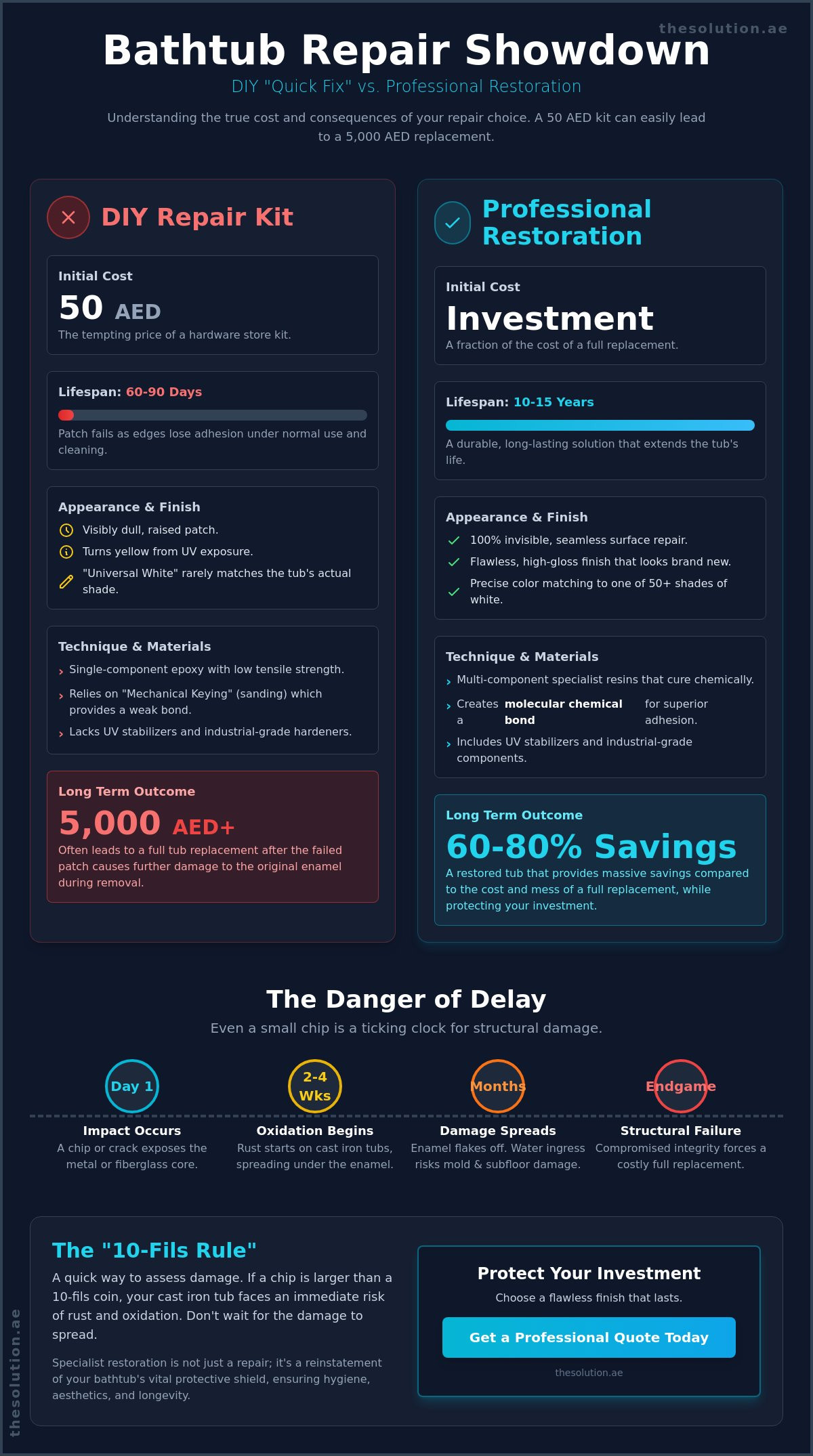
Retail kits typically contain a small tube of epoxy putty, two or three sheets of standard sandpaper, and a basic brush-on glaze. This combination targets the “Good Enough” trap, where a homeowner prioritizes a fast fix over a permanent one. However, these repairs are almost always visible under standard bathroom lighting as dull, raised patches. When evaluating the bathtub enamel repair kit vs professional restoration choice, it’s vital to look past the initial low investment. A DIY failure usually begins within 60 to 90 days as the edges of the patch lose adhesion. UV exposure from bathroom lighting then triggers discolouration, turning the patch a distinct yellow. The hidden cost is the difficulty of removal; failed epoxy is notoriously stubborn. It often requires aggressive mechanical sanding that further thins the surrounding original enamel, making a later professional surface repair more labor-intensive.
The Chemical Limitations of Over-the-Counter Kits
Industrial resins used by specialists are multi-component systems that cure through a chemical reaction rather than simple evaporation. Over-the-counter kits often use single-component epoxies that lack UV stabilizers and high-tensile strength. There’s also the “Universal White” myth. Bathtub manufacturers utilize over 50 distinct shades of white, from cool blue-tones to warm creams. A generic kit cannot provide a seamless match. Retail resins also have high shrinkage rates, often losing up to 3% of their volume as they cure. This tension causes the patch to “pop” out of the chip within six months of application, making the bathtub enamel repair kit vs professional comparison a matter of longevity.
The DIY Process and Potential Pitfalls
Most DIY failures stem from inadequate surface preparation. Removing 100% of soap scum and body oils is impossible with standard household cleaners. Professionals use specialist industrial degreasers to ensure a pristine substrate. Curing is another hurdle; a dust-free environment is impossible to maintain in a standard home. Airborne particles settle into wet glazes, creating a sandpaper-like texture. Safety is a primary concern as well. Professionals adhere to EPA regulations on VOCs and use HEPA-filtered extraction to manage harmful sanding dust and chemical fumes. DIYers often lack this protection, risking respiratory irritation from fine particulates.
Professional Restoration: The Master Craftsperson Approach
The Solution utilizes a systematic methodology that begins with a comprehensive damage assessment. Our technicians don’t simply apply a patch; they analyze the substrate and the specific cause of failure to ensure the repair is permanent. Precision cleaning follows, using industrial-strength degreasers to remove every trace of biofilm and mineral deposits. This level of preparation is why professional work succeeds where the bathtub enamel repair kit vs professional choice often leads to DIY failure. We then apply specialist resins designed for high-adhesion and long-term durability in high-moisture environments.
Color matching is a technical art that requires a trained eye. Because bathtub manufacturers use dozens of distinct white and off-white shades, a pre-packaged glaze will never truly disappear. Our specialists perform on-site tinting, adjusting the resin’s pigment until it achieves 100% invisibility against the original surface. We also utilize UV-stable topcoats. These are essential in high-light environments like Dubai’s luxury high-rises, where constant sun exposure through floor-to-ceiling windows can cause inferior resins to yellow and degrade within months.
Industrial-Grade Materials and Equipment
We use High Volume Low Pressure (HVLP) spray systems to achieve a factory-level finish that is impossible to replicate with a brush or aerosol can. These systems provide a uniform layer of resin with minimal overspray, creating a smooth surface that resists bacteria buildup. Because the UAE’s humidity can fluctuate significantly, we implement climate-controlled curing techniques to ensure the resin bonds correctly at a molecular level. This creates a surface that is significantly more resilient than the fragile, brittle putty found in retail kits. Professional technicians are also trained to handle hazardous materials in older fixtures, adhering to safety protocols similar to HUD’s healthy homes guidelines to ensure no lead-based contaminants are released during the restoration process.
The “Invisible” Finish: More Than Just Paint
Achieving a seamless result requires the “feathering” technique. This involves meticulously blending the edges of the repair into the original enamel until the transition is undetectable to the eye and touch. After the resin has cured, we perform intensive polishing and buffing to match the original factory gloss level. For property managers in the hospitality sector, this process is an intelligent financial decision. Choosing restoration over replacement typically results in a 50-80% cost saving for the client. To achieve full bathroom harmony, we often combine this service with ceramic and tile repair, ensuring every surface meets our exceptional quality standards.
The Decision Framework: When to DIY vs. Hire a Professional
Deciding between a bathtub enamel repair kit vs professional service requires a pragmatic assessment of the damage and the asset’s value. You can use the “10-fils rule” as a primary benchmark. If a chip or crack is larger than a 10-fils coin, the structural integrity of the enamel is compromised beyond what a retail putty can stabilize. For cast iron or steel tubs, the material itself dictates the urgency. Because these metals begin to oxidize within 14 to 28 days of exposure, a temporary DIY fix often traps moisture against the metal, accelerating internal rust. You must also consider the damage location. If the fracture is on the floor of the tub or near the drain, the constant weight of water and thermal expansion will cause a DIY patch to delaminate within weeks.
Commercial vs. Residential Considerations
Hotels and property managers don’t have the luxury of “good enough” repairs. A visible, yellowing patch in a luxury suite directly impacts guest satisfaction and brand reputation. In the UAE construction sector, the stakes are even higher during the handover phase. Snagging inspectors will reject any surface that shows visible repair work, which can lead to significant project delays or financial penalties. Our technicians provide expert hard surface repair that satisfies the most meticulous commercial standards. For facilities management professionals, scheduling a professional damage assessment is the most efficient way to ensure long-term durability and compliance.
Cost-Benefit Analysis Over 5 Years
A short-term perspective often makes a 50 AED kit look attractive, but the five-year financial outlook tells a different story. DIY repairs typically fail within six months, requiring repeated applications that eventually ruin the tub’s texture. Professional restoration extends a tub’s lifespan by 10 to 15 years, effectively removing the need for a full replacement. When you factor in the “nuclear option” of replacement, costs escalate quickly. A mid-range tub replacement in the UAE can cost between 3,000 and 8,000 AED once you include the labor for plumbing, retiling, and waste disposal. Professional refinishing typically saves the client 60% to 80% of these costs while delivering a finish that remains invisible for years. It’s an intelligent financial decision that prioritizes asset preservation over temporary concealment.
- Size: Is the damage larger than a 10-fils coin? (Hire a professional)
- Material: Is the tub cast iron or steel? (Hire a professional to prevent rust)
- Location: Is the damage in a high-water contact area? (Hire a professional)
- Objective: Are you looking for a 10-year solution or a 2-month patch? (Hire a professional)
The Solution: Premier Bathtub Restoration in the UAE
The Solution is the premier damage repair and restoration service in Dubai, providing technical mastery across the Emirates. We’ve developed a range of innovative repair solutions to rectify damage to all types of hard surface, ensuring that full replacement is never the first option. Our philosophy centers on the proficient use of specialist resins to restore fixtures to their original factory condition. This approach eliminates the logistical nightmare of removing a bathtub, which often involves breaking tiles and disrupting plumbing. For property owners, the decision between a bathtub enamel repair kit vs professional restoration is a choice between a temporary cosmetic patch and a permanent structural solution.
Our technicians are fully trained in damage assessment, ensuring every chip, crack, or stain is treated with the correct chemical bonding agent. We serve the marine, hospitality, and construction sectors, where the standard for “acceptable” is nothing less than perfection. By choosing on-site restoration, you minimize downtime and avoid the landfill waste associated with full fixture disposal. We don’t just hide damage; we renew the surface integrity to prevent future oxidation and decay.
Why We Are the Preferred Partner for UAE Developers
Major developers and facilities management firms across the UAE rely on our expertise to maintain high-traffic commercial environments. In luxury hospitality and high-end residential projects, a visible repair is a failure. We achieve 100% invisibility through precise on-site color matching and industrial-grade finishing. The financial logic is clear: savings to the client of 50-80% are normal practice when compared to the cost of a full replacement. Our versatile capabilities extend beyond the bathroom; we also offer stainless steel finish restoration to ensure every hard surface in a building remains in pristine condition.
Get a Professional Assessment Today
Securing an affordable repair solution starts with an accurate damage assessment. We’ve streamlined our process to respect the time of busy commercial and residential clients. You can provide high-resolution photos of the damage via our digital platforms to receive a no-obligation, fixed-price quote. During a professional repair visit, our technicians work meticulously to contain the work area, ensuring no dust or fumes affect the rest of your property. Most repairs are completed within a few hours, allowing the surface to be back in use within 24 hours. Don’t settle for the visible seams of a DIY kit. Restore your fixtures to their original glory and secure the longevity of your bathroom assets today.
Secure Your Bathroom Assets with Professional Restoration
Maintaining the integrity of your bathroom fixtures requires a move away from temporary retail solutions. A DIY patch often masks underlying issues like oxidation, which can destroy a cast iron tub in weeks. Professional restoration ensures that damage is rectified at a molecular level, preventing costly structural failures. Choosing between a bathtub enamel repair kit vs professional restoration is ultimately a choice between a short-term patch and a long-term asset strategy. It’s an intelligent decision that prioritizes quality over a quick fix.
Our technicians are fully trained in advanced damage assessment to deliver seamless, invisible finishes on all hard surfaces. By opting for our innovative repair techniques, you achieve savings of 50-80% compared to the expense of a full replacement. This approach minimizes disruption to your property while renewing the factory-grade quality of your fixtures. Request a Professional Bathtub Repair Quote from The Solution to ensure your bathroom remains in pristine condition for years to come. Your property deserves the precision and reliability of a master craftsperson.
Frequently Asked Questions
Can I use my bathtub immediately after a professional repair?
Professional repairs require a 24-hour curing period before the surface can be exposed to water. While the specialist resin feels dry to the touch within 4 hours, the chemical bond needs a full day to reach its maximum hardness and durability. Using the tub prematurely can cause the material to soften or delaminate, which compromises the waterproof seal and the longevity of the finish.
Will the repair be visible to the naked eye?
A professional repair is 100% invisible to the naked eye. Unlike the “patch” look common with retail products, we perform precise on-site color matching to replicate the specific shade of your fixture. We then feather the edges of the repair and polish the surface to match the original factory gloss. This ensures the restored area is undetectable in both texture and light reflection.
How long does a professional enamel restoration last compared to a kit?
Professional restoration typically lasts between 10 and 15 years with standard maintenance. In contrast, a retail kit often fails within 6 to 12 months because it lacks industrial-grade bonding agents. The technical gap in the bathtub enamel repair kit vs professional comparison is significant; specialists use high-tensile resins that withstand daily thermal shock without shrinking or popping out.
Is it possible to repair a cracked bathtub, or only chips?
Both chips and cracks are fully repairable using advanced restoration techniques. While chips are usually cosmetic impact points, cracks often indicate structural stress or “spider-webbing” that can lead to leaks. We use specialized high-density resins to bridge these fractures, stopping them from spreading further and preventing water from reaching the substrate or the subfloor beneath the tub.
What is the cost difference between professional repair and full replacement in Dubai?
In Dubai, professional refinishing ranges from AED 500 to AED 1,500, while a full replacement can cost between AED 3,000 and AED 8,000. This replacement figure includes the hidden costs of plumbing labor, waste disposal, and retiling the surrounding area. Restoration allows you to avoid these expenses, typically resulting in a 60% to 80% saving for the client.
Do DIY enamel repair kits yellow over time?
DIY enamel repair kits frequently yellow within 90 days of application. This discolouration occurs because retail epoxies often lack the UV stabilizers found in professional-grade resins. These single-component products react to bathroom lighting and sunlight, turning a distinct yellow or beige. Professional topcoats are chemically engineered to remain color-stable in high-light environments for over a decade.
Can professional repair fix damage on both cast iron and acrylic tubs?
Professional technicians can rectify damage on cast iron, steel, acrylic, and fiberglass surfaces. We use different chemical bonding agents specifically tailored to the substrate’s properties. This specialized approach ensures that the repair achieves maximum adhesion, whether it’s bonding glass-to-metal on a vintage tub or a high-grade polymer on a modern acrylic unit.
What happens if I ignore a chip in my enamel bathtub?
Ignoring a chip in a cast iron or steel tub can lead to visible rust within 14 to 28 days. Once oxidation begins, it spreads beneath the surrounding enamel, causing large sections to flake off and eventually creating holes in the metal. In acrylic tubs, untreated cracks allow water to seep into the porous core, which can trigger mold growth and structural rot.


